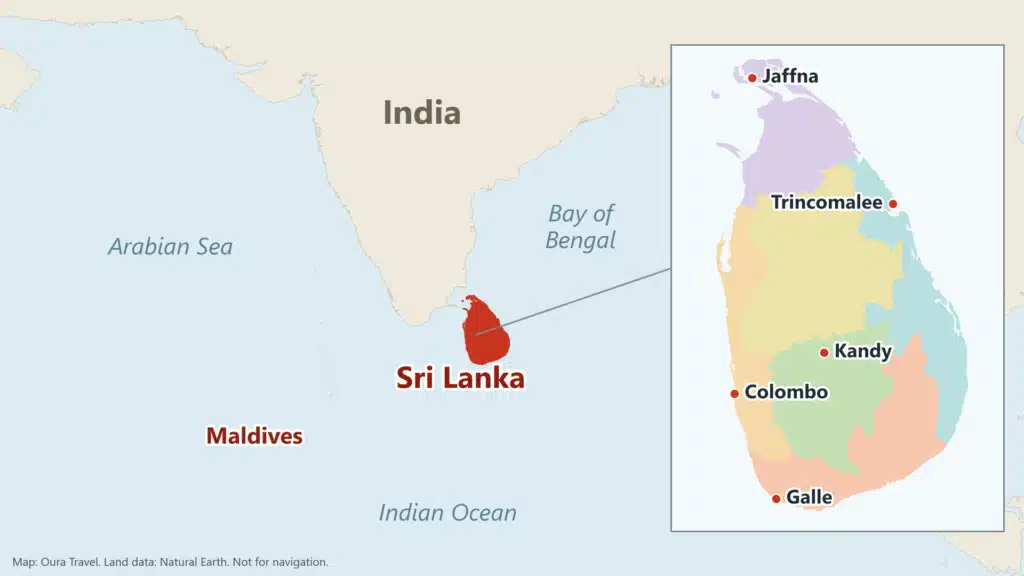
A Sri Lanka round trip is a loop that starts and finishes at Bandaranaike International Airport, 32.5 km north of Colombo (Wikipedia). The classic route goes inland to Sigiriya and the Cultural Triangle, then south through Kandy into the tea hills. From Ella it drops past a safari park to the south coast and returns to the airport by expressway. Driven in full that’s about 730 km, usually 17.5 to 21.5 hours on the road. Our six itineraries, from 5 to 21 days, are all built on this loop, and the month you travel decides which coast it ends on.
Key takeaways
- The classic loop has six stops: Sigiriya, Kandy, Nuwara Eliya, Ella, one park and the south coast. Its seven drives cover about 730 km and usually take 17.5 to 21.5 hours.
- Drive it with the coast last in December and January, when Galle’s average rain is still falling month by month. In April, put the coast first, ahead of the south-west monsoon.
- During the south-west monsoon, which the Met Department dates May to September, finish on the east coast instead: Trincomalee averages 66 mm of rain a month then, Galle 219 mm.
- On our planner’s rule of two nights a stop and one more, the full loop needs 13 nights. Shorter trips leave out a whole stop.
- On 21 October 2026 we found no single train running from Kandy through to Ella. The loop goes by road from Kandy to Nanu Oya at least.
What a round tour of Sri Lanka covers
A round tour strings the island’s regions together so the car never doubles back. Wikivoyage warns that senseless backtracking to lengthen a trip and raise its cost is “a real danger” when you hire a driver (Wikivoyage). A loop is the simplest guard against it.
Our Sri Lanka itinerary planner splits the island into six regions, each with a range of nights:
- Cultural Triangle (base: Sigiriya or Dambulla): 2 or 3 nights.
- Hill country, Kandy to Ella: 1 or 2 nights each for Kandy and Nuwara Eliya, 2 for Ella.
- Safari park (Yala or Udawalawe): 1 night.
- South coast, Galle to Mirissa: 2 to 5 nights.
- East coast (Trincomalee, Pasikudah or Arugam Bay): 2 or 3 nights.
- North (Jaffna): 2 or 3 nights.
A first round trip usually combines four: Triangle, hills, a park and a coast.
Clockwise or anticlockwise: which way round?
Put a map with north at the top and trace the classic order: airport, Sigiriya, Kandy, Ella, the south coast, airport. Seen from the middle of the island, the stops run north, east, south and west in that order, the way a clock’s hands turn. That’s clockwise. Anticlockwise is the same loop the other way round: coast first, Triangle last. We’d drive it clockwise on most trips, for three reasons.
First, the drive home is the easiest one. The opening drive, to Sigiriya, runs 145 km and takes 3.5 to 4 hours (OpenStreetMap). Coming home from Weligama, however, 160 of the 170 km are on the Southern Expressway, the Outer Circular Highway and the Katunayake Expressway (OpenStreetMap). Second, the hills sit between the Triangle and the sea. Kandy lies on the road south from Sigiriya, and going by Udawalawe adds only about 25 km to the drive from Ella to the coast, so the safari falls on the way. Third, the weather often favours a coast finish. At Galle, the south-coast weather station, the 1991 to 2020 averages fall from 283 mm on 15 rain days in November to 176 mm on 11 in December. January brings 87 mm on 7 (WMO climate normals). On a December trip, going inland first puts the beach later in that fall.
When to turn the loop round
In spring, however, the same numbers argue the other way. Galle’s April average is 202 mm on 12 days, and May jumps to 316 mm on 17 (WMO climate normals). Maha Illuppallama, the station nearest Sigiriya, averages 113 mm in May (WMO climate normals). The Department of Meteorology says the south-west monsoon establishes itself over the country at the end of May or in early June (Department of Meteorology). So for a trip that runs from April into May, we’d go anticlockwise: south coast first, Triangle last. The hill railway gives a second reason. When our Kandy to Ella train guide searched the railway’s booking site on 19 October 2026, it found no online seats from Nanu Oya towards Ella on 22 of the next 30 days. Seats from Ella were on sale every day (seat reservations). Our 5-day itinerary runs coast first for exactly that reason.
Which coast in which month
The table uses the Department of Meteorology’s four seasons (Department of Meteorology). A paper in the Department’s journal says south-west monsoon rain is heaviest in the low country of the south-west and on the western face of the hill country (Department of Meteorology).
Figures come from the WMO’s 1991 to 2020 normals for one station on each coast where the loop can end, and a rain day has at least a millimetre of rain (WMO climate normals).
| Season | Months | Galle, a month | Trincomalee, a month |
|---|---|---|---|
| First inter-monsoon | Mar, Apr | 146 mm, 9 rain days | 52 mm, 4 rain days |
| South-west monsoon | May to Sep | 219 mm, 16 rain days | 66 mm, 4 rain days |
| Second inter-monsoon | Oct, Nov | 314 mm, 17 rain days | 296 mm, 15 rain days |
| North-east monsoon | Dec to Feb | 111 mm, 8 rain days | 196 mm, 9 rain days |
From December to February the south coast is the drier finish, with a little over half Trincomalee’s rain, and from May to September the east is, with under a third of Galle’s. Pottuvil, the station near Arugam Bay, averages just 30 mm a month from May to September, on about 3 rain days (WMO climate normals). Sri Lanka Tourism calls those months the best time for the dry zone, naming Trincomalee, Arugam Bay and Jaffna (Sri Lanka Tourism). In March and April, Trincomalee gets about a third of Galle’s rain. Neither coast is dry in October and November, and nor are the hills, where Nuwara Eliya averages 473 mm over the two months (WMO climate normals). These are long-run averages, not a forecast for your dates.
Classic routes for a Sri Lanka tour, compared
Each page picks its best months from the weather stations along its own route, so they differ a little. Galle’s three driest months are January to March (WMO climate normals). The 9-day, 10-day and three-week pages all pick February, when every station on their routes averages under 100 mm of rain.
| Trip | Nights and route | Best months | Suits |
|---|---|---|---|
| 5 days | 4: south coast 1, Ella 2, Kandy 1 | Jan to Mar; inland version May to Sep | One loop of three bases |
| 7 days | 6: Sigiriya 2, Kandy 1, Ella 2, south coast 1 | Jan to Mar; east version May to Sep | One loop of four bases |
| 9 days | 8: Sigiriya 3, Kandy 1, Ella 2, south coast 2 | Feb; then Jan and Mar | A first visit, taken slowly |
| 10 days | 9: Sigiriya 2, Kandy 1, Ella 2, park 1, south coast 3 | Feb; then Mar | A safari night and beach time |
| 2 weeks | 13: Anuradhapura 1, Sigiriya 3, Kandy 2, hills 3, park 1, coast 3 | South-west Dec to Mar; east May to Sep | The whole loop, one coast |
| 3 weeks | 20: north and east 7, Sigiriya 3, Kandy 2, hills 3, park 1, south coast 4 | Feb and Mar; reversed version May to Sep | Slow travel, a second visit |
For the monsoon months, the 5-day page swaps the coast for Sigiriya and Kandy, and the 7-day page runs Sigiriya, Trincomalee and Kandy. The two-week route ends on the south-west coast or the east, picked by the month. The three-week route starts in the north, at Anuradhapura (with Wilpattu), Jaffna and Trincomalee. From May to September it runs the other way round, so that its long beach stay falls in the east.
How to choose a length
Start by counting nights. Our planner’s rule is two nights a stop and one more: 7 nights carry three stops, 9 carry four, 11 carry five and 13 carry six (itinerary planner). The full classic loop has six stops, so it needs 13 nights; our 2-week route fits in a seventh, one night at Anuradhapura. Below that, the planner says to drop a whole region rather than trim a night everywhere. Then look at the road hours. For example, our 7-day route drives 17 to 20.5 hours (7-day itinerary), almost as much as the classic loop. The two-week route’s south-west version drives 19.5 to 24 (2-week itinerary). So the second week adds seven nights but only 2.5 to 3.5 hours of driving. The 5-day loop, with three stops, keeps it to 12.5 to 15.5 hours (5-day itinerary). Wikivoyage says some main roads are in good condition, while others are narrow and bumpy, especially in the interior (Wikivoyage). That’s why we print every drive as a range.
How we’d match a length to a trip:
- Five or seven days: one quick loop, with the Triangle or the hills cut short.
- Nine days: a steady first visit with three Triangle nights. The third leaves room for Polonnaruwa and a jeep drive at Minneriya, where Love Sri Lanka says elephants gather from July to October (Love Sri Lanka).
- Ten days: a park night and three nights by the sea.
- Two weeks: every stop on the classic loop, with the coast picked by season.
- Three weeks: the north as well, such as Jaffna and Wilpattu, for slow travel or a second trip.
The classic loop in outline
This is the six-stop loop, one line per stop. We ran every drive through the OpenStreetMap planner on 20 and 21 October 2026 and kept the ranges already used on ouratravel.com. The planner assumes empty roads, so every range starts above its time.
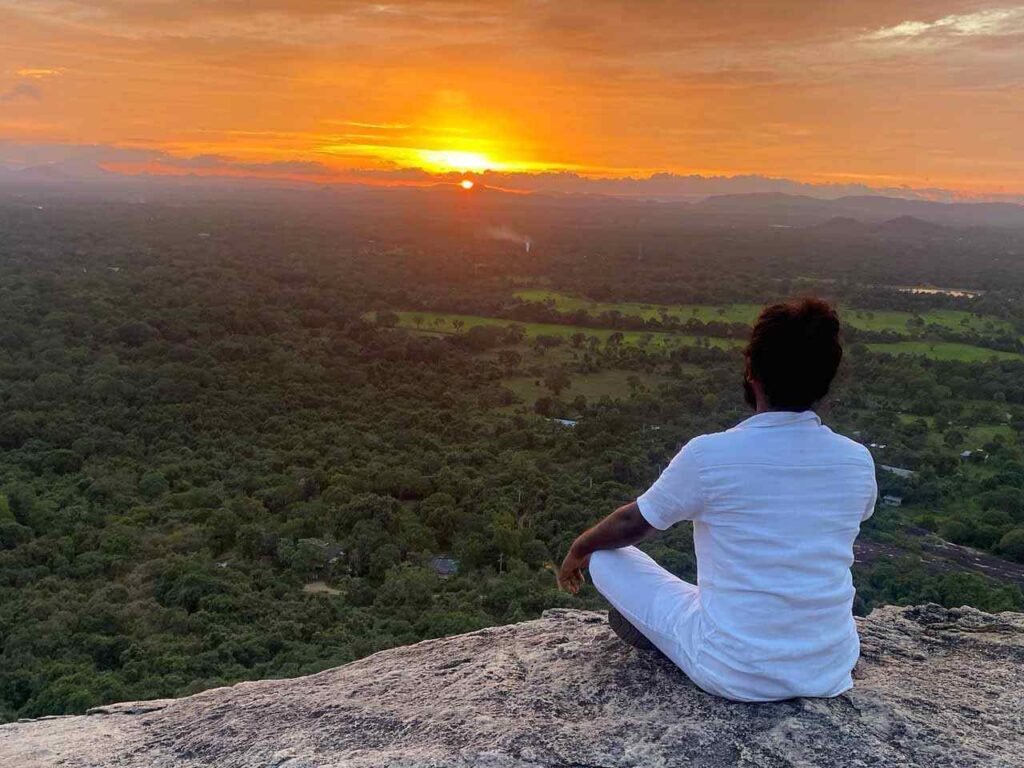
- Stop 1, Sigiriya: from arrivals, 3.5 to 4 hours for some 145 km. Sigiriya, the Dambulla cave temple and the ancient city of Polonnaruwa are all on UNESCO’s World Heritage List (UNESCO). Pidurangala, the rock just north of Sigiriya, takes 20 to 30 minutes to climb (Wikivoyage).
- Stop 2, Kandy: roughly 90 km on from Sigiriya, 2.5 to 3 hours. Plan on the Temple of the Tooth’s evening service, 6.30pm to 8pm, dressed in more than shorts or a sleeveless top (Sri Dalada Maligawa).
- Stop 3, Nuwara Eliya: by road, near enough 75 km, 2.5 to 3 hours.
- Stop 4, Ella: some 55 km, 2 to 3 hours by car, or the train from Nanu Oya when you can get seats. Its two classic walks are Little Adam’s Peak, which Wikivoyage rates relatively easy, and the Nine Arch Bridge, a walk it times at 45 minutes from the centre (Wikivoyage).
- Stop 5, Udawalawe: around 90 km south, 2.5 to 3 hours. Love Sri Lanka gives the park’s hours as 6am to 6pm and suggests a jeep at the start or the end of the day (Love Sri Lanka).
- Stop 6, the south coast at Weligama: close to 110 km, 2 to 2.5 hours. Galle’s fort, which the Portuguese began in the 16th century, is on UNESCO’s list too (UNESCO). Love Sri Lanka gives November to April as Mirissa’s whale-watching season and promises no sighting (Love Sri Lanka).
- Home: Weligama back to arrivals, near 170 km, 2.5 to 3 hours.
That’s about 730 km. The router’s own times add up to just under 13 hours, and the seven ranges come to 17.5 to 21.5 hours.
Yala is the other park choice, with jeeps booked through hotels and guest houses in Tissamaharama, Wikivoyage says (Wikivoyage). Its Blocks 1 and 2 shut on 14 September 2026 in severe dry weather (Ada Derana), and the Department of Wildlife Conservation later gave 16 October 2026 as their reopening date (Newswire). Searching on 21 October, we found nothing to say they had opened, so ask before booking. In the east-coast months, meanwhile, the loop bends the other way after the Triangle. Sigiriya to Trincomalee is usually 2.5 to 3 hours (OpenStreetMap). Ella to Arugam Bay takes 3 to 3.5 hours (OpenStreetMap), but the airport is 6 to 7 hours from Arugam Bay (OpenStreetMap). Avoid it on your last night.
Getting round the loop: car, train or both
Most of the loop goes by road. On 2 October 2026 the Colombo Times reported repairs still going on along two sections of the hill line between Gampola and Nanu Oya (Colombo Times). Colombo trains came back that month to Peradeniya and Gampola but not to Kandy, as work on the Mahaweli bridge past Peradeniya was unfinished (Sunday Times). In news searches up to 21 October 2026, we found no sign of those gaps closing. As a result, the car covers Kandy to Nanu Oya: 80 km or so, in 2.5 to 3 hours. The Nanu Oya to Badulla section has been back in passenger service since 20 June 2026 (Sunday Times).

For what a car and driver costs, our driver cost page compares 15 sellers’ own listings. To see trips already drawn on this pattern, browse our round tours of Sri Lanka. On 21 October 2026, the day we looked, the list held 18 routes of 5 to 14 days. The page calls each one a starting point rather than a fixed package.
Questions about a Sri Lanka round trip
How many days does a Sri Lanka round trip take?
Thirteen nights, or two weeks, for the full six-stop loop on our planner’s rule. Nine or ten days covers a first trip with four or five of the six stops. A week works as one quick loop, with 17 to 20.5 hours of driving.
Which direction should a Sri Lanka round tour go?
For a December or January trip, go Triangle first and coast last, because Galle’s average rain falls from November to January. From April into May, reverse it and see the coast before the south-west monsoon sets in.
Can you do the classic route by train?
Partly. As of our 21 October 2026 search, nothing ran from Kandy all the way to Ella, and the newest report had Colombo trains stopping at Peradeniya, short of Kandy. Our train guide found Nanu Oya to Ella trains on the booking site on 19 October (seat reservations). A rail day can start at Nanu Oya while the car carries the bags.
Which months suit a Sri Lanka tour itinerary?
It depends on the coast. December to March suits the south coast and May to September the east, on the Met Department’s seasons and the averages above. For the longer routes that end in the south, February is the pick. October and November are wet almost everywhere.
Plan your round trip with us
Oura Travel works out of Weligama, arranging private tours with your own car and driver-guide. If you’d like this loop drawn for your own dates, message us with your flights and the stops you’d hate to miss.
Fact check, 21 October 2026: we reran the route planner and the WMO averages and reread the rail, park and Oura pages. Railway repairs and the Yala reopening could change within days, so look at the linked sources again before booking.