This Sri Lanka itinerary planner is a method in eight steps. Pick the month, count your nights, choose regions and check the drive times. Then check anything with a date on it, decide how you’ll move, start from a classic route, and adjust it or hand it over. The month comes first because it decides which coast is dry. On 30-year averages, Galle on the south coast has its dry months from January to March, and Trincomalee on the east coast from February to August (WMO climate normals). We plan private trips from Weligama, and this is the order we’d work in. Use it as your Sri Lanka travel planner, one step at a time.
Key takeaways
- The month picks the coast. Galle’s station passes our dry test from January to March and Trincomalee’s from February to August.
- Allow two nights for every stop, plus one. That gives three stops in 7 nights, four in 9 and six in 13.
- The classic loop is 17 to 21.5 hours of driving whether you take one week or two.
- On 5 October 2026 the Kandy to Ella railway still had gaps, two of Yala’s blocks were closed for drought, and 40 nationalities paid nothing for a 30-day ETA.
Step 1: plan a trip to Sri Lanka around the month
The south-west monsoon, from May to September, typically brings cooler, wetter weather to the south-west. From December to February it’s the turn of the north-east monsoon, which affects the island’s north-east (Department of Meteorology).
The table uses the 1991 to 2020 averages that the World Meteorological Organization publishes for two stations: Galle on the south coast and Trincomalee on the east. A month passes our test when its average rainfall is below 100 mm and it has fewer than ten wet days, meaning days with 1 mm or more. Each cell gives rain, then wet days, and says where a month passes (WMO climate normals). The test covers rain, not the sea.
| Month | Galle, south coast | Trincomalee, east coast |
|---|---|---|
| January | Passes: 87 mm, 7 days | 152 mm, 8 days |
| February | Passes: 71 mm, 6 days | Passes: 96 mm, 5 days |
| March | Passes: 90 mm, 7 days | Passes: 55 mm, 4 days |
| April | 202 mm, 12 days | Passes: 48 mm, 4 days |
| May | 316 mm, 17 days | Passes: 72 mm, 4 days |
| June | 184 mm, 17 days | Passes: 26 mm, 2 days |
| July | 173 mm, 15 days | Passes: 51 mm, 3 days |
| August | 162 mm, 14 days | Passes: 67 mm, 4 days |
| September | 261 mm, 17 days | 113 mm, 6 days |
| October | 345 mm, 18 days | 216 mm, 13 days |
| November | 283 mm, 15 days | 376 mm, 18 days |
| December | 176 mm, 11 days | 339 mm, 15 days |
On those figures we’d put beach days on the south coast from January to March and on the east coast from April to August. September just misses at Trincomalee, but Pottuvil, the station nearest Arugam Bay, still passes with 52 mm and four wet days. Neither station passes from October to December. October and November fall in what the Department of Meteorology calls the second inter-monsoon (Department of Meteorology). In December Galle is the drier of the two.
We ran the same test inland. In the hills few months pass: Katugastota, the station for Kandy, and Nuwara Eliya pass only in February and March. Bandarawela and Badulla, the two nearest Ella, both pass from June to August. Maha Illuppallama, the nearest to Sigiriya, passes from January to March and from June to September (WMO climate normals). So pick the coast by the month and expect some rain in the hills. These are averages of past years, not a forecast.
Step 2: count your nights and cap your stops
Count nights, then stops, meaning the places you sleep. Each stop costs one drive, and none of the legs in step 4 usually takes under two hours, so a driving day leaves half a day for sightseeing at best.
The rule we’d defend is to keep at least as many clear days, with no transfer, as driving days. Count the run from the airport, each move between stops and the run back. It works out at two nights for every stop, plus one: 7 nights for three stops, 9 for four, 11 for five and 13 for six.
A one-night stop has no clear day. We’d use one in two cases only: to split a drive of four hours or more, Kandy to Ella for instance, or to sleep beside a national park before a dawn safari.
If your list breaks the rule, drop a whole region. Shaving a night off every stop keeps every drive and removes the clear days.
Step 3: choose regions, not a list of sights
A list of sights sends you back and forth across the map. A region gives you one base with several sights near it. From Sigiriya, for example, it’s 30 to 40 minutes to either the Dambulla caves or the gate of Minneriya National Park, on the figures in our Sri Lanka destinations guide.
That guide sorts the island into six regions and suggests nights for each:
- The Cultural Triangle, based at Sigiriya or Dambulla: two or three nights.
- The hills from Kandy to Ella: one or two nights each in Kandy and Nuwara Eliya, and two in Ella.
- The south coast from Galle to Mirissa: two to five nights.
- The safari parks, Yala or Udawalawe: one night.
- The east coast at Trincomalee, Pasikudah or Arugam Bay: two or three nights, and more for surfers.
- The north, around Jaffna: two or three nights, which the guide keeps for a second trip.
On a first trip we’d join four of the six: the Triangle, the hills, one park and one coast.
Step 4: check every leg on the map
Before you book a bed, check the drive that ends at it. On 5 October 2026 we ran each leg through the OpenStreetMap route planner. It works as if the roads were empty, so treat its time as a floor. The last column is the range our destinations guide already prints for the same leg.
| Leg | Route planner: rounded km, time on empty roads | Usual time |
|---|---|---|
| Airport to Sigiriya | 145 km, 2 h 33 min | 3.5 to 4 hours |
| Airport to Kandy | 115 km, 1 h 57 min | 2.5 to 3.5 hours |
| Sigiriya to Kandy | 90 km, 1 h 47 min | 2.5 to 3 hours |
| Kandy to Nuwara Eliya | 75 km, 1 h 33 min | 2.5 to 3 hours |
| Nuwara Eliya to Ella | 55 km, 1 h 12 min | 2 to 3 hours |
| Kandy to Ella | 135 km, 2 h 39 min | 4 to 5 hours |
| Ella to Udawalawe | 90 km, 1 h 54 min | 2.5 to 3 hours |
| Ella to Tissamaharama, for Yala | 90 km, 1 h 42 min | 2 to 2.5 hours |
| Udawalawe to Mirissa | 110 km, 1 h 43 min | 2 to 2.5 hours |
| Tissamaharama to Mirissa | 120 km, 1 h 50 min | 2.5 to 3 hours |
| Mirissa to the airport | 175 km, 2 h 20 min | 2.5 to 3 hours |
| Sigiriya to Trincomalee | 100 km, 1 h 58 min | 2.5 to 3 hours |
| Ella to Arugam Bay | 130 km, 2 h 27 min | 2.5 to 3.5 hours |
| Arugam Bay to the airport | 340 km, 5 h 51 min | 6 to 7 hours |
On 5 October 2026 the hill line had no through train from Kandy to Ella. Trains from Colombo came back on 2 October, but only to Peradeniya and Gampola (Sunday Times). Colombo Times reported repairs continuing on two stretches higher up that day, with trains running from Nanu Oya to Badulla, past Ella (Colombo Times). On 5 October a fall of earth and rocks derailed a train and stopped the service between Rambukkana and Peradeniya (Ada Derana). Trains were running again that afternoon, the Daily Mirror reported (Daily Mirror). So check the day before you travel: our Kandy to Ella train guide follows each section, and Sri Lanka Railways is where to confirm.
Step 5: check anything with a date or a price
We read these sources on 5 October 2026.
- Every foreign visitor needs an Electronic Travel Authorization (ETA) before arrival. The 30-day tourist ETA has cost nothing since 25 May 2026 for passport holders from 40 countries, among them the UK, the USA, Australia, Canada and New Zealand (official ETA site). Most other passports pay a fee, set out in our guide to visiting Sri Lanka.
- The Central Cultural Fund’s list of 24 September 2026 has Sigiriya at USD 35, and Polonnaruwa and Anuradhapura at USD 30 each (CCF price list). Online orders stay valid for 90 days (CCF tickets).
- At Yala, Blocks 1 and 2 were closed for dry weather on 14 September 2026, until 15 October (Ada Derana). The other four blocks remained open (Daily Mirror). After 15 October, still confirm which blocks have reopened before booking a jeep.
- Love Sri Lanka gives November to April for whale watching off Mirissa (Love Sri Lanka), and recommends August and September for the elephant gathering at Minneriya (Love Sri Lanka).
- Sri Lanka Railways takes seat reservations from 30 days before travel (Sri Lanka Railways).
- GOV.UK’s Sri Lanka page, last updated on 21 September 2026, carried three warnings that touch a route. Heavy inter-monsoon rain had increased the risk of floods and landslides, and disruption to transport was possible. The government was limiting fuel purchases: every vehicle would get a weekly quota, and it had announced that tour operators and hotels would get special arrangements. Some Colombo to UK flights via hubs in the Middle East might be delayed, postponed or re-routed (GOV.UK). Read your own government’s page before you pay.

Step 6: decide how you’ll move
Car and driver
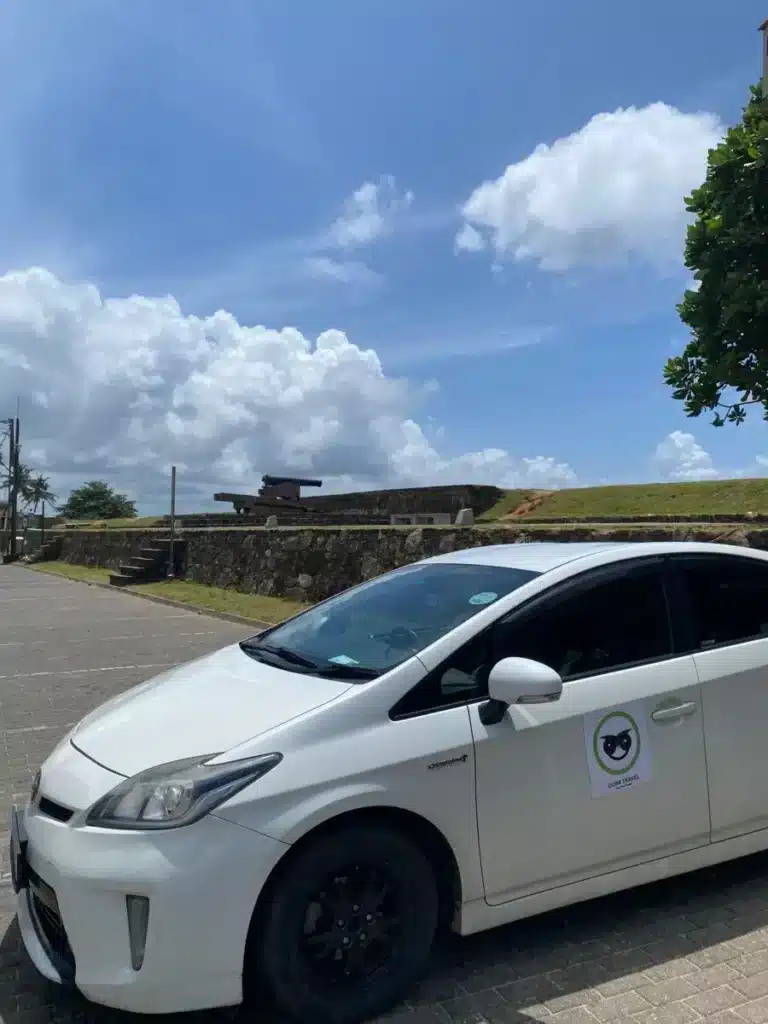
Our private car with driver page says the hire covers fuel, tolls, parking, and the driver’s own room and meals. Hotels, entrance tickets, your meals, safari jeeps and site guides are yours to pay, and a tip is your call. On that page, a driver’s break between driving days is around ten hours, and you can change a day’s plan by telling the driver the night before.
Trains and buses
Public transport reaches nearly all tourist destinations (Wikivoyage), and the fares are low. On the National Transport Commission’s table, in force from 6 July 2026, a normal bus from Colombo to Kandy is Rs 521 and an air-conditioned one Rs 1,018 (National Transport Commission). Sri Lanka Railways’ undated fare notice has an unreserved seat from Colombo Fort to Weligama at Rs 550 in second class and Rs 280 in third (Sri Lanka Railways).
On 5 October 2026 GOV.UK said some roads, particularly in remote areas, may be in poor condition, and called driving erratic and road accidents frequent, particularly at night. For public buses it lists fast driving, a habit of not giving way and poor maintenance, and it ties them to serious accidents in recent years. It rates the driving on tourist buses as usually more professional and safer, while noting that standards can vary. On trains it says to stay inside the carriage while the train moves, after fatal accidents at open doorways and windows, and to guard against theft (GOV.UK).
A mix
The private car page also describes a hybrid: you ride the hill train, the driver takes your bags by road and is on the platform when you reach Ella. In October 2026 that ride starts at Nanu Oya. Self-drive needs two permits, both set out on GOV.UK’s page (GOV.UK).
Step 7: classic routes for a Sri Lanka tour, by length
The loop we’d start from runs one way: the Cultural Triangle, the hills, a park and then the south coast. Hours are the step 4 ranges added up, with Mirissa standing for the south coast.
| Nights | Nights at each stop, in order | Driving |
|---|---|---|
| 6 (7 days) | 2 Sigiriya, 1 Kandy, 2 Ella, 1 Unawatuna or Galle Fort, with a stop at Udawalawe on the way south | 5 driving days, 17 to 20.5 hours |
| 10 | 3 Sigiriya, 1 Kandy, 1 Nuwara Eliya, 2 Ella, 1 Udawalawe or Tissamaharama, 2 south coast | 7 driving days, 17.5 to 21.5 hours |
| 14 | 3 Sigiriya, 2 Kandy, 1 Nuwara Eliya, 2 Ella, 1 Udawalawe or Tissamaharama, 5 south coast | 7 driving days, 17.5 to 21.5 hours |
We tested them against step 2. Four stops want 9 nights and six want 13, so the 6-night and 10-night versions are each three nights short. Only the 14-night version fits, with a night to spare.
With a week, we’d drop a region to get down to three stops, which is still one night short. Our 7-day itinerary sets out both versions, and the three-stop one leaves out the Triangle.
From April to August, turn the loop east: Trincomalee is 2.5 to 3 hours beyond Sigiriya. Arugam Bay is 2.5 to 3.5 hours from Ella but 6 to 7 from the airport, so we wouldn’t sleep there the night before a flight.
Our 10-day itinerary and 2-week itinerary posts are older: each is a night shorter than its row above, and the 10-day one skips Nuwara Eliya. They still board the train at Kandy, so use this page’s road times for that day.
Step 8: make it a custom itinerary, or hand it over
A custom itinerary is one of those routes changed to suit you, and the tables show what each change costs. Swap the coast to match the month, drop a region to win back clear days, or add a one-night stop to split a long leg.
If you hand the plan to a tour operator, ask for a tailor-made route in writing, with every drive time on it, and the right to change it.
Whoever you ask, send the same five things:
- Your dates, with flight arrival and departure times.
- Your pace: the longest drive you’ll accept and how many one-night stops.
- Your must-sees, three at most.
- A budget band: what you’d pay for a room per night.
- Mobility and ages. The Central Cultural Fund counts approximately 1,200 steps up Sigiriya (Central Cultural Fund), so say who will climb.
Then ask what the price includes, whether it’s per person or per vehicle, and how flexible the itinerary is on the road. Sri Lanka Tourism’s website lists registered travel agents, with a licence number and its validity for each (Sri Lanka Tourism). Search it for any operator, us too, before you pay a deposit, and ask about any name you can’t find.
Questions about how to plan a Sri Lanka itinerary
How long should a Sri Lanka itinerary be?
Ten to fourteen nights for the classic loop. On our rule of two nights per stop plus one, its six stops want 13 nights, four want 9 and three want 7. A 7-day trip has six nights, so drop a region and expect one clear day fewer than driving days.
Which month is best for a trip to Sri Lanka?
February and March, if you want a free choice of coast. Galle and Trincomalee both pass our dry test in those two months (WMO climate normals). January suits the south coast, and April to August the east. October and November are the hardest: both stations average more than 200 mm in each.
Can I customise my own Sri Lanka tour?
Yes. Our tours page lists 30 private routes, and says each can be taken as it stands or redrawn around your dates. A tailored itinerary starts from the five things in step 8.
Hand us the brief
Oura Travel works from Weligama and arranges private trips by car with a driver-guide. Send the five things from step 8 through our contact page.
We read everything dated on this page on 5 October 2026. Rail, parks, tickets and travel advice can all change within a week, so open the linked sources before you book.