On 29 October 2026, whale watching in Mirissa cost USD 48 to 75 for a shared seat on four sellers’ own websites (Whale Watching Club; Raja & the Whales; Lakpura; Mirissa Water Sports). The season runs from November to April, with December to April the best months on Love Sri Lanka, and these four sellers’ boats sail at 6.30am for about four to five hours. In rupees, Whale Watching Club charged LKR 16,000 and Raja & the Whales LKR 20,000, both with the government charge included. Booking sites start at USD 14, but often leave that ticket to pay at the pier. Whale Watching Club and Raja & the Whales put the odds of a whale at 50%, and nobody promises one.
Key takeaways
- Ten listings read on 29 October 2026 ran from USD 14 to USD 75 a seat; the cheapest leave out the government ticket.
- The 2012 gazette set that ticket at USD 8 for a foreign adult. Two sellers now quote more: USD 19.50 and USD 22.
- The season is November to April on Love Sri Lanka’s dating. For blue whales, the IWC handbook’s text says December to March.
- No seller promises a whale; two put the odds at 50%.
- Under the 2012 regulations, a boat stops its engine 100 metres from a whale, goes no nearer, and lets nobody into the water.
Whale watching Mirissa price: ten listings on 29 October 2026
The table reports what each seller published on 29 October 2026, in alphabetical order; it is not a ranking or a recommendation. Rupees are converted at the Central Bank’s rate that day, LKR 332.49 to the dollar (Central Bank of Sri Lanka).
| Seller and trip | What the listing includes | Government ticket | Price per adult |
|---|---|---|---|
| Believe it tours, 3 hours (listing) | Tea or coffee, sandwiches, cake, fruit, water, life jackets | Ticket option, or pay at the harbour | From USD 25 |
| Heros Adventures, 4 hours, boards 6.00am (listing) | Pickup in the Mirissa area, light refreshments, life jackets | Not in the cheaper rates | GBP 24.02 without ticket; GBP 49.55 with ticket and pickup |
| Lakpura, shared two-deck boat, 5 hours from 6.30am (listing) | Entrance tickets and a litre of water. No food, no pickup | Included | USD 61 |
| Mirissa Adventures (Geeth’s crew), 4 hours (listing) | Pickup within 4 km, tea and snacks, seasickness tablets | Optional add-on | From USD 22 |
| Mirissa Water Sports, 6.30am, 4 to 5 hours (website) | Breakfast, tea, water, fruit, life jackets, liability insurance. No pickup | Not stated for shared seats | USD 75 |
| My Lanka Trips, 4 to 8.5 hours (listing) | Pickup within 5 km, breakfast, seasickness tablets | Only with the ticket option | From USD 14 |
| Raja & the Whales, 6.30am, 2 to 8 hours (website) | All government fees and taxes, breakfast, snacks, pickup within 6 km, photos by email | Included | LKR 20,000 (USD 60); ages 5 to 11 LKR 10,000; under 5 free |
| Sea & Safari Tours, 4 hours (listing) | Pickup in the Mirissa area, food, seasickness tablets; a free second trip if you miss whales or dolphins | Ticket option, or buy it that morning | From USD 21 |
| Whale Watching Chaminda, starts 7.00am, about 3 to 4 hours (listing) | Breakfast, fruit, a snack, pickup from Ahangama, Weligama or Mirissa | Not mentioned | From USD 16 |
| Whale Watching Club, 6.30am, 4 to 6 hours (website) | Tea or coffee, breakfast, fruit, roti with sambal | “With government tax” | LKR 16,000 (USD 48); ages 5 to 10 LKR 10,000 |
The six booking-site prices are each listing’s cheapest option, which may leave the ticket, breakfast or the drive to you.
What the government ticket costs
Under the 2012 regulations, everyone on a whale watching boat needs a Department of Wildlife Conservation permit, issued at the departure point. It cost 8 US dollars for a foreign adult and 4 for a foreign child aged 6 to 12 (Government Gazette 1774/27). Two sellers in the table quoted more on 29 October 2026. Whale Watching Club put the Department’s fee at USD 19.50 per adult; the Heros Adventures listing gave a “mandatory tax” of USD 22, or USD 12 per child under 12. We found no newer gazette and no fee on the Department’s home page, so neither figure is confirmed. Ask whether the ticket is in your price.
Seeing nothing is not grounds for a refund under Raja & the Whales’ policy, dated 31 July 2026, though the firm refunds or rebooks when it cancels (refund policy). Mirissa Water Sports, linked in the table, offers a free later trip if nothing is seen, subject to seats and to conditions it doesn’t spell out.
Mirissa whale watching season and the best time to go
Love Sri Lanka, the private-sector Sri Lanka Tourism Alliance’s website, dates the season from November to April, when the sea is calmest. It calls December to April the best months for Mirissa (Love Sri Lanka). The International Whaling Commission’s handbook puts blue whales off Mirissa from December to March, though the table in the same profile says October to March (IWC Whale Watching Handbook).
The south-west monsoon lasts from May to September (Department of Meteorology), and our Sri Lanka weather by month table shows which coasts are drier then. Operators’ calendars run longer:
| Operator | Months on its website |
|---|---|
| Raja & the Whales | Most days from November into late April or early May, given 10 passengers; some days from August to October when the sea is fit; none in May to July (source) |
| Whale Watching Club | From July until May, plus trips at other times when weather and sea are good enough (source) |
| Mirissa Water Sports | Calls November to April the best season, and sails from August as well (source) |
The same Love Sri Lanka page says whales are likelier soon after dawn. If you’re coming for Sri Lanka in December, book the boat for one of your first mornings on the coast, so a trip cancelled for weather leaves time for another.
The 2026/27 season so far
A search on 29 October 2026 found no notice about this season’s start from the Department of Wildlife Conservation or the Navy. Raja & the Whales’ trips page, linked in the table above, said it would resume “as soon as sea conditions allow”. Mirissa Water Sports’ newest log entries are dated 17 August, 8 September and 20 October 2026 (sightings log). The Navy’s newest Mirissa notice covers 2022/23, a season that began on 28 November 2022 (Sri Lanka Navy). November is the usual start, not a fixed date.
Your odds of seeing a whale off Mirissa
Even in season, Love Sri Lanka warns, a sighting can’t be guaranteed (Love Sri Lanka). Each operator below states its own figure, read on 29 October 2026, and none says when or how it was worked out.
| Operator | Its stated odds |
|---|---|
| Whale Watching Club | 50% chance of whales, 90% of dolphins (source) |
| Raja & the Whales | Whales 50%; blue whales about 20% (source) |
| Mirissa Water Sports | “Around a 90% sighting success rate” for Mirissa as a whole, though its own FAQ adds that sightings can’t be guaranteed 100%; it doesn’t say whether dolphins count (source) |
Two marine biologists told Mongabay in April 2025 that blue whale sightings off Sri Lanka had fallen (Mongabay). One of them, Nanayakkara, dated the fall from 2018 and said that in 2024 his team saw four blue whales, three off Mirissa. The same article reports a scientist at NARA, the state’s marine research agency, as saying its 2024 transect study showed a fall of more than 90%. We know that figure only through Mongabay, with no baseline or method, and found no published copy: read it as a reported summary, not a measured rate. Both biologists named climate change as the likeliest cause.
One operator’s own log also names blue whales less often in recent seasons. We counted the November to April entries in Mirissa Water Sports’ log on 29 October 2026 (sightings log).
| Season (November to April) | Entries | Entries naming a blue whale |
|---|---|---|
| 2021/22 | 100 | 58 |
| 2022/23 | 80 | 19 |
| 2023/24 | 123 | 21 |
| 2024/25 | 57 | 9 |
| 2025/26 | 59 | 5 |
These are the company’s own records and labels. Many days are missing and the page counts neither trips nor empty mornings, so these figures aren’t a sighting rate. For 2025/26 it labels 38 entries fin whale and names dolphins in 54.
Blue whales and the other species
Between January and May 2017, researchers on a boat survey logged 242 sightings and at least nine species off Mirissa (University of East Anglia record of the Integrative Zoology paper). Of 174 baleen whale encounters, 167 were blue whales. By 2025, the same Mongabay report says, Bryde’s whales and short-finned pilot whales turned up regularly, and spinner, bottlenose and Risso’s dolphins came in large numbers.
What a whale watching morning looks like
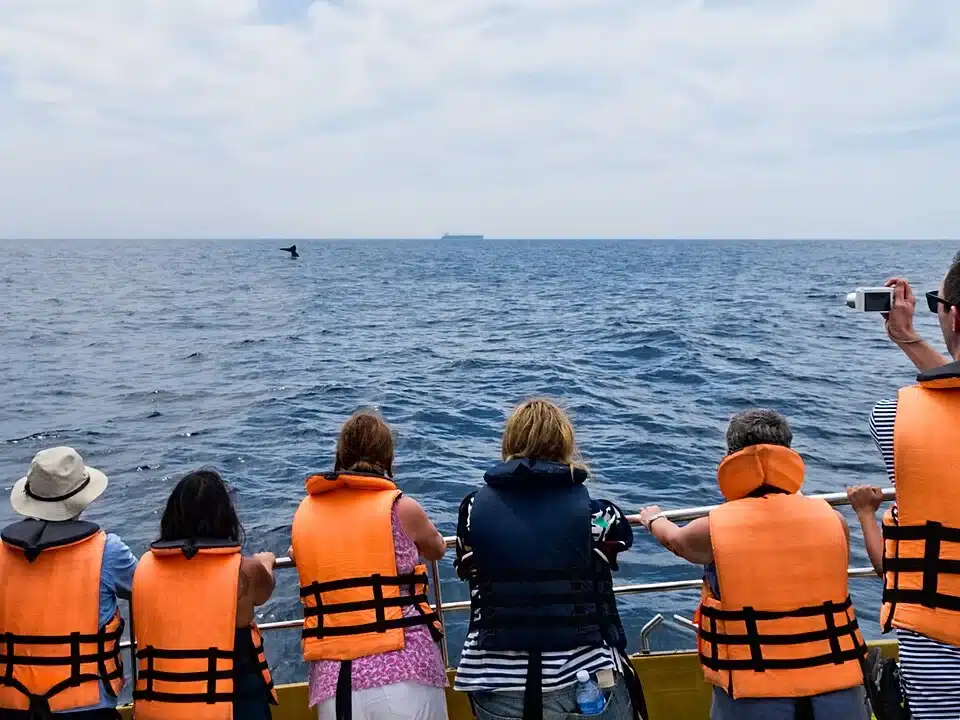
The three harbour operators check you in at 6.00am and sail at 6.30am, and all three serve breakfast (Raja & the Whales; Whale Watching Club; Mirissa Water Sports). The regulations allow trips between 5.30am and 7pm (Government Gazette).
Raja & the Whales quotes 2 to 8 hours, four to five typical, and won’t turn back early for seasick guests, check-outs or flights. Keep the afternoon free.
The distance rule and the other rules at sea
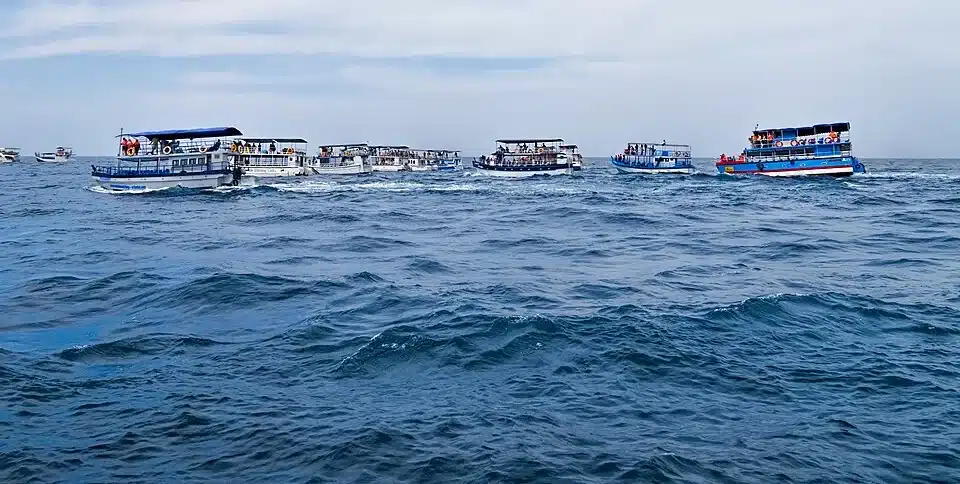
The rules are in 2012’s Sea Mammals (Observation, Regulation and Control) Regulations, number 1, issued under the Fauna and Flora Protection Ordinance (Government Gazette 1774/27). Condition 5 of Schedule III sets the distances. Once animals are seen, the boat slows gradually until it is 400 metres away. For whales, the engine goes off at 100 metres, and the boat must never be closer than 100 metres. Other sea mammals get 50 metres.
The other licence conditions, in short:
- A Department licence for the calendar year, kept on board, granted only with a fitness certificate, insurance that covers crew and passengers, and life jackets on board.
- An operator, an assistant and a Department-trained guide on every trip.
- No sudden changes of speed or course, and no sailing in front of or behind the animals.
- No food, lights or sounds to lure them, and no alcohol on board.
- Nobody in the sea, except for a dive the Director-General has approved in advance.
- No trips in bad weather.
Condition 18 says breaking any of them will cancel the licence. The Morning reported in February 2025 that the rules were amended in 2019 (The Morning). We could not find that amendment, so the figures above are the 2012 text.
Separately, the Sri Lanka Tourism Development Authority has guidelines for operators registering with it, in a file still named “final draft” on 29 October 2026 (SLTDA criteria). They cap speed at 5 knots in the approach zone, ban swimming or diving with the animals and require life jackets.
When the Pearl Protectors asked Mirissa operators in a 2024 study, 11 of the 15 that answered said they would take people swimming with whales (Pearl Protectors). In the same report, the Department says it had licensed no one in Mirissa or Trincomalee to do so. The study names no operator. The Morning found in October 2025 that many swim boats sail on sport fishing licences; the Fisheries Minister said “stern” action would follow after 31 December (The Morning). We found no later report of arrests on 29 October 2026.
How to choose a boat
The gazette’s conditions turn into questions you can ask before you pay:
- Does this boat hold this year’s Department licence?
- Is the guide on board trained by the Department?
- What is the nearest you get to a whale? The 2012 rule says 100 metres.
- Is there a life jacket for each passenger?
- Do you put anyone in the water? If yes, we’d look elsewhere.
We’d also ask how many people the boat carries and whether the ticket is in the price. For a snorkelling trip instead, see our Weligama snorkeling guide.
Seasickness, children and pregnancy
There is always some swell on the Indian Ocean, Raja & the Whales warns (trips page). The NHS, on a page last reviewed on 19 June 2023, suggests sitting mid-boat, looking at the horizon, and skipping heavy meals, spicy food and alcohol beforehand (NHS). It lists tablets, patches for adults and over-10s, and acupressure bands, which don’t help everyone.
Children, pregnant women and people on some medicines get it more often, according to MedlinePlus, updated on 23 September 2024 (MedlinePlus). The CDC’s page, last reviewed on 28 January 2022, puts the most affected ages at 2 to 12 (CDC). It says to talk to a healthcare professional before taking medicine for it, and about doses for children.
Love Sri Lanka says children of any age can come and that the trip suits the whole family (Love Sri Lanka). Mirissa Water Sports wants pregnant guests, and parents bringing a child under 3, to check with a doctor before booking (website). Three listings say their trips don’t suit pregnant women. With trips of eight hours or more on some boats and no early return, we’d ask a doctor before taking a toddler or a pregnancy on board.
Reaching Mirissa harbour in time for check-in
We ran each route through OpenStreetMap’s router on 29 October 2026, rounding up because it assumes empty roads. The set-off time takes the slower figure from a 6.00am check-in, plus five minutes to park.
| Starting point | Set off by | Drive | Road distance |
|---|---|---|---|
| Weligama | 5.40am | 10 to 15 minutes (route) | 6 km |
| Matara | 5.30am | 15 to 25 minutes (route) | 10 km |
| Unawatuna | 5.05am | 35 to 50 minutes (route) | 28 km |
| Galle Fort | 4.55am | 45 minutes to an hour (route) | 34 km |
| Colombo Fort | 2.55am | 2.5 to 3 hours (route) | 147 km |
From Colombo, we’d stay the night on the south coast instead. If you’re flying in, our Colombo airport to Weligama guide compares the ways down. Most listed pickups cover only a few kilometres around Mirissa.
A typical trip lands you back between roughly 10.30am and 11.30am. From the harbour it’s about 600 metres by road to the western end of Mirissa beach (OpenStreetMap), and our best beaches in Sri Lanka guide covers the rest of the coast.
Out of season: Trincomalee and Kalpitiya
From May, look at the other coasts, though sources differ on months.
| Coast | What the source says | Source |
|---|---|---|
| Trincomalee, north-east | March to July for blue whales, plus sperm whales | IWC Whale Watching Handbook |
| Trincomalee | Whales move to the east coast from May to October | Love Sri Lanka |
| Kalpitiya, north-west | Best months November to March, or into April | Love Sri Lanka |
| Kalpitiya | Tourist boats only from November to April; whales likeliest in November or March and April | Wikivoyage |
| Kalpitiya | Spinner dolphins peak from October to March; sperm whales gather in March | IWC handbook, as above |
On land, our Yala safari cost guide prices a jeep morning, and the Sri Lanka safari guide compares the parks.
Questions about whale watching in Mirissa
How much is whale watching in Mirissa?
Between USD 14 and USD 75 a seat in the ten listings we read on 29 October 2026. The two rupee prices, LKR 16,000 and LKR 20,000, include the government charge; many booking-site prices don’t.
Which months are best for whale watching in Mirissa?
November to April is the season on Love Sri Lanka, with December to April its pick of the months (Love Sri Lanka). The IWC handbook, cited in the season section, narrows blue whales to December to March.
Are whale sightings guaranteed in Mirissa?
No. On 29 October 2026, Raja & the Whales put whales at 50% and blue whales at about 20% (Raja & the Whales). Whale Watching Club also gave 50%. Ask whether a free second trip is offered if you see nothing.
Is it legal to swim with whales in Mirissa?
No, not as a tourist. Under the regulations nobody on a trip may enter the water, unless the Director-General has cleared a dive beforehand (Government Gazette). In October 2025 the Director-General said he gives that permission only for scientific documentation, The Morning reported (The Morning).
Is whale watching in Mirissa worth it?
In our view it’s worth a morning if a pod of dolphins alone would still feel like a good day. Skip it if you’re prone to bad seasickness, or if anything less than a blue whale would disappoint you.
Planning the drive around your boat morning
Oura Travel is based in Weligama, about 6 km along the coast from the harbour. We plan private trips by car with a driver-guide. If a Mirissa boat is part of your plans, send us your dates and we’ll plan the drive around a 6am check-in and a free afternoon.
We read every listing, the odds, the log and the gazette on 29 October 2026. Prices and sailings change, so check with your seller before paying.
Top photo: Arian Zwegers, CC BY 2.0, via Wikimedia Commons.