Trincomalee is in season from March to September, when each month averages 26 mm to 113 mm of rain, against 216 mm to 376 mm a month from October to December. It suits two or three nights of beaches, snorkelling at Pigeon Island, a Hindu temple on a sea cliff and, in the right months, whale trips.
Those summer months are when the south-west monsoon rains on the other side of the island, so the east coast fits a European summer holiday. We checked every dated fact on 7 November 2026, from desk research, and we say where sources disagree.
Key takeaways
- June is the driest month on the WMO averages (25.9 mm) and November the wettest (375.6 mm); from May to August the daily highs average around 35 °C.
- Pigeon Island’s 2022 gazetted fee for a foreign adult is USD 25 a day (tourist season) or USD 20 (regular period), plus taxes.
- The International Whaling Commission gives March to July for blue whales off Trincomalee; other sources give later months.
Best time to visit Trincomalee
The best time to visit Trincomalee is March to September, and June is the driest month. In a December 2023 bulletin, the Department of Meteorology gives May to September for the south-west monsoon and December to February for the north-east one. Inter-monsoon spells fill March and April and October and November. The north-east monsoon, it says, affects the north-eastern parts of the island, where Trincomalee lies. In July, for example, Galle on the south coast averages 172.6 mm of rain, more than three times Trincomalee’s 51.0 mm. However, Trincomalee’s driest months are its hottest too. The WMO station figures below show average highs of 35.2 to 35.4 °C from May to August, so plan beach time and the temple steps for mornings and late afternoons.
Rainfall is from the WMO normals for 1991 to 2020 for the Trincomalee station, downloaded on 7 November 2026.
| Months | Average rain | Rain days (1 mm or more) | What it means |
|---|---|---|---|
| February | 96 mm | 4.7 | Drying out after the monsoon |
| March and April | 55 and 48 mm | 4.0 and 4.2 | Dry, before the summer heat |
| May to August | 72, 26, 51 and 67 mm | 4.2, 1.9, 3.4 and 4.2 | Hottest months; June is the driest |
| September | 113 mm | 5.7 | Wetter, still mostly dry days |
| October to January | 216, 376, 339 and 152 mm | 12.8, 17.9, 15.0 and 8.4 | Inter-monsoon and north-east monsoon rain |
The park can close in the wet months. On 20 December 2023 the Department of Wildlife Conservation closed Pigeon Island National Park as the north-east monsoon began, Sri Lanka Mirror reported, with rough seas expected until February.
Other regions are in our Sri Lanka weather by month page, and a wider summer route in our guides to July in Sri Lanka and August in Sri Lanka.
Trincomalee beaches: Uppuveli, Nilaveli and Marble Beach
Uppuveli is the nearest beach to town, 4.5 km by road on the router.
Nilaveli lies 16.6 km north of town by road and is the starting point for boats to Pigeon Island. Salt in Our Hair (updated 24 May 2026) describes 4 km of sand.
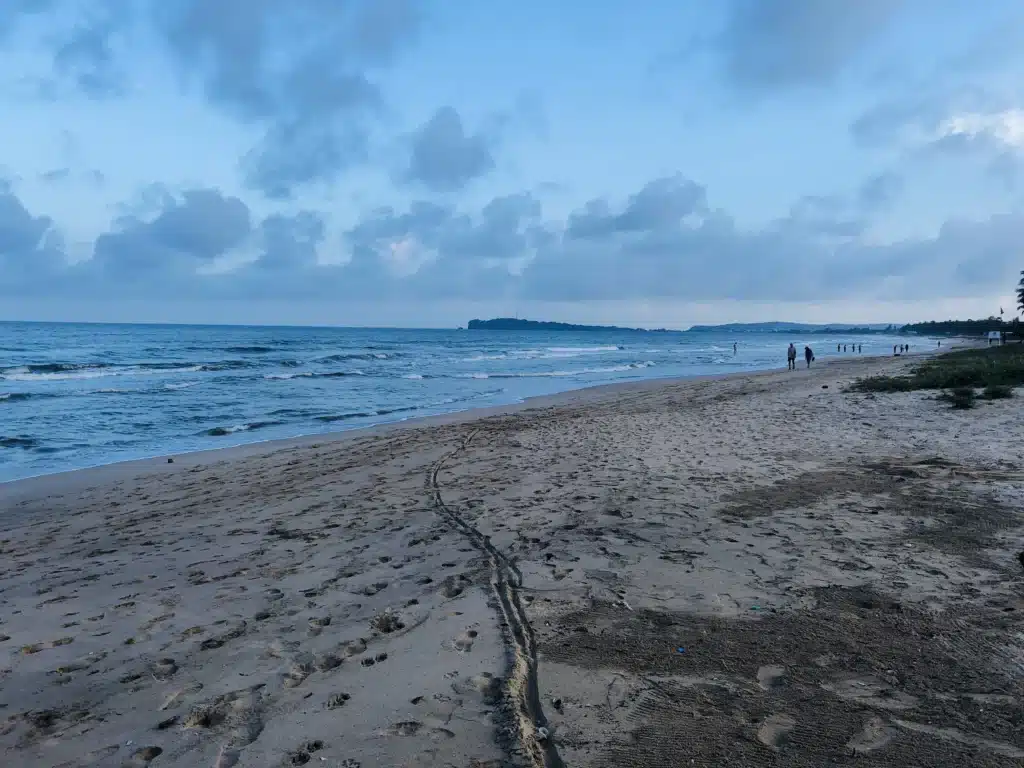
Marble Beach is a cove 18.6 km south of town by road near China Bay. Its resort belongs to the Sri Lanka Air Force, whose news page of 19 January 2024 reports new cabanas opening there. Wikivoyage reports a small entry fee and a free public side without facilities.
Wikivoyage (edited 3 November 2026) says these beaches are mostly shallow, in places under 2 m deep even 100 m out. It also says plastic washes up, and that clean-ups happen only in the high season.
Before swimming, read what GOV.UK says (page updated 21 September 2026). It warns of dangerous surf or rip tides on many of the country’s beaches in some seasons, and says to get advice from the hotel or a tour operator before entering the water. Canada’s advice (updated 2 November 2026) adds that public beaches are generally unsupervised and warns against diving into unfamiliar water: hidden rocks or shallow spots, it says, can cause serious injury or death. To compare the east coast with the rest of the island, see our best beaches in Sri Lanka guide.
Pigeon Island National Park: fee, rules and coral
Pigeon Island National Park is a marine park of roughly 471 hectares about 1 km off Nilaveli, built around two islets, the President’s Media Division said on 2 June 2025.
How much does Pigeon Island cost? A foreign adult officially pays USD 25 for a day visit during the tourist season, or USD 20 during the regular period, or the same in rupees. A child pays USD 15 or USD 10. Those figures come from the wildlife fee regulations in Gazette Extraordinary 2292/11 of 8 August 2022, which list Pigeon Island in Category I. They are 2022 figures, and we found no newer gazette when we checked on 7 November 2026. The gazette does not fix the tourist season’s months: the Director-General of Wildlife Conservation declares it. It also adds government taxes without naming a rate. Reports run higher: Salt in Our Hair says it paid USD 48, nearly double the base fee. The boat from Nilaveli costs extra.
| Source | Foreign adult | Date |
|---|---|---|
| Gazette, Category I, daytime | USD 25 tourist season, USD 20 regular period, plus taxes | 8 August 2022 |
| Salt in Our Hair | USD 48 to enter the park | Updated 24 May 2026 |
| Destinationless Travel | Park fee “around 4,000 rupees ($48 USD)”; boat 2,000 rupees for up to six | Updated 20 July 2026 |
| Wikivoyage | Boat about USD 30 return | Listing updated June 2025 |
The Destinationless figures do not match: at the Central Bank rate of 6 November 2026 (332.41 rupees), 4,000 rupees is about USD 12.
The gazette’s Schedule VIII sets the permit conditions. You give your name, passport number, address and phone number at the entry point, and nobody without an identity document is let in. The permit covers one entry. You stay with the officer assigned to you and must not cause “any nuisance or disturbance”.
The President’s Media Division blamed illegal fishing, coral harvesting, unregulated tourism and rising sea temperatures, among other threats, for harm to the reef, and its June 2025 clean-up targeted crown-of-thorns starfish. Keep your hands and fins off the coral and take your rubbish back with you.
Whale and dolphin watching off Trincomalee
No two sources give quite the same whale season.
| Source | Season it gives | Page date |
|---|---|---|
| IWC whale watching handbook | Blue whales March to July | Read 7 November 2026 |
| Love Sri Lanka, a private tourism alliance’s site | May to October; blue whales close in from May to August | 30 September 2020 |
| Wikivoyage | Peak whale watching in the April to September dry season | 3 November 2026 |
| Salt in Our Hair | April to October, best April to July | 24 May 2026 |
From May to August, Love Sri Lanka says, blue whales can be within 6 to 8 nautical miles of Trincomalee to the east, about half an hour out by boat. No sighting is certain.
The Sea Mammals Regulations of 2012 set the rules. A boat must switch off its engine at 100 metres from a whale and never get nearer, and stay 50 metres from other sea mammals. Anyone going out to watch sea mammals, alone or in a group, must get a wildlife department permit from the officers at the departure points.
Some boats sell swims with whales. The Morning reported on 26 October 2025 that, according to an October 2024 study, “83% of operators in Trincomalee engage in illegal whale-swimming activities”. The Director-General of Wildlife Conservation told the paper he did not grant swim permits except for scientific documentation, and that swimming with whales was dangerous. Our whale watching in Mirissa guide covers the south coast season.
Koneswaram temple and Fort Frederick
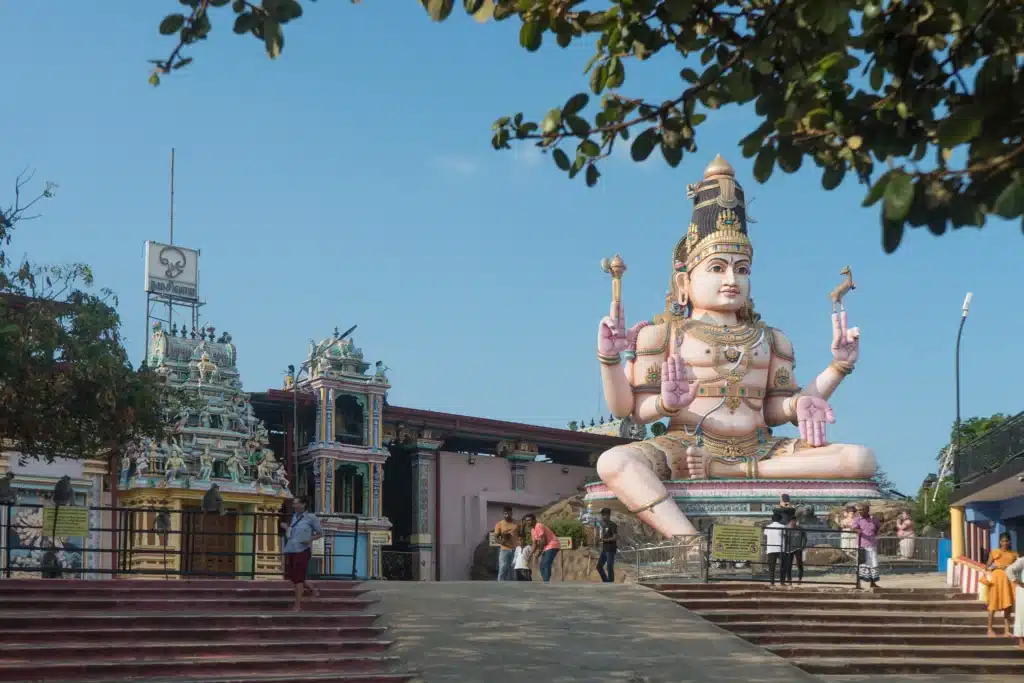
Koneswaram is a Hindu temple to Shiva on the headland inside the Fort Frederick area, with Swami Rock, a 130 m cliff, on one side of the compound. The Portuguese destroyed the old temple on 14 April 1622 and used its stone for their fort, according to Wikipedia’s Fort Fredrick article. Lonely Planet dates the present building to 1952; Wikipedia’s temple article says only that the latest restorations were in the 1950s.
Lonely Planet’s undated listing gives puja at 6.30am, 11.30am and 4.30pm, so check the times locally. It suggests socks for the hot paving once your shoes are off. Canada’s travel advice (updated 2 November 2026) asks visitors to “dress conservatively” and to “respect religious and social traditions and artifacts”.
The fort itself was completed by the Portuguese in 1624 and rebuilt by the Dutch in 1665, Wikipedia says. Lonely Planet notes that the Sri Lankan military uses it today but that visitors can walk or drive through, among spotted deer. Canada’s advice says photographing or filming government and military installations is prohibited, so take care where you point the camera inside the fort.
More things to do in Trincomalee
Kanniya hot wells
Sri Lanka Tourism describes seven hot springs about 8 km from town. Wikivoyage (listing updated June 2025) gives 7am to 7pm, Rs 500 for foreigners, and warns that wearing only a swimsuit will cause offence.
Sri Pathrakali Amman Kovil
This brightly painted Hindu temple stands near the town centre. Salt in Our Hair reports free entry, a welcome for non-Hindu visitors, and opening from 6.30am to noon and 4pm to 6.30pm.
Where to stay in Trincomalee, by area
Very few visitors stay in Trincomalee town itself, according to Wikivoyage. Uppuveli, a few minutes away by road, has most of the restaurants, at about double town prices, and the guesthouse whale trips. Nilaveli has the longer beach and the Pigeon Island boats, though Salt in Our Hair found fewer places to eat there.
Staying in town puts you near the railway station, the bus stand, the fort and the temples. South of town, near China Bay, Marble Beach has the Air Force resort.
Holidify notes that many beach restaurants close in the low season. If you travel outside the dry months, check that the area you choose is still open.
Getting to Trincomalee by road, rail and air
By road
We took distances and times from OpenStreetMap’s car router on 7 November 2026. Plan time is our own rule, not a measured figure: router time times 1.3, or 1.5 to and from Kandy, rounded up to the half hour.
| From | Distance and router time | Plan time |
|---|---|---|
| Colombo airport | 236.7 km, 4 h 19 | 6 h |
| Colombo Fort | 259.5 km, 4 h 43 | 6.5 h |
| Kandy | 180.9 km, 3 h 31 | 5.5 h |
| Sigiriya | 103.7 km, 2 h 02 | 3 h |
By train
The Railway Department cancelled six journeys on the Trincomalee and Batticaloa lines on 27 November 2025 because floods covered the tracks, Ada Derana reported. Day trains restarted on 20 December 2025, leaving Colombo Fort and Trincomalee at 7am, Newsfirst said.
The Night Mail returned from 20 January 2026, leaving at 9.30pm in both directions (Newsfirst). We found no newer notice for the Trincomalee line by 7 November 2026, so confirm times at the station.
By air
Cinnamon Air’s 2026/27 winter timetable (1 November to 30 April) shows a daily flight from Colombo airport at 2.30pm, landing at China Bay at 3.15pm. The return leaves at 3.30pm and stops at Batticaloa.
Its summer 2026 timetable (1 May to 31 October) had a daily 10.30am departure; no 2027 summer timetable was online when we checked.
Visitors from the US, Australia, Germany, France, Italy, Spain and the Netherlands get a free 30-day ETA, since 25 May 2026 on the ETA site. Apply before you fly, as our Sri Lanka visa guide explains.
Combining Trincomalee with the Cultural Triangle
Habarana is 87.3 km away (plan 2.5 hours), and Anuradhapura 110.7 km (plan 3 hours). Our Cultural Triangle guide covers Sigiriya, Dambulla and Polonnaruwa.
Wikivoyage suggests Habarana as the base for the elephants at Minneriya, Kaudulla or Hurulu, and our Minneriya National Park guide covers that safari. Further down the east coast, Pasikudah is 107.5 km away (plan 3.5 hours) and Arugam Bay 249.6 km (plan 7 hours).
Two 2027 poya days fall in the summer: Esala on 18 July and Nikini on 16 August (Central Bank list). On religious holidays, GOV.UK notes, alcohol is not usually on sale. The Kandy Esala Perahera dates for 2027 were not announced when we checked; our Sri Lanka festivals page tracks them.
Before you go: safety notes and Cyclone Ditwah
Cyclone Ditwah hit Sri Lanka in late November 2025. The UN’s humanitarian office (OCHA) named Trincomalee among the districts with the heaviest population impacts on 30 November 2025, in its flash update.
Canada’s advice (updated 2 November 2026) says marked and unmarked minefields may still be present in parts of eastern Sri Lanka. There, it says, travellers should stay on paved and main roads, avoid walking in fields and watch for warning signs. It adds that the military keeps a strong presence in the north and east, where checkpoints can appear and roads close suddenly.
For help fitting Trincomalee into a longer route, contact our team with your dates.
Questions about visiting Trincomalee
When is the best time to visit Trincomalee?
March to September, when the WMO averages stay between 26 mm and 113 mm a month. June is the driest; October to January is the wettest, with up to 17.9 rain days a month.
Is Trincomalee good in July and August?
Yes for dry weather: July averages 51.0 mm and August 66.6 mm, with highs of 35.3 °C. The Sunday Observer described July to September as Pigeon Island’s busy period in 2021.
How much is the Pigeon Island entrance fee?
The 2022 gazette charges a foreign adult USD 25 a day during the tourist season or USD 20 during the regular period, plus government taxes. Salt in Our Hair (updated May 2026) reports paying USD 48. The boat from Nilaveli costs extra.
How many days do you need in Trincomalee?
Two or three nights covers Pigeon Island, a beach day and Koneswaram with Fort Frederick. Add a night if you also want a whale trip.
How do you get from Colombo to Trincomalee?
By road it is about 260 km, or 6.5 hours by our planning rule. The day train and the Night Mail were both running again by January 2026, and Cinnamon Air’s 2026/27 winter timetable shows a daily flight from Colombo airport to China Bay.
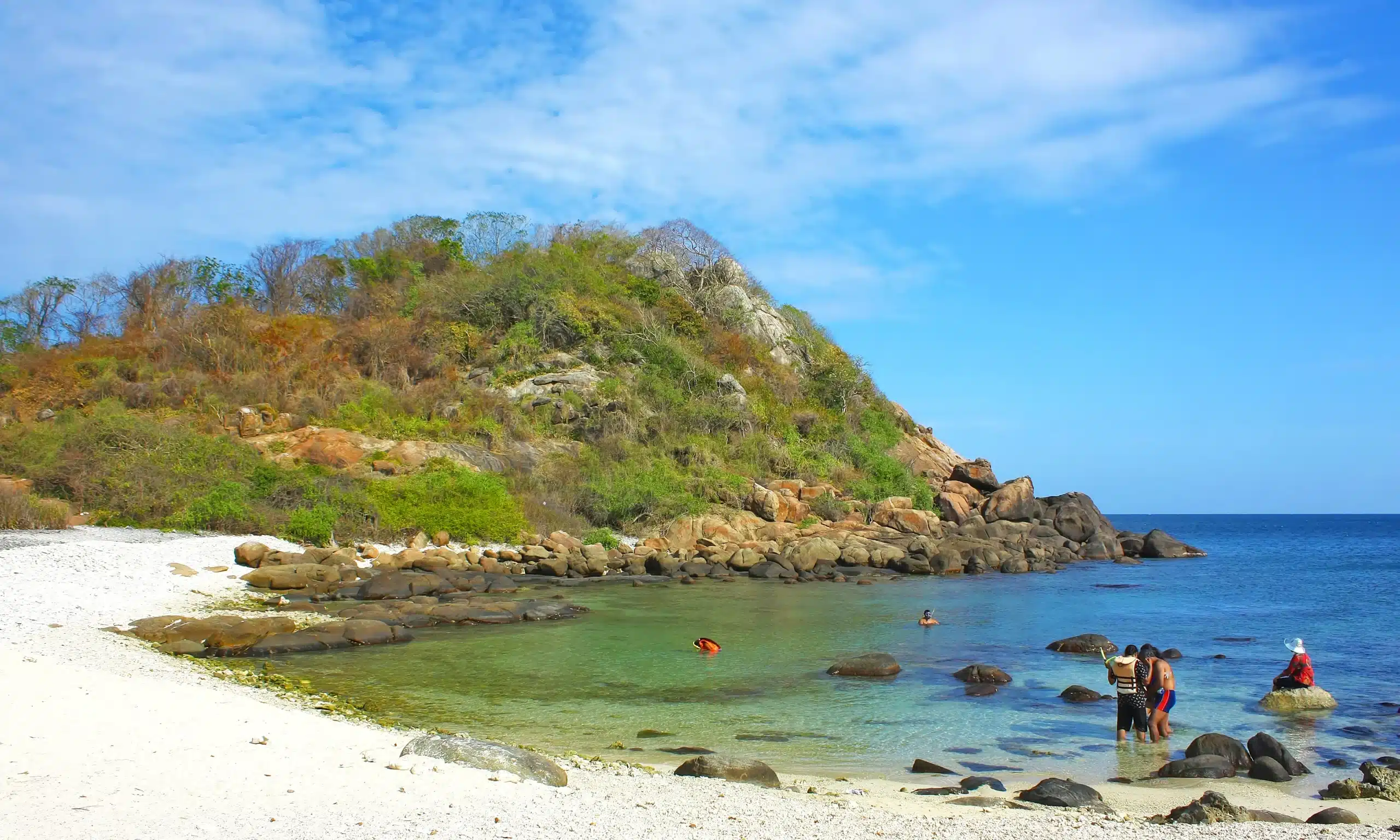
Top photo: Pigeon Island National Park, Trincomalee, 22 August 2012. Photo: AntanO, CC BY-SA 4.0, via Wikimedia Commons.