A cooking class in Sri Lanka is usually a few hours in a home, school or hotel kitchen making rice and curry, then eating it. We read eight operator pages on 3 October 2026. Where they gave a length, sessions ran from 1.5 hours (Teardrop Hotels) to 5 (Rustic Colombo Cooking Class). Group sizes ran from a single guest (Ceylon Cooking Class) to a maximum of twelve (Ella Spice Garden). Before you book, find out whether you’ll cook or watch, because ‘hands-on’ and ‘demonstration’ are different promises. Some of the pages advertise vegan cooking and one offers halal meals on request, and each diet needs its own questions.
Key takeaways
- Rice and curry, a plate of rice with several curries, is the lesson on five of the eight operator pages we read.
- Read the listing’s wording. A demonstration is watched and a hands-on class is cooked, so ask how many guests share one fire.
- Vegetarians and vegans: check for Maldive fish. It’s cured tuna, and cooks season vegetable dishes and sambols with it.
- Halal: none of the eight pages showed a certificate, and one offered halal meals on request. The halal certifier’s scheme page doesn’t mention cooking classes, so ask the host.
- Oura Travel runs a class in a family home in Weligama. On 3 October 2026 GetYourGuide listed it as a 4-hour class with lunch, from USD 14 per person.
How a Sri Lankan cooking class usually runs
The pages we read on 3 October 2026 describe a similar order. Some classes start at a market. Rustic Colombo Cooking Class builds a guided market tour into each five-hour session (Rustic Colombo Cooking Class). Next comes an introduction to the spices, which at Ella Spice Garden is a walk round the garden where they grow (Ella Spice Garden). Then comes the cooking, and the meal you’ve made.
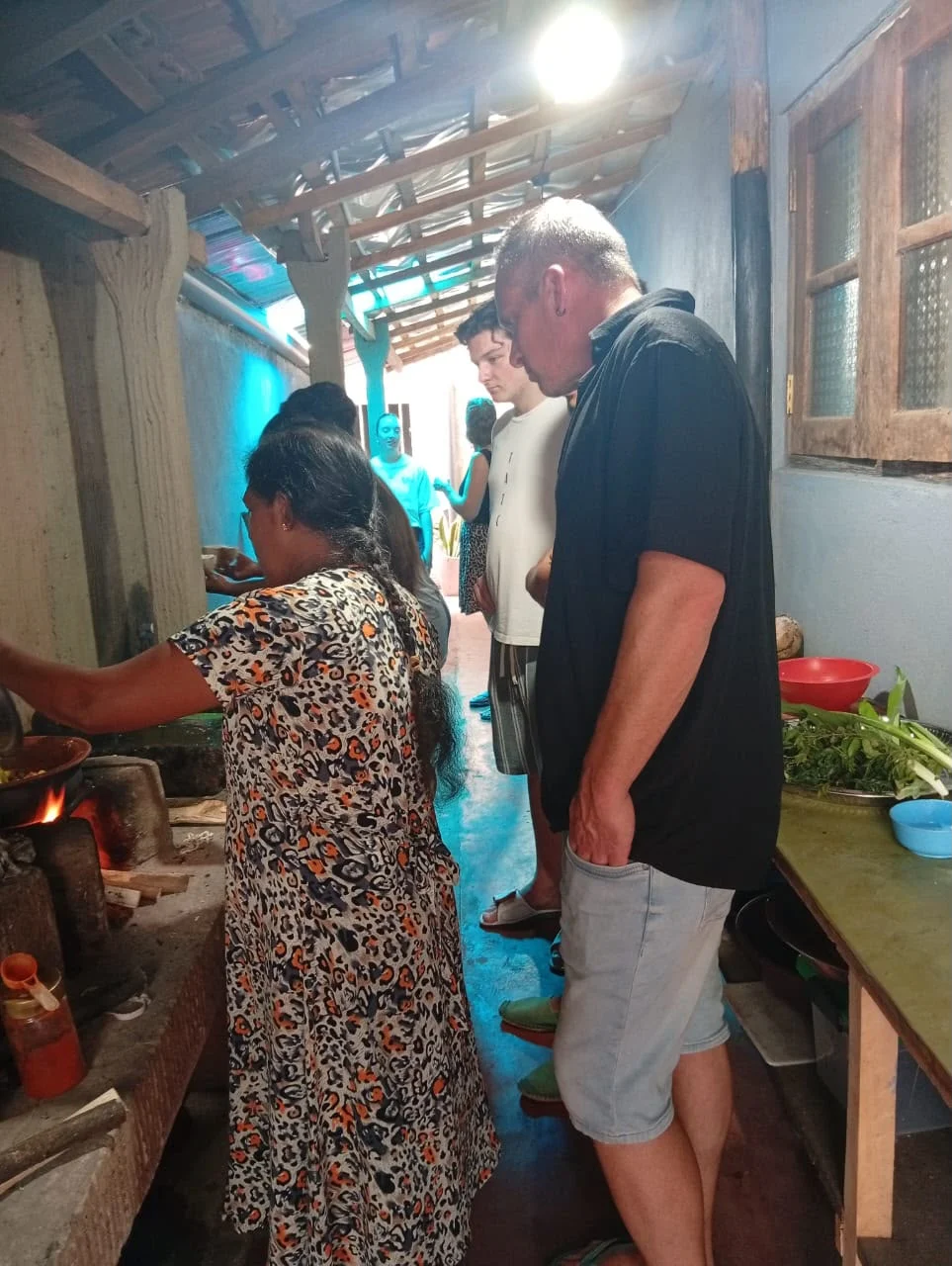
On the pages we read, a class might be in a family house, a school’s garden kitchen or a hotel. Anantara’s resort at Tangalle calls its own a cooking school (Anantara). Two of the pages list two sessions a day. Ella Spice Garden’s lunch class runs from 10am and its dinner class from 4.30pm (Ella Spice Garden). Rustic Colombo Cooking Class starts at 9.30am or 3.30pm (Rustic Colombo Cooking Class).
Ask what you take away. Sajee’s Place in Sigiriya says it provides all the recipes (Sajee’s Place), and Ella Spice Garden shares an e-cookbook (Ella Spice Garden).
In a family home, expect to leave your shoes at the door. The local way to eat is with the fingertips of the right hand, and Wikivoyage calls it harder than it looks (Wikivoyage).
What you cook: rice and curry, coconut and spices
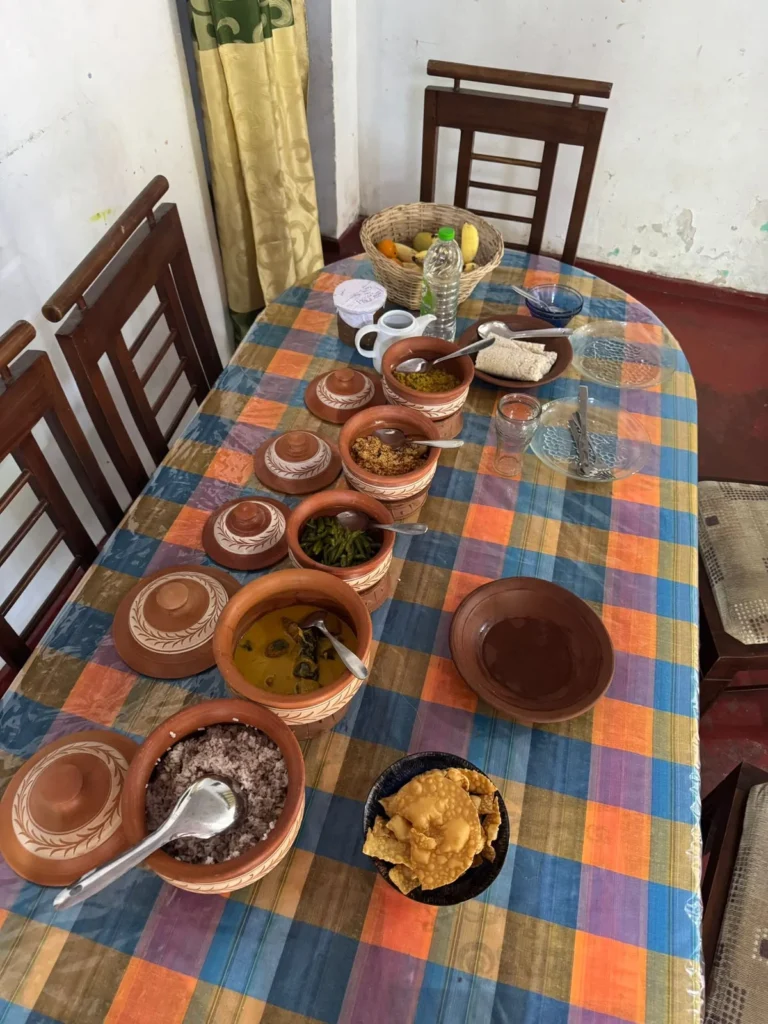
Rice and curry is the usual lesson in a Sri Lankan cooking class, and that means a whole plate. Five of the eight operator pages we read on 3 October 2026 name it, or list rice with several curries. It’s rice, boiled or steamed, served with one curry of fish or meat and others of vegetables, lentils or fruit. Pickles, chutneys and sambols go alongside (Wikipedia). Sajee’s Place in Sigiriya gave its menu on its website that day. It had four or five vegetable curries, a dhal, a chicken or fish curry, a salad, mallum or coconut sambol, papadam and rice (Sajee’s Place).
One school’s site goes beyond the curry plate. Negombo Cooking Class lists hoppers, string hoppers, pittu and milk rice among its foods, and says its menu changes with the day of the week (Negombo Cooking Class).
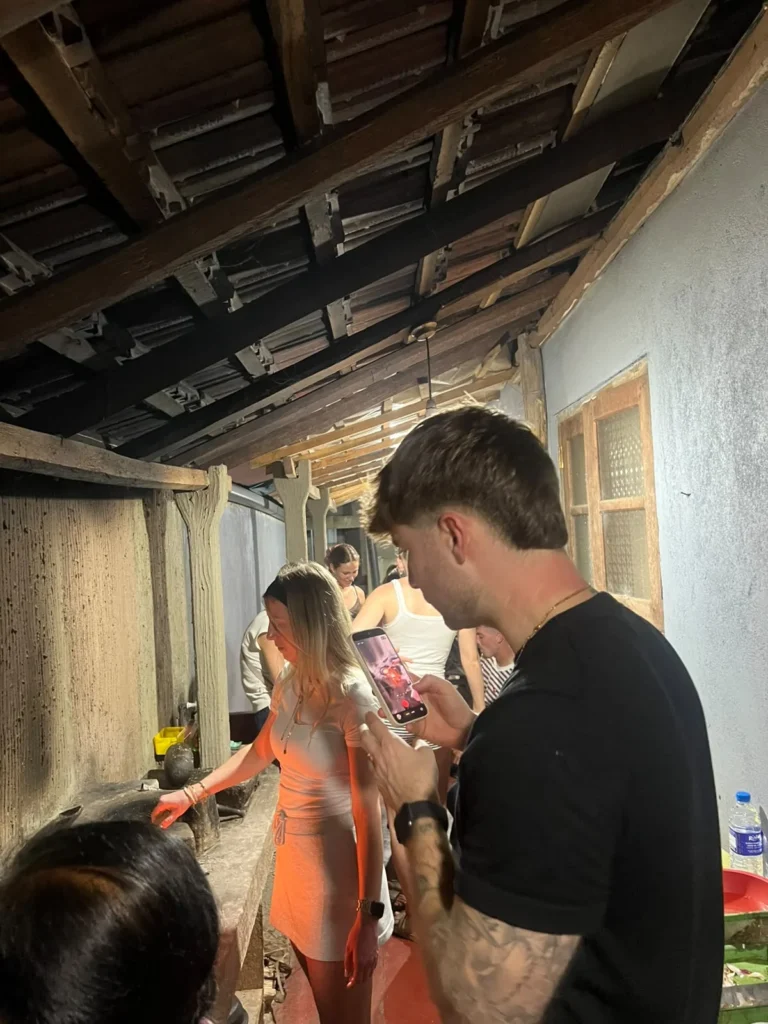
Ask which techniques you’ll do with your own hands. Rustic Colombo Cooking Class says each dish is prepared by hand, spice grinding and slow-cooked curries included (Rustic Colombo Cooking Class). The GetYourGuide listing for our own class in Weligama, read the same day, mentions clay pots and spice grinding. The table explains the main techniques.
| Technique | What it involves | Source |
|---|---|---|
| Scraping and milking a coconut | In most households, cooks prepare coconut milk and grated coconut afresh nearly every day. You grate the flesh and squeeze it. The first pressing gives the thick milk. Soaking the pulp in hot water and pressing again gives the thin | Wikipedia; Wikipedia |
| Grinding a sambol | Pol sambol is grated coconut, shallots, dried chilli, lime juice and salt, traditionally ground on a miris gala, a granite block with a granite rolling pin | Wikipedia |
| Roasting curry powder | Home cooks roast their spices until brittle, grind them to a powder and keep it in airtight containers | Love Sri Lanka |
| Tempering | Whole spices and curry leaves are fried briefly in oil, then tipped into the dish with the oil | Wikipedia |
| Making a mallung | Mallung, also spelt mallum, is finely shredded greens cooked lightly with fresh coconut, chilli and spices | Wikipedia |
| Cooking in clay over wood | Love Sri Lanka says a clay vessel gives the truest version of a curry, and that an open wood fire leaves a smoky taste | Love Sri Lanka |
Expect a few flavours that may be new. Wikipedia’s list includes heavy use of cinnamon and black pepper, pandan leaf (rampe), curry leaf (karapincha) and goraka (Wikipedia). Goraka is a souring and thickening agent (Sri Lanka Tourism).
How to choose: a home kitchen experience or a hotel demonstration
Choose a cooking class in Sri Lanka by one question: will you cook, or watch someone cook? The wording of a listing often tells you. Teardrop Hotels calls its session a demonstration by the hotel chef, 1.5 hours long for up to six guests (Teardrop Hotels). Rustic Colombo Cooking Class says its guests cook hands-on in a home kitchen, “far from commercial kitchens or staged environments” (Rustic Colombo Cooking Class). Some sites use both words, so ask what happens in the kitchen. The table repeats what eight operator pages said about themselves when we read them on 3 October 2026. A ninth row, marked as ours, covers our own class. It isn’t a ranking.
| Operator and place | Its own description | Group size | Length |
|---|---|---|---|
| Sajee’s Place, Sigiriya | A private class, though it also calls its sessions demonstrations | Two or more | About 3 hours, between 9.30am and 3pm. Elsewhere the page says 2 or 3 hours |
| Ella Spice Garden, Ella | A group class after a tour of its spice garden | Up to 12 | Up to 3 hours, with lunch sessions from 10am and dinner from 4.30pm |
| Rustic Colombo Cooking Class, Colombo | A hands-on class in a home kitchen after a market tour | Up to 8 | 5 hours, from 9.30am or 3.30pm |
| Negombo Cooking Class, Katunayake | A class at a house about 2 km from Colombo’s international airport. The site’s banner also says “cookery demonstration” | 4 to 6 | “Few hours”, in its words |
| Colombo Cooking Class, outside Colombo | A class at a house in a residential area. The site’s banner also says “cookery demonstration” | 2 to 4 | Not stated |
| Ceylon Cooking Class, Hikkaduwa | A private, hands-on class in a garden kitchen | Private, from one guest | Not stated |
| Teardrop Hotels, seven of its hotels | A demonstration by the hotel chef, then lunch | Up to 6 | 1.5 hours |
| Traveling Spoon listing, Wattala | A private, hands-on class in the host’s home | 1 to 5 | 1.5 hours of cooking |
| Our class, Weligama, as its GetYourGuide listing describes it | Hands-on cooking with local culinary experts. Reviews there say it’s held in a family’s home | No limit stated. One review describes a group of 10 | 4 hours |
If an authentic cooking experience means, to you, cooking with locals in their own kitchen, send these questions before you pay:
- Will I cook each dish myself, or watch and help?
- How many guests share one fire or hob?
- Whose kitchen is it, and does the household eat with us?
- Is a market visit or transport part of the price?
- Do you wash salad vegetables in purified water? Sri Lanka Tourism warns that salads can be risky otherwise (Sri Lanka Tourism).
Do you need to know how to cook? Classes for beginners
No, on the evidence we found. We read six Sri Lankan cooking-school home pages on 3 October 2026, and none asked for cooking experience. Sajee’s Place in Sigiriya says its sessions create dishes “simply and easily” (Sajee’s Place). On a Traveling Spoon listing in Wattala, the host explains how each dish is prepared before guests help with the prepping and cooking (Traveling Spoon). Tell the host two things when you book: that you’re a beginner, and how much chilli you can take. Sri Lankan food is generally spicy, and Wikivoyage warns that a less spicy version will still be spicy (Wikivoyage). Our own class in Weligama is listed on GetYourGuide, and that listing, read the same day, describes hands-on cooking and mentions no skill requirement.
If you searched for how to cook for beginners, our view is to learn two dishes first. Dhal is lentils in spiced coconut milk (Love Sri Lanka). Pol sambol is five ingredients ground together: grated coconut, shallots, chilli, lime juice and salt (Wikipedia).
Nervous cooks could start with a demonstration, where the chef does the cooking, as at Teardrop Hotels (Teardrop Hotels). Confident cooks should ask for the opposite: a pot of their own.
Private or shared cooking classes
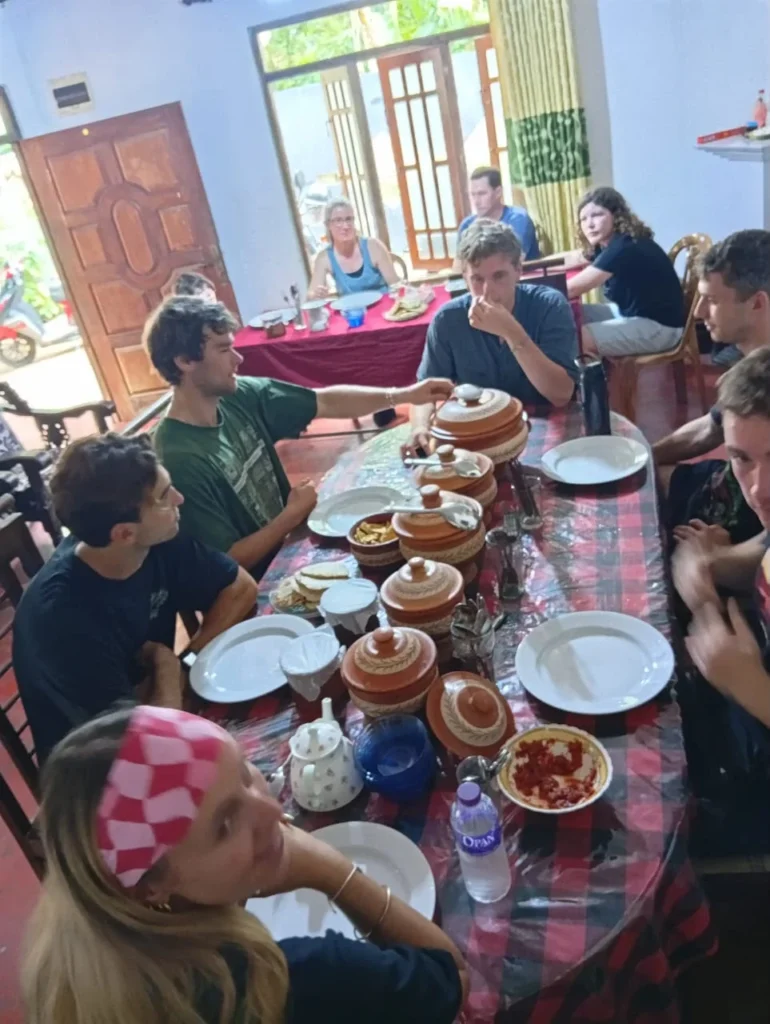
A private cooking class in Sri Lanka means only your party cooks. A shared class puts you with other travellers, up to the school’s limit. On the pages we read on 3 October 2026, Ceylon Cooking Class in Hikkaduwa describes a private class for one guest or more (Ceylon Cooking Class). Traveling Spoon says every experience on its platform is private, and that its hosts can often change the timing for that reason (Traveling Spoon). Shared classes gave limits of 8 at Rustic Colombo Cooking Class (Rustic Colombo Cooking Class) and 12 at Ella Spice Garden (Ella Spice Garden). For a shared class, ask how many guests are booked on your date. Reviews on the GetYourGuide listing for our own class in Weligama, read the same day, describe a shared class. One mentions a group of 10, where it “wasn’t always possible to be involved”. Ask us about group size, and whether a private session is possible, before you book.
A private cooking class isn’t a private chef: in a class, you cook alongside a host. If you searched for a private chef in Sri Lanka, you want someone to cook where you’re staying, and that’s a question for your villa or hotel. For what private and shared classes charge, see our guide to cooking class prices.
Vegetarian and vegan cooking classes
Some cooking schools in Sri Lanka advertise vegan cooking, but check the seasoning whichever class you choose. On 3 October 2026, Ella Spice Garden’s website described its recipes as vegan family recipes (Ella Spice Garden), and Rustic Colombo Cooking Class listed a separate vegan class (Rustic Colombo Cooking Class).
Love Sri Lanka says local food caters to meat-eaters, pescatarians and vegetarians (Love Sri Lanka). Wikipedia describes rice and curry as rice with one curry of fish or meat and others of vegetables, lentils or fruit (Wikipedia). But a vegetable dish isn’t always vegetarian. Maldive fish is cured tuna (Wikipedia). Wikipedia’s article on the cuisine says it’s heavily used in vegetable dishes for its savoury taste, and lists it among the ingredients of coconut sambol (Wikipedia).
Ask the host:
- Can you leave Maldive fish out of every dish, the sambol and the mallung included? Wikipedia’s ingredients for mallung include it in powdered form (Wikipedia).
- Do you cook with coconut oil or with ghee? Cow and buffalo ghee are both on Wikipedia’s list of the cuisine’s oils (Wikipedia).
- What’s for dessert? Wikipedia calls buffalo curd a simple home dessert (Wikipedia). It’s a yogurt made from buffalo milk (Wikipedia), and watalappam is made with eggs (Wikipedia).
For our own class in Weligama, the GetYourGuide listing we read that day doesn’t say whether vegetarian or vegan versions are offered, so ask us before you book.
Halal cooking classes
For halal cooking classes in Sri Lanka, expect to rely on the host’s answers. None of the eight operator pages we read on 3 October 2026 showed a halal certificate, and only one mentioned halal. That was a Traveling Spoon listing for a Sri Lankan Muslim cooking class in a home in Wattala, which says halal meals are available on request (Traveling Spoon). The 2024 census counted Muslims as 10.7% of Sri Lanka’s people (Department of Census and Statistics). The Halal Assessment Council (HAC) calls itself the only entity certifying and auditing halal standards in Sri Lanka (HAC). Its general scheme lists four sectors: products, poultry abattoirs, food premises such as restaurants, hotels and caterers, and imported finished goods (HAC). The scheme page doesn’t mention private homes or cooking classes, so ask:
- Where does the meat come from? HAC’s consumer directory has a chicken category, so ask for the brand (HAC).
- Is pork ever cooked in the same pots? It’s on Wikipedia’s list of the cuisine’s meats (Wikipedia).
- Is the hopper batter fermented with yeast or with palm toddy? Wikipedia names both, and calls toddy mildly alcoholic (Wikipedia).
HAC’s own list of what isn’t halal includes pig products, alcoholic beverages, blood and improperly slaughtered animals (HAC).
Our own Weligama class is listed on GetYourGuide. That listing, read the same day, doesn’t mention halal either, so ask us before you book.
Cooking classes for couples
For a couple taking a cooking class in Sri Lanka, the main choice is private or shared. Sajee’s Place in Sigiriya gears its class to groups of two or more (Sajee’s Place). Ceylon Cooking Class in Hikkaduwa runs privately from a single guest (Ceylon Cooking Class). At Ella Spice Garden, a couple could share the class with up to ten other guests (Ella Spice Garden). A hotel session may be shared as well: Teardrop Hotels takes up to six guests (Teardrop Hotels). Those are the sites’ own statements, read on 3 October 2026. Going by the reviews on its GetYourGuide listing, read the same day, our own class in Weligama is shared, so ask us whether a private session is possible. We’d pick a private couples cooking class if you both want to cook every dish. A shared one suits you better if you’d like company at the table. Either way, ask whether you’ll each have a pot or take turns at one.
Pick the session by the meal it ends with. Ella Spice Garden’s morning class finishes with lunch and its 4.30pm class with dinner (Ella Spice Garden). Rustic Colombo Cooking Class starts at 9.30am or 3.30pm (Rustic Colombo Cooking Class).
Cooking classes with children
Children can join some cooking classes in Sri Lanka, but confirm it before you book and ask about open fires. On 3 October 2026 Traveling Spoon said most of its experiences are family friendly, and that a host who can’t take children says so in the notes. Ages 5 to 11 pay half and under-fives go free (Traveling Spoon). Our own class in Weligama is booked through GetYourGuide. Its listing, read the same day, says the class is not suitable for babies under 1 or people over 70. One review there is from a family with children aged 10 and 12, in a group of 10. The listing shows no child price, so ask us.
The World Health Organization says children are usually burned in domestic kitchens, by upset pots of hot liquid or by flames (WHO). In a family-friendly cookery class with kids, we’d do four things:
- Keep small children back from the hearth and hot oil, with one adult free to watch them.
- Give children cold jobs, such as washing vegetables.
- Leave the knives and the chillies to adults. Capsaicin, which makes chilli hot, causes a burning feeling on skin and in eyes (Wikipedia).
- Ask for the children’s dishes without chilli.
If someone is burned, the NHS says to “hold the burn or scald under cool running water for 20 minutes” (NHS).
Where to take a cooking class in Sri Lanka
The operator pages we read were in or near Sigiriya, Ella, Colombo, Negombo, Hikkaduwa and Wattala, with hotel classes elsewhere. Local specialities differ from place to place. On Love Sri Lanka’s list, Galle’s are fish ambul thiyal and curries of crab and prawn. Ella’s are dhal, pol sambol and gotu kola mallum, and Kandy’s include chicken curry and coconut roti (Love Sri Lanka).
We run our own class in a family home in Weligama, where we’re based, and the Weligama class page has the details. Its GetYourGuide listing, read on 3 October 2026, gave four hours with an English-speaking instructor, and counted ingredients and lunch as included. Transport to the house wasn’t included. The rating on the listing that day was 5.0 out of 5, across 43 reviews. One reviewer got a bit lost finding the house, so allow time for that.
We’ve also written pages on cooking classes in Galle and on cooking classes in Ella and the hill country. A class can also be one stop on a longer private tour with a driver-guide. For the dishes themselves, start with our Sri Lanka food guide.
What a cooking class costs
We found prices on five pages on 3 October 2026, all per person. GetYourGuide priced our own class from USD 14 per person. Ceylon Cooking Class in Hikkaduwa showed $15 (Ceylon Cooking Class) and Ella Spice Garden $30 (Ella Spice Garden), with no currency named. The Traveling Spoon listing in Wattala showed USD 50 to 78 for its class with a meal, depending on the size of the party (Traveling Spoon). Cookly’s Sri Lanka page showed three classes at GBP 42 to 144 (Cookly). That’s seven listings, ours among them, and too few to call a market rate. Our cooking class cost guide compares a wider set of listings and goes through what a price includes.
Booking, paying and cancelling
Terms differ, so read them before you commit. Ella Spice Garden asks guests to send a WhatsApp message to confirm a place. It takes payment in cash on arrival and wants at least two hours’ notice if you can’t come (Ella Spice Garden). Traveling Spoon doesn’t charge your card until the host accepts the booking, and says hosts typically reply within 72 hours. It refunds a cancellation made 48 hours or more ahead, less a 4% fee (Traveling Spoon). For our class, GetYourGuide offered free cancellation up to 24 hours ahead. We read all three sets of terms on 3 October 2026.
A booking platform may keep part of the price. Traveling Spoon says its hosts set their own prices and receive, on average, over 70% of what the traveller pays (Traveling Spoon).
We’d book a few days ahead if you’ve asked for a special menu. Carry small notes if you’re paying cash. Rustic Colombo Cooking Class says it takes cash only, in US dollars or rupees (Rustic Colombo Cooking Class). Sri Lanka Tourism’s travel tips say change is scarce except at hotels and big shops (Sri Lanka Tourism).
Questions about cooking classes in Sri Lanka
Which is the best cooking class in Sri Lanka?
We don’t rank classes, because we’ve read their pages rather than taken them. The best cooking class in Sri Lanka for you is the one whose answers fit your trip. Check four things: whether it’s hands-on or watched, the group size, your diet, and how far it is from where you’re staying.
How long does a cooking class in Sri Lanka take?
Five of the eight pages we read on 3 October 2026 gave a length in hours, from 1.5 to 5. Sajee’s Place said about three hours and Ella Spice Garden up to three (Sajee’s Place; Ella Spice Garden). Rustic Colombo Cooking Class, which includes a market tour, said five (Rustic Colombo Cooking Class). The listing for our class said four.
Is a market visit included?
Sometimes. Rustic Colombo Cooking Class builds one into every session (Rustic Colombo Cooking Class). Negombo Cooking Class says it arranges private market tours (Negombo Cooking Class). Anantara’s resort at Tangalle starts its class with a tuk-tuk trip to a local market (Anantara). We read all three on 3 October 2026. The listing for our class doesn’t mention a market visit. Elsewhere, ask whether one costs extra.
Can I take a class if I have a food allergy?
Tell the host when you book. Name coconut if that’s your allergy, because coconut milk and grated coconut are everywhere in this cuisine (Wikipedia). Watalappam contains cashew nuts and eggs (Wikipedia). On Traveling Spoon, the booking form sends allergies and dietary restrictions straight to the host (Traveling Spoon). The GetYourGuide listing for our own class doesn’t mention allergies, so ask us.
Is the food you cook very spicy?
It can be. Love Sri Lanka calls chillies “the main hero of Sri Lankan cooking” (Love Sri Lanka). Say what you can manage before the pot goes on, and ask to add the chilli yourself.
Book or ask about our Weligama cooking class
Our office is in Weligama, and so is our class. Read what the Weligama cooking class involves, then book it on GetYourGuide. The listing doesn’t say whether the class can cater for vegetarian, vegan, halal or allergy needs, so send us a message before you book if you have one. Ask there too about group size, private sessions and how to reach the house.
We read each operator page, price and source linked here on 3 October 2026. Menus, prices and group limits change, so confirm them with the host before you book.