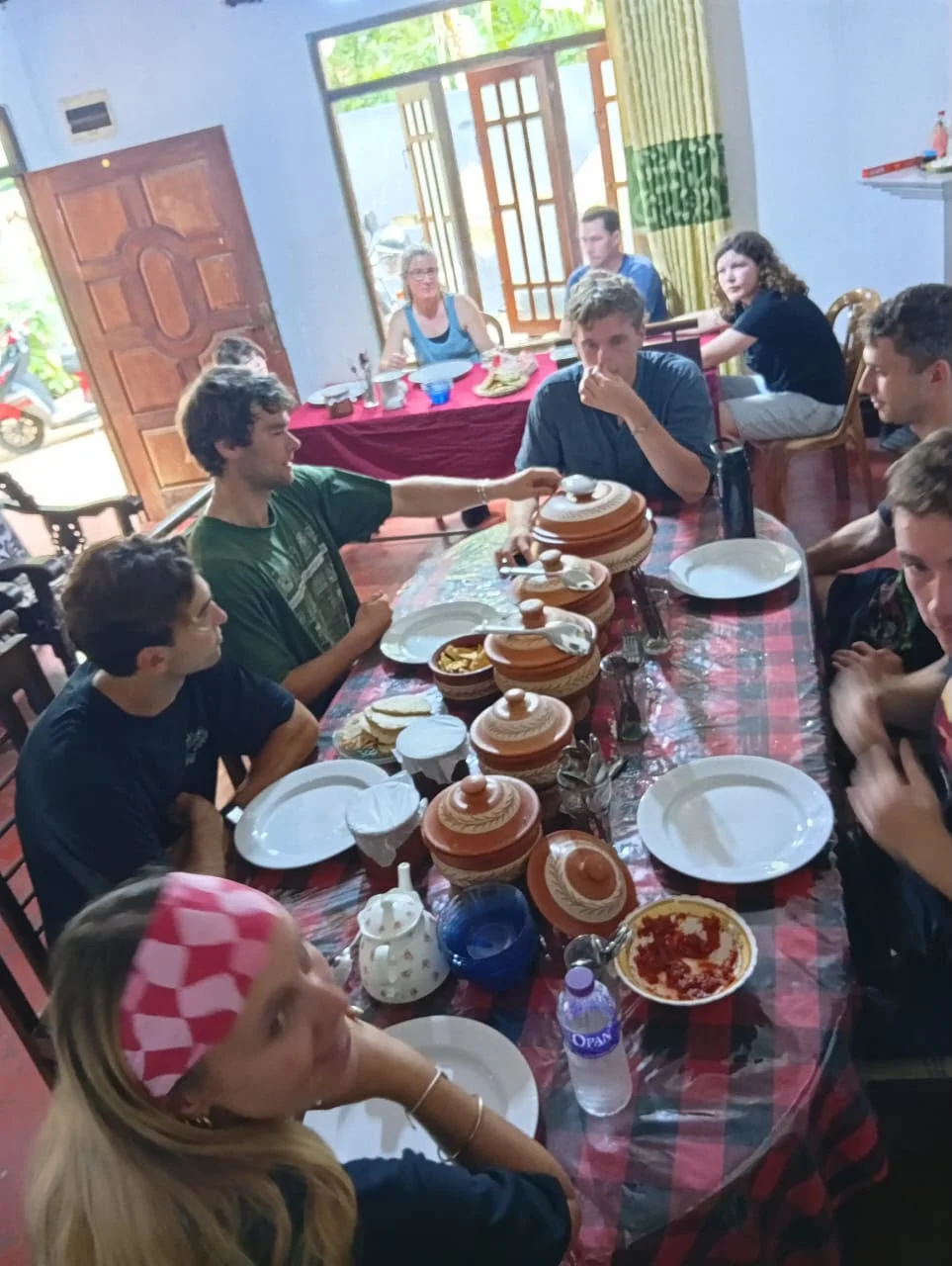
Cooking classes in Galle take place inside the fort, in Unawatuna and in home kitchens where the host collects you, going by the seven class pages we read on 3 October 2026. Two put the kitchen inside Galle Fort (Lucky Fort Restaurant; Traveling Spoon). Two are in Unawatuna, about 7 km from the fort’s main gate and usually a 15 to 20 minute drive (OpenStreetMap). Three are home kitchens, reached by a pickup from a hotel, a railway station or a bus station, and two of those pages don’t say where the house is.
Key takeaways
- A Galle Fort cooking class does exist: two of the seven pages we read place the kitchen inside the walls.
- Two more classes are on Yaddehimulla Road in Unawatuna, about 7 km from the fort’s main gate.
- A village class means a pickup or a drive. One meets at Baddegama bus station, 19 km from the fort’s main gate.
- No page we read sells a seafood-only class. Four list one fish or seafood curry, and two shop at a fish market in Galle before cooking.
- Six of the seven classes had a price on a page we could save. The seventh, Lucky Fort, quotes on request.
Where cooking classes around Galle take place
A listing headed “Galle” can mean a kitchen in the fort, a restaurant in Unawatuna or a house in a village the page never names. On 3 October 2026, byFood’s Galle category showed 14 classes under that label, among them classes in Mirissa, Weligama and Bentota (byFood).
Each row gives a class’s location in its own words, its OpenStreetMap distance from the fort’s main gate, and the length and price its page showed that day. Viator, Tripadvisor and GetYourGuide blocked our page requests, so classes listed only there are missing. Nothing in the order is a ranking.
| Class and source | Where its page says it happens, and how far from the fort’s main gate | Market visit | Length, group size and price shown on 3 October 2026 |
|---|---|---|---|
| Lucky Fort Restaurant, its own website | “Mama Lucky’s home”, 7 Parawa Street, inside Galle Fort; a semi-outdoor courtyard kitchen. About 500 m on foot | None mentioned | About 3 to 4 hours with the meal, by appointment; small groups, no number given; price on request |
| Kodi and Meena, Traveling Spoon listing | A Dutch-built house inside the fort, less than 10 minutes’ walk from the main entrance. A byFood listing of the same class gives Chando Street | “The local fish market”, then the Green Market, about an hour by car with the host | 9am to 1pm; private, one to five guests; USD 59 to 69 a person plus a 4% fee |
| Nautilus Cooking Class, its own website and a byFood listing | 138 Yaddehimulla Road, Unawatuna; a balcony with a sea view. The road is about 7 km away, usually 15 to 20 minutes | “Green market, fish market” in Galle, then a tuk-tuk back | 3 hours, up to 10 guests, EUR 37.77 on its byFood listing page |
| Cook with Wasantha, byFood listing | Wasantha’s Sri Lanka Cuisine, Yaddehimulla Road, on the way to Jungle Beach. About 7 km, usually 15 to 20 minutes | “Local markets”, not named | 4 hours, up to 10 guests, EUR 42.51 on its listing page |
| Galle Village private class, byFood listing | The hosts’ home, village not named; pickup from your hotel or from opposite Galle railway station, about 850 m from the gate on foot | Not in the itinerary | 3 hours 30 minutes, up to 15 guests, EUR 33.03 on its listing page |
| Cooking and cultural experience, byFood listing | A family home in a village; you meet at Baddegama bus station, 19 km away, usually 30 to 45 minutes | None mentioned; ingredients come from the family’s garden | 3 hours, up to 10 guests; 2pm on weekdays, 11am at weekends; EUR 37.67 on its listing page |
| Cooking class and cookery demonstrations, airKitchen listing | A clay-walled kitchen in the old village style; exact location sent after booking; free pickup from Galle station, about 850 m from the gate on foot | Tagged “market visiting” | 3 hours, up to 30 guests, $45 a person; the page names no currency |
Inside Galle Fort
You can take a Galle Fort cooking class without leaving the walls. Lucky Fort Restaurant’s website puts its class in “Mama Lucky’s home” at 7 Parawa Street, in a semi-outdoor courtyard kitchen. Vegetarian and vegan menus are available on request (Lucky Fort Restaurant).
The Traveling Spoon listing for hosts Kodi and Meena describes a house the Dutch built 300 years ago, less than ten minutes’ walk from the main entrance. Their private class lasts two hours, after an hour at the markets, and the listing warns that the house has no air conditioning (Traveling Spoon).
A hotel may arrange one too. That day, the Cape Weligama resort’s website listed a “Galle Fort Cooking Class with Mama” at an art deco house in the fort, starting with a market visit, and gave no street or price (Cape Weligama).
Unawatuna
Unawatuna is a beach town that Wikivoyage says can be seen as a suburb of Galle. Yaddehimulla, the original village, sits along a road about a kilometre long off the highway from Galle to Matara (Wikivoyage).
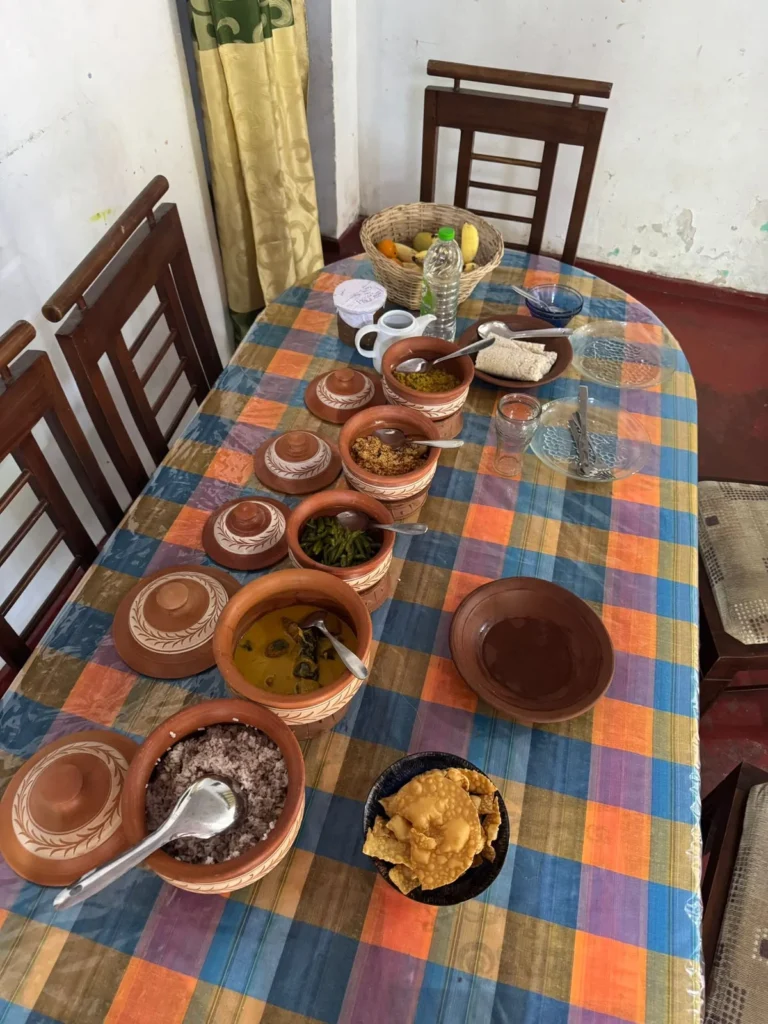
Nautilus Cooking Class, at 138 Yaddehimulla Road, lists eight dishes on its website: rice, dhal, three vegetable curries, coconut sambol, papadam and fish or chicken. You cook them on a balcony with a sea view after shopping in Galle (Nautilus Cooking Class).
Cook with Wasantha meets at Wasantha’s Sri Lanka Cuisine on the same road, on the way to Jungle Beach. The menu on its listing is four vegetable curries with tuna or chicken, after a visit to local markets (byFood). Jungle Beach is in our Unawatuna beach guide, if you’d like to add the beach to a class day.
Village homes
A village class is the hardest to place from a listing, because the kitchen is somebody’s home. The clearest is byFood’s “Authentic Sri Lankan Cooking & Cultural Experience”. You meet the hosts at Baddegama bus station and go on to a family house in a village, where guests cook with ingredients from the family’s spice and tea garden (byFood). From the fort’s main gate the bus station is 19 km, usually 30 to 45 minutes by road (OpenStreetMap).
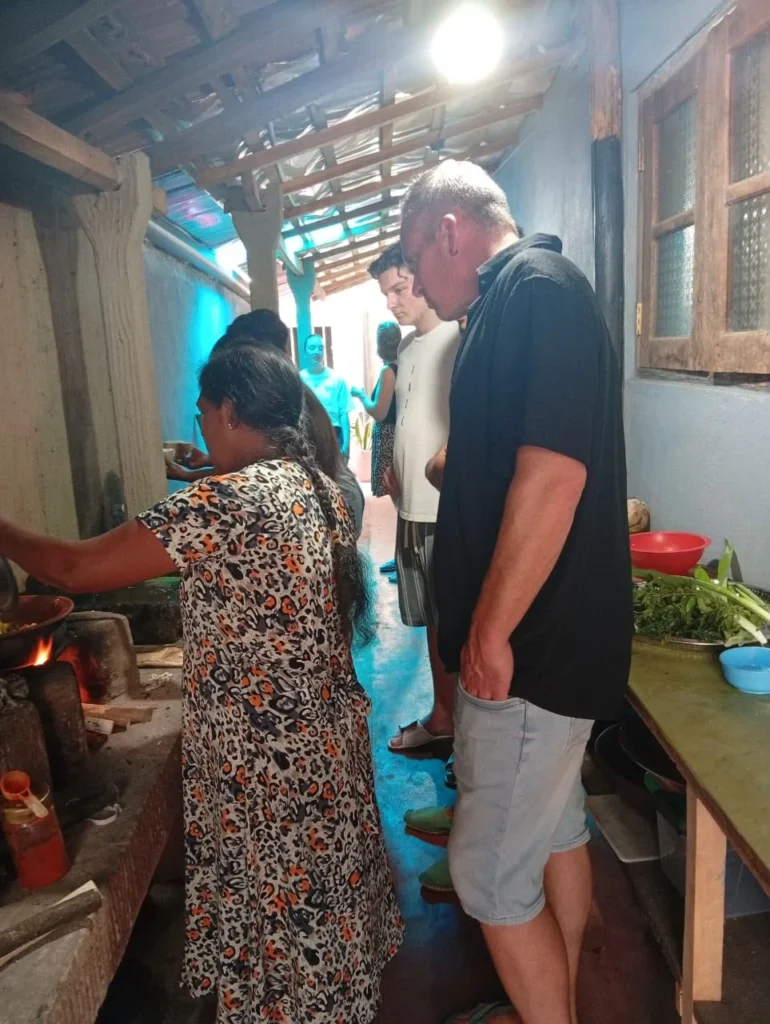
The other two describe a home kitchen and don’t say where it is. The Galle Village private class collects guests from their hotels, or from opposite Galle railway station. Guests choose the menu, chop the vegetables and grate the coconut, and the hosts offer vegan, vegetarian and non-vegetarian menus (byFood).
On airKitchen, a host describes a clay-walled kitchen of the kind village houses used to have, where rice and a meat curry cook over firewood. Pickup from Galle station is free, and the exact location arrives after you book (airKitchen). With either class, ask where the house is and how long the drive takes before you pay.
Seafood cooking classes in Galle and the fish market
We found no seafood-only cooking class among the seven Galle class pages we read on 3 October 2026. Four put one fish or seafood curry on a rice and curry menu, and two say the class shops at a fish market in Galle first. The table near the top of this page shows where each class is.
Love Sri Lanka sends visitors to Galle for fish ambul thiyal and for crab and prawn curries (Love Sri Lanka). Class menus are narrower. Kodi and Meena, who teach in a house inside Galle Fort, have one fish curry on their sample menu beside dhal and three or four vegetable curries (Traveling Spoon). In Unawatuna, Nautilus Cooking Class lists “fish or meat” (Nautilus Cooking Class) and Cook with Wasantha offers tuna or chicken (byFood). A class on airKitchen lists one seafood curry (airKitchen). No fish dish appears on the other three, and none of the seven mentions crab or prawns.
Galle’s fish market
The fish market building is on Fish Market Street, at the corner of Sea Street and Dickson Street, across the road from the ocean (Wikivoyage). That’s about 650 m from the fort’s main gate, roughly ten minutes on foot (OpenStreetMap).
Its predecessor, a British building of the 1890s with fourteen fish stalls, was destroyed by the 2004 tsunami. UN-Habitat helped to rebuild it with money from the chemical company BASF (UN-Habitat). Wikivoyage dates the opening to 2011. Its undated note adds that fish here typically costs 10 to 40% more than from fishermen on the beach, such as at an informal market five minutes’ walk to the north-east (Wikivoyage).
Two of the seven pages say the class shops at a fish market, and neither says whether that means this building or the market on the beach. Kodi drives guests to his regular vendor at “the local fish market” and then to the Green Market for vegetables, about an hour in all (Traveling Spoon). Nautilus names the “Green market” and “fish market” in Galle before a tuk-tuk ride back to Unawatuna (Nautilus Cooking Class). Ask the host which market you’ll visit. From the Fish Market Street building, the Green Market is about 250 m away (OpenStreetMap).
A January 2026 guest review on the Galle Village listing mentions the Dutch Market and the fish market, though the listing’s own itinerary doesn’t (byFood). We found no source for the market’s opening hours. The only start time we found for a market class is 9am, on Kodi and Meena’s listing (Traveling Spoon).
Ambul thiyal, the dish to ask for
Fish ambul thiyal is a sour, dry fish curry that comes from the south of the island. The cook cubes tuna or another firm fish and cooks it with spices and goraka, a small dried fruit that turns the dish sour. It then simmers until the liquid has reduced (CNN Travel).
Only one of the seven pages names it: Kodi and Meena’s listing says a meal at their house may include ambul thiyal (Traveling Spoon). If it’s the dish you came for, ask for it when you book. Our Sri Lanka food guide lists it among the dishes to try.
If you don’t eat fish, say so in advance, and ask about Maldive fish as well, which Sri Lankan cooks use heavily in vegetable dishes (Wikipedia).
What a Galle cooking class costs
These are the prices on the pages we saved on 3 October 2026, in the currency each page showed. On their own listing pages, the four byFood classes in our table ran from EUR 33.03 a guest (byFood) to EUR 42.51 (byFood). That day the Galle category page on byFood showed the same four in US dollars, from US$37.16 to US$47.83 (byFood), so expect the figure to follow the currency byFood shows you.
Kodi and Meena’s market tour, class and meal cost USD 69 for one guest and USD 59 each for two or more, before a 4% processing fee (Traveling Spoon). On byFood the same class was EUR 74.41 a guest, with a drink, taxes and gratuities in the price and hotel pickup left out (byFood).
The airKitchen class showed $45 a person, with a dollar sign and no currency named (airKitchen). Lucky Fort and Nautilus showed no price on their own websites (Lucky Fort Restaurant; Nautilus Cooking Class).
Seven pages aren’t a market rate, and platform prices change. What the money covers differs too: Cook with Wasantha’s listing includes private transport and lunch (byFood). Compare like with like using our cooking class cost guide.
Fitting a Galle culinary experience around the fort
A class is the longest part of a Galle culinary experience: it takes half a day, so the question is which half you give it.
With a morning class, the walls come last. Kodi and Meena’s market tour and class runs from 9am to 1pm (Traveling Spoon). That leaves the afternoon for the streets and the end of the day for the ramparts. Wikivoyage calls a sunset walk there very pleasant, if you don’t mind hawkers (Wikivoyage).
With an afternoon class, start on the walls. Wikivoyage suggests an early-morning circuit of the ramparts, which it says many locals walk (Wikivoyage). The Baddegama village class starts at 2pm on weekdays (byFood), so leave the fort soon after 1pm.
Walking round the fort is free, on Wikivoyage’s 2021 note (Wikivoyage), so the class is the only part to book. Still deciding between a home kitchen and a restaurant class? Our main Sri Lanka cooking class guide lists the questions to put to a host.
Our own class is in Weligama, not Galle
We don’t run a cooking class in Galle. Ours is in Weligama, and Weligama is 28 km from the fort’s main gate, usually 45 minutes to an hour by road (OpenStreetMap).
Our listing on GetYourGuide, read on 3 October 2026, gives the length as 4 hours and the price as from USD 14 per person. Lunch is part of that price, the meeting point is in Weligama, and reviews there describe a family’s home. Getting to the class isn’t included, so from Galle you’d add the drive both ways. Start times appear only once you pick a date. To book, use our Weligama cooking class page.
Questions about cooking classes in Galle
Can you do a cooking class inside Galle Fort?
Yes. Lucky Fort Restaurant’s website puts its class at 7 Parawa Street in the fort (Lucky Fort Restaurant). Kodi and Meena’s listing describes a Dutch-built house less than ten minutes’ walk from the main entrance (Traveling Spoon).
How far is Unawatuna from Galle Fort?
Yaddehimulla Road in Unawatuna is about 7 km from the fort’s main gate, usually a 15 to 20 minute drive (OpenStreetMap). Wikivoyage gives 15 minutes for the public bus from Galle’s main bus station (Wikivoyage).
Does a Galle cooking class include the fish market?
Some do. Of the seven pages we read, two say the class shops at a fish market in Galle: Kodi and Meena’s (Traveling Spoon) and Nautilus’s (Nautilus Cooking Class). Neither says which market, and Cook with Wasantha’s says only “local markets” (byFood). Ask before you book.
Is there a seafood cooking class in Galle?
Not as a class of its own on the seven pages we read. Four list one fish or seafood curry on a rice and curry menu, and only Kodi and Meena’s listing names ambul thiyal (Traveling Spoon).
How much is a cooking class in Galle?
On 3 October 2026 the four byFood classes in our table showed EUR 33.03 to EUR 42.51 a guest on their listing pages (byFood; byFood). Kodi and Meena’s fort class was USD 59 to 69 on Traveling Spoon (Traveling Spoon). Seven pages aren’t a market rate, so read these as examples.
Plan the day around your class
Oura’s team works out of Weligama, planning private trips that come with a driver-guide. A fish market in the morning, a kitchen in Unawatuna and the ramparts at sunset make three journeys, and a private car with a driver covers all of them. Tell us where you’re staying and which class you’ve booked, and we’ll plan the day around it.
We read every class page, the market notes from UN-Habitat and Wikivoyage, and the OpenStreetMap routes on 3 October 2026. Hosts change prices, times and menus without notice, so confirm with the class before you set out.