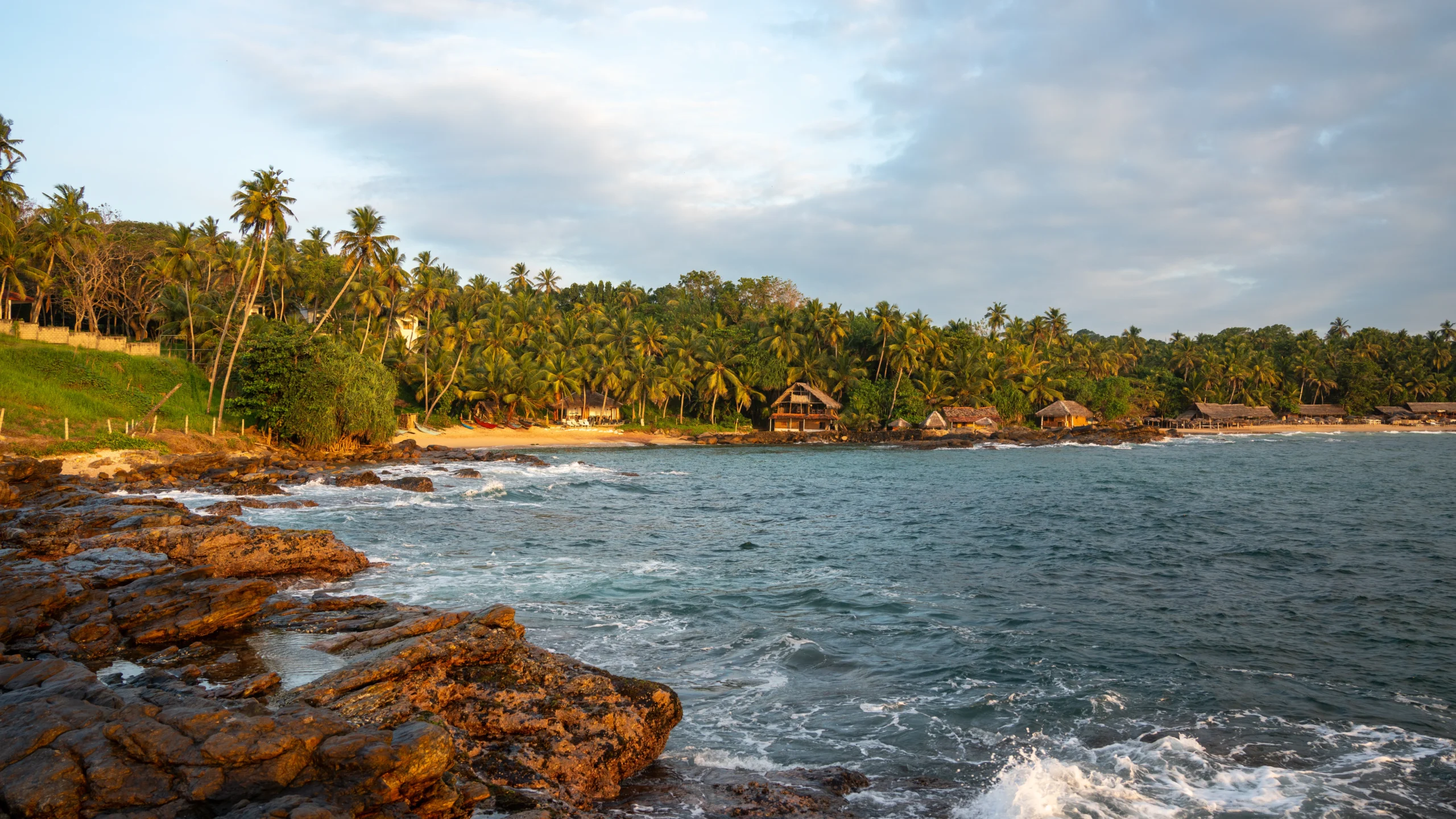
**Tangalle** is a quiet beach base on Sri Lanka’s south coast, about 3 to 3.5 hours by road from Colombo airport. For a winter trip from Europe, January to March give the best odds of dry days, but Rekawa’s turtle numbers peak from April to July, so decide which matters more.
The town is a fishing port on a large bay in Hambantota District (Wikipedia). This guide was written from sources, without a visit, and hours, tickets and timetables are as read on 31 October 2026.
Key takeaways
- January to March are the only months with under 100 mm of rain at both nearby long-record stations, Hambantota and Galle.
- Turtle Watch Rekawa runs every night from 8.30pm. Its page put a foreign adult’s ticket at LKR 2,000, and it expects 1 or 2 turtles a night from October to January.
- Its home page says not to ask locals, hotel staff or guides to show you baby turtles.
- Rough Guides warns of steep beaches and dangerous currents at Medaketiya, Medilla and Marakolliya. Tourists have died in the sea off both Medilla and Marakolliya.
- Since April 2019 trains have run past Matara to Beliatta, about 7 km from Tangalle.
Who Tangalle suits
Love Sri Lanka sells Tangalle on lazy days on the sand and trips into the lagoons, and leaves water sports to other towns (Love Sri Lanka). That fits readers who want a long beach, a night with the turtles and a temple climb. It suits you less if you want to swim every day. Our best beaches guide compares it with the rest of the island.
Best months for Tangalle
The WMO’s 1991 to 2020 rainfall normals have no Tangalle station. Hambantota lies up the coast to the east and Galle to the west, and rain falls very differently at the two: 1,042 mm a year against 2,348 mm. Tangalle’s own rain may fall anywhere between them, so read both columns (Hambantota normals; Galle normals). The turtle figures are the Turtle Watch’s own.
| Months | Hambantota, mm a month | Galle, mm a month | Turtles a night at Rekawa |
|---|---|---|---|
| Jan to Mar | 47 to 68 | 71 to 90 | 1 or 2 in Jan; Feb, Mar not stated |
| Apr, May | 73 to 92 | 202 to 316 | 5 to 15 |
| Jun to Aug | 31 to 59 | 162 to 184 | 5 to 15 in Jun, Jul; Aug not stated |
| Sep to Nov | 100 to 222 | 261 to 345 | 1 or 2 in Oct, Nov; Sep not stated |
| Dec | 132 | 176 | 1 or 2 |
Hambantota is at its driest in June and July, at 41 and 31 mm, while Galle gets 184 and 173 mm in those months. January to March are the only months when both stay under 100 mm, so they are the safer bet and not the only dry spell.
Days run near 31°C in January at Hambantota. For the southwest coast, Sri Lanka Tourism lists calm seas and peak season from December to February, with possible rough seas in the two months before (Sri Lanka Tourism). It does not name Tangalle, and a season summary is not a clearance to swim. See also our weather by month and monsoon guide.
Tangalle beaches, one by one
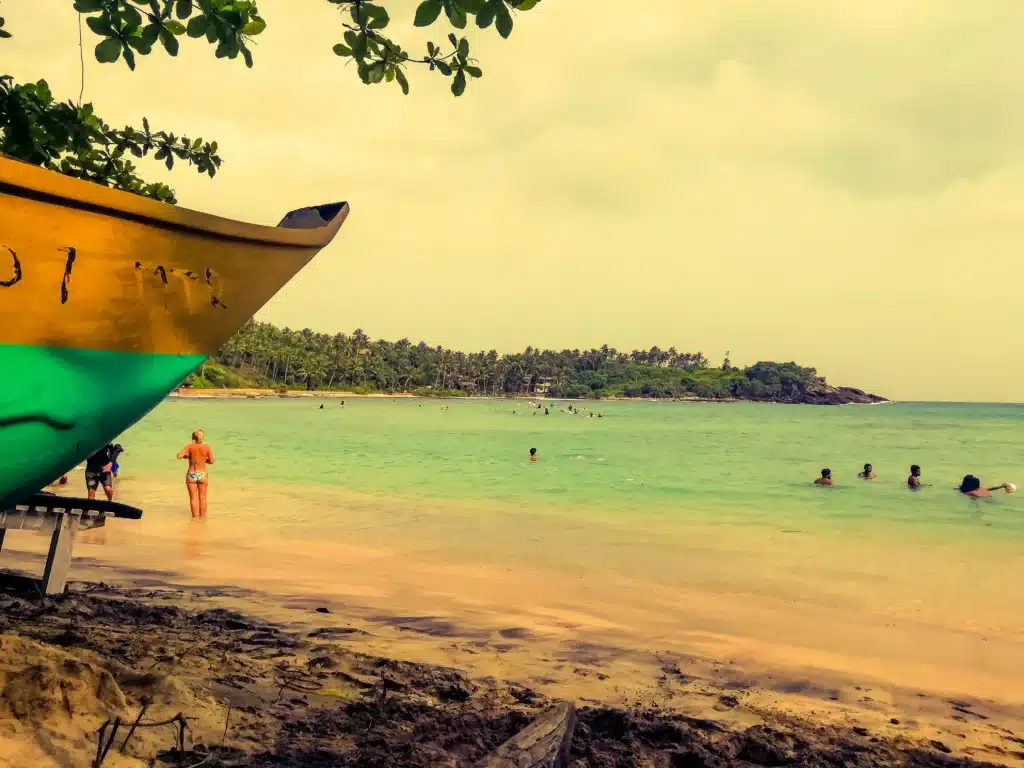
Road distances are from the town centre by our routing. Sea notes are reports, not our own tests, and Rough Guides says conditions vary even within a few hundred metres (Rough Guides).
| Beach | Where | What it is | Sea, as reported |
|---|---|---|---|
| Medaketiya, Medilla | 2 km north-east | Long, straight sand with guesthouses | Steep, with dangerous currents in places |
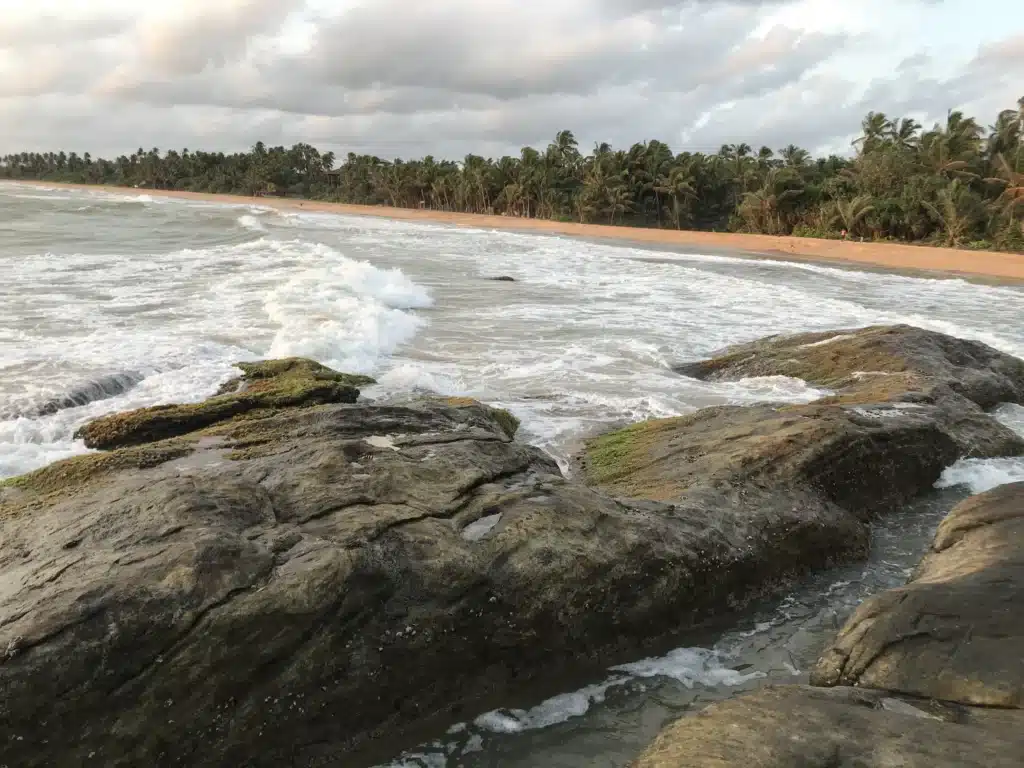
| Marakolliya | 6 km north-east | Sandspit backed by Rekawa lagoon | Steep, with dangerous currents in places |
| Goyambokka | 4 km west | Sand beside a rocky headland | Sources disagree: see below |
| Silent Beach | West of that headland | Also called Godellawela, shared with hotel guests | No report of its own found |
| Rekawa | 11 km east | Turtle nesting beach | No report found; go for the turtles |
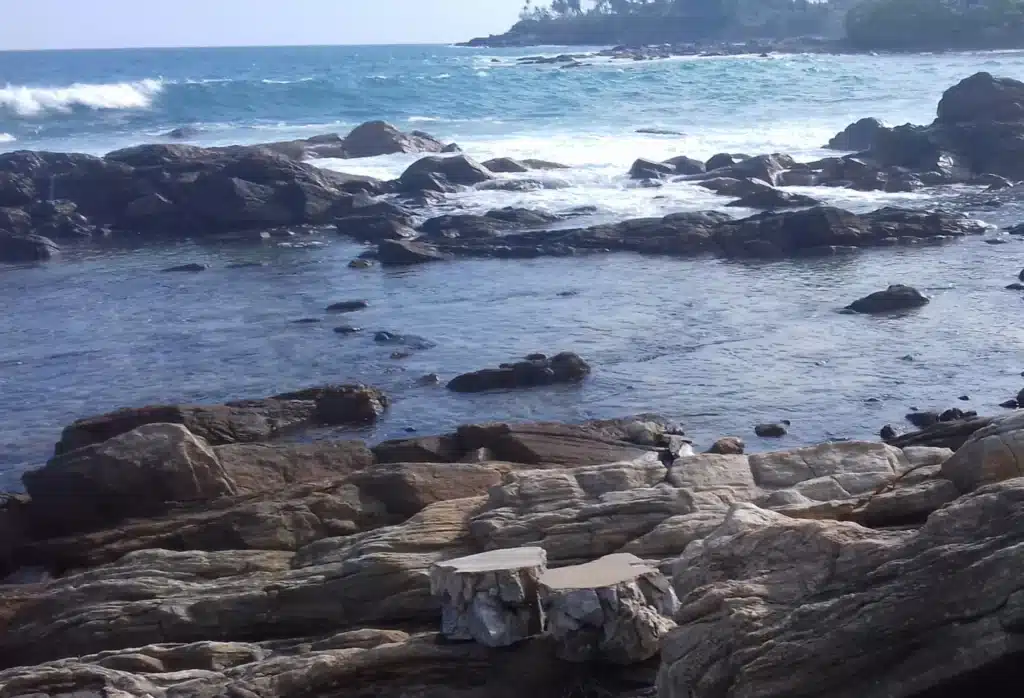
The advice on Goyambokka splits. Rough Guides, last updated in June 2024, calls the coves at Pallikaduwa and Goyambokka pleasantly sheltered. The undated page of Epic Sri Lanka Holidays, a tour seller, says the water at both is not safe for swimming. We found no dated report that settles it, so treat “sheltered” as a description and ask before going in.
Is it safe to swim in Tangalle?
We cannot call any beach here safe. The Foreign Office’s advice for Sri Lanka was marked still current on 31 October 2026 and last updated on 21 September (GOV.UK). Under “Swimming safety” it says: “Many beaches in Sri Lanka have dangerous surf or rip tides at certain times of the year. Get advice from your hotel or tour operator before going in the sea.” Its only other line links to water safety advice (UK Foreign Office).
Sri Lankan reports show what that means here:
- On 10 November 2017 a German man drowned off Medilla while bathing with his wife (Ada Derana).
- On 24 December 2017 a German woman died off Marakolliya. Police said she went in despite warnings from the coastguard and beach patrol (Ada Derana).
- In August 2019 police lifeguards pulled a British mother and son from rips and strong waves off Medilla (Daily Mirror).
- On 24 September 2023 a Polish woman died after strong waves reportedly swept her and her boyfriend away at Mango Beach in Tangalle, in what the report calls a dangerous area (Ada Derana). We could not place that beach on a map.
- On 9 July 2026 a wave swept a 19-year-old local man into the sea while he was rod fishing at Mawella (Hiru News). The report places Mawella in Tangalle, but it is about 9 km west of town, near Hummanaya, and not one of the beaches above. Stay back from the edge too.
We found no such report for Goyambokka, Silent Beach or Rekawa. That is not evidence that they are safer.
The police announced 71 lifeguard units across the island in February 2026 (Ada Derana), but no list we could find shows posts or hours for Tangalle, so do not count on one. Beyond Wild Places, a blog last modified in July 2026, reports a few protected spots guarded in the dry season, one of them on Medaketiya. It also warns that waves can be deceivingly strong all year (Beyond Wild Places). We could not confirm the guarded spots from any official source. Ask at your hotel each day.
Rekawa turtle watch
Rekawa is a nesting beach, and the Turtle Conservation Project started its community nest protection there in 1996 (Turtle Watch Rekawa). The project marked 30 years on 2 September 2026 (News 1st). Sri Lanka’s country update to a regional turtle meeting in March 2023 counted 2,040 green turtle arrivals at Rekawa Sanctuary in 2022, down from 2,728 in 2020 (CMS).
What the Turtle Watch’s own visitor page said when we checked:
- The watch starts at 8.30pm every night of the year, and you need not book for now. Be there by 9pm.
- Foreign visitors paid LKR 2,000 an adult and LKR 1,000 a child. Love Sri Lanka still says there is no entrance fee, so expect the ticket.
- You wait at the visitor centre until a protector finds a turtle. Expect about an hour more before you see her, and a nesting can take two hours or longer.
- Groups watch one turtle while she lays, or as she returns to the sea, from behind.
- In the low season the guide usually ends the watch at 11.30pm if no turtle has come.
- Flash and white or yellow lights are banned. Only red light is used near turtles.
- It asks women especially to cover shoulders and knees. Your feet may get wet at high tide.
Turtle watching in winter, and baby turtles
A trip from November to January falls in the low season, so a blank evening is possible. Love Sri Lanka’s page gives April to July as the best season, but a tip on the same page says full moon nights from January to April are best (Love Sri Lanka).
Several travel pages call this “turtle hatching”, but what you pay to see is a nesting adult. The Turtle Watch’s home page warns: “Releasing newly hatched baby turtles prematurely into the sea can be deadly.” It says that asking locals, hotel staff or guides to show you hatchlings has become a tipping business, so please do not ask.
A hatchery is a different thing, with eggs moved and hatchlings kept in tanks. Our Bentota guide sets out the research on those.
Mulkirigala, Hummanaya and the lagoon
Mulkirigala rock temple
This cave temple complex sits on a natural rock 205 m high, and locals call it Little Sigiriya (Wikipedia). It is 18 km inland by our routing. A Sunday Times writer in 2003 got a figure of 533 steps from a temple aide (Sunday Times).
Dates vary by source. Wikipedia’s temple page cites the Mahavamsa for a founding by King Saddhatissa in “the third century”, with no era given, while the Sunday Observer says second century BC (Sunday Observer). Murals and sculptures are Kandyan era, says Love Sri Lanka. It advises going early or in the evening. Shoulders and knees must be covered, and shoes stay at the door (Love Sri Lanka). Holidify, undated, lists LKR 500 and 6am to 6pm (Holidify). We found no official figure.
Hummanaya blowhole and Tangalle Lagoon
Hummanaya, at Kudawella, is 13 km west by our routing. Sea water forced through a submerged cavern shoots up every couple of minutes, often to 25 to 30 m (Wikipedia). Love Sri Lanka ties that height to April to September, so expect less in a European winter. It suggests mornings and describes a 20 minute walk through a village (Love Sri Lanka). “Second largest in the world” is repeated widely, but we found no measurement behind it.
Love Sri Lanka also lists kayaking on Tangalle Lagoon, early or late in the day, among birds and crocodiles, and tells you to stay in the boat (Love Sri Lanka).
Where to stay in Tangalle, by area
We give areas, not hotels. The third column is from Rough Guides and the Turtle Watch. The last is our own reading of those.
| Area | Position | Reported character | Our read |
|---|---|---|---|
| Medaketiya, Medilla | North-east of town | Most developed, guesthouses along the sand | Most choice near town |
| Marakolliya | North-east, beyond Medilla | Sandspit with mangrove lagoon behind | Quiet, long walks |
| Pallikaduwa | Just west of town | Rocky coves, little sand, rooms behind the road | Scenery over sand |
| Goyambokka | A couple of km further west | Headland and two beaches | Scenery and sand together |
| Rekawa | About 11 km east | Rural village with little tourism | Turtle nights |
If the turtles are the point, a room near Rekawa saves the late drive back. Otherwise, Medaketiya has the most around it.
Tangalle or Mirissa?
Mirissa is 52 km west, 52 minutes on empty roads, and 35 km closer to the airport. Pick Mirissa for whale boats and a shorter transfer, and Tangalle for its long sand and Rekawa. Weligama or Mirissa compares those two. Hiriketiya, the nearby surf bay, is about half an hour away by Love Sri Lanka’s estimate.
Getting to Tangalle by road and rail
**Road.** From Colombo airport our routing gives 211 km and 2 hours 47 on empty roads, so allow 3 to 3.5 hours (route). The Southern Expressway reached Hambantota on 23 February 2020 and has an interchange at Beliatta (Wikipedia), about 17 km from town. Our airport taxi guide covers fares. Beyond Wild Places reports expressway buses from Pettah in Colombo taking about 4 hours.
**Train.** The Matara to Beliatta line opened on 8 April 2019 (Sunday Times), so ignore guides that end the railway at Matara. Tangalle has no station. Beliatta is about 7 km away (Wikipedia). The unofficial timetable site trainschedule.lk had four Colombo Fort departures for Saturday 31 October 2026, the first at 6.20am and the last at 2.40pm. They took 3 hours 46 to 5 hours 7, at Rs 650 second class and Rs 340 third (trainschedule.lk). Plan a tuk tuk or taxi for the last leg, and confirm times at the station.
**Status.** BYC.lk, an unofficial travel site, has a rail page headed “checked 28 October 2026”. It lists Maradana to Beliatta as running normally (BYC.lk). The same list also shows a Main Line section as open that the page’s own notice calls closed, so that date may not cover this line. Sri Lanka Railways’ timetable site failed with an expired certificate on 31 October, so we have no official status. We found no news of disruption on this line in October 2026.
When Cyclone Ditwah hit at the end of November 2025, the Daily FT described Matara and Hambantota as comparatively less affected (Daily FT). We found no report of lasting damage at Tangalle. GOV.UK’s September update warns of flooding and landslides in inter-monsoon rain. Entry rules changed in May 2026: see our visa guide.
Questions about Tangalle
How many days do you need in Tangalle?
We suggest three nights: one day for the beach, one for Mulkirigala and Hummanaya, and an evening at Rekawa with a slow morning after it. That is our own estimate.
Is Tangalle worth visiting?
Yes, if you want long, quiet sand and the Turtle Watch’s better odds between April and July. In a European winter you get good odds of dry days but fewer turtles, and swimming is the weak point.
Can you see turtles at Rekawa in December?
You can try, as the watch runs nightly, but the Turtle Watch expects only 1 or 2 turtles a night then and nothing is promised.
Does Tangalle have a train station?
No. The line ends at Beliatta, about 7 km away on Wikipedia’s figure, and trains from Colombo Fort run there.
Add Tangalle to your route
Oura Travel is based in Weligama, about 50 km west of Tangalle, and plans private trips by road. Send your dates through our contact page if you would like help fitting it in.
Top photo: Satdeep Gill, CC BY 4.0, via Wikimedia Commons.