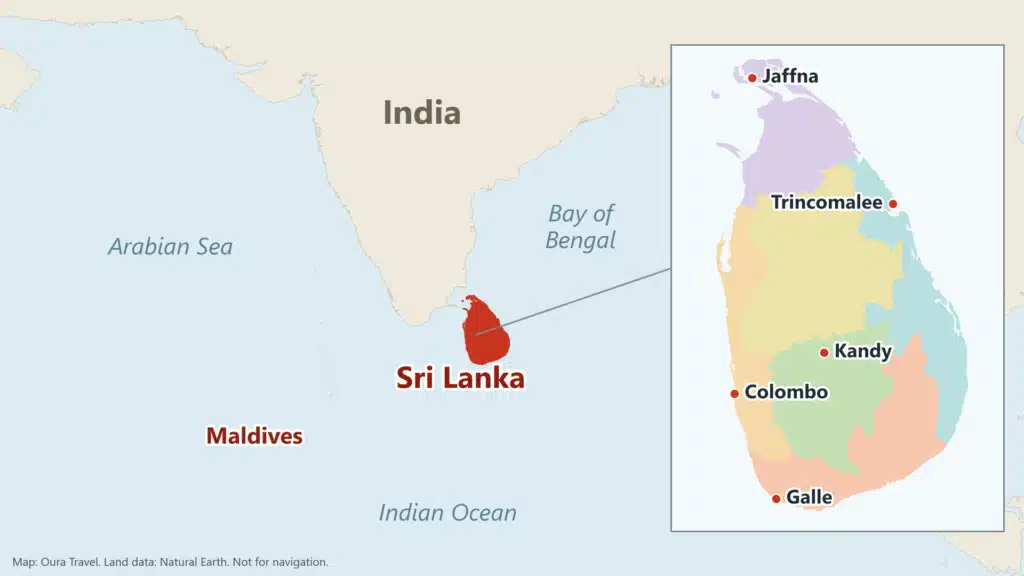

The Sri Lanka monsoon season comes in two parts, each soaking a different side of the island. The Department of Meteorology’s year opens with the first inter-monsoon in March and April. The south-west monsoon follows from May to September, then the second inter-monsoon in October and November. December to February is the north-east monsoon (Department of Meteorology). The south-west monsoon rains hardest on the south-western low country and the hills’ western side; the north-east monsoon mostly wets the east and north (Department of Meteorology). From October to December 2026, the Department expects above-normal rain over most of the island (Department of Meteorology).
Key takeaways
- On the Department of Meteorology’s calendar the north-east monsoon starts in December, not October.
- From May to September the south-west coast and the hills take the rain while the east coast stays fairly dry. From December to February the rain moves mainly to the north and east.
- October and November bring more rain per month than either monsoon at 19 of the 20 Sri Lankan weather stations in the 1991 to 2020 averages.
- In 2026 the south-west monsoon was declared fully established on 27 May, after red landslide warnings in Kegalle and Ratnapura. By September, drought had closed parts of Yala.
- The Department’s outlook, issued on 2 October 2026, expects above-normal rain from October to December and gives a better than 90% chance of a very strong El Niño.
Sri Lanka’s monsoon seasons at a glance
The table puts the Department’s four seasons beside the World Meteorological Organization’s 1991 to 2020 station averages. For each season it names the two stations with the most rain in total, and the two with the least (WMO climate normals). The seasons last two, five, two and three months, so compare stations along a row rather than down a column.
| Season | When | Wettest | Driest |
|---|---|---|---|
| First inter-monsoon | Mar, Apr | Ratnapura, Kurunegala | Trincomalee, Jaffna |
| South-west monsoon | May to Sep | Ratnapura, Galle | Mannar, Pottuvil |
| Second inter-monsoon | Oct, Nov | Ratnapura, Ratmalana | Hambantota, Mannar |
| North-east monsoon | Dec to Feb | Batticaloa, Pottuvil | Puttalam, Katunayake |
For the same normals month by month, see our Sri Lanka weather by month guide.
May to September: the south-west monsoon
A paper in the Department’s journal calls this the most prominent season for rain. Its rain falls hardest on the south-western low country and on the hills’ western side (Department of Meteorology). It normally sets in over the island at the end of May or early in June; in 2023 that happened on 2 June (Department of Meteorology).
Galle, on the south coast, gets 1,095 mm in these five months, 47% of its year, with rain on about 80 days. Nuwara Eliya, high in the hills, gets 789 mm on about 73 days. East of the hills, Trincomalee gets 328 mm, and Pottuvil, the bus town for Arugam Bay, only 150 mm on about 15 days. In the Cultural Triangle, Anuradhapura’s five monsoon months together bring about 242 mm, no more than it gets in March and April alone (WMO climate normals; Wikivoyage).
For these months, Sri Lanka Tourism points visitors to the dry zone, naming Jaffna, Trincomalee and Arugam Bay (Sri Lanka Tourism). Our Arugam Bay guide covers the bay and its surf season, and Sri Lanka in June follows one month of the season.
October and November: the second inter-monsoon
Between the two monsoons, the intertropical convergence zone moves back south across the island. The Department says convective rain is common in both inter-monsoons. Bay of Bengal depressions, mostly in this second one, can set off bursts of heavy rain in a short period (Department of Meteorology).
Measured by the month, this is the wettest time of year almost everywhere. We divided each season’s average rain by its months at all 20 stations the WMO lists for Sri Lanka. October and November came out highest at 19; only Pottuvil gets more per month from December to February. Colombo averages more rain in October, and again in November, than in any month of the south-west monsoon. Jaffna gets 49% of its year in these two months (WMO climate normals).
Sri Lanka Tourism sums up the season as “Occasional heavy showers across the island” (Sri Lanka Tourism). Our Sri Lanka in November guide gives station figures and a route planned around the rain.
December to February: the north-east monsoon
December, January and February make up the Department’s north-east monsoon, which brings its rain mainly to the island’s north and east (Department of Meteorology). Some travel guides start it in October or November. On the Department’s calendar those two months belong to the second inter-monsoon (Department of Meteorology).
On the east coast, Batticaloa averages 886 mm over the three months, 48% of its yearly total, and Pottuvil 706 mm. Trincomalee gets 588 mm. On the south-west coast, Galle and Colombo average 334 mm and 328 mm, about 14% of their year each. At both, more than half of it falls in December (WMO climate normals).
Sri Lanka Tourism lists these months as peak tourist season along the south-west coast (Sri Lanka Tourism). The Weligama beach guide has a weather table for our home bay. Sri Lanka in December covers the first month.
March and April: the first inter-monsoon
In March and April the convergence zone moves north again, and the Department groups these months as the first inter-monsoon (Department of Meteorology). Sri Lanka Tourism describes a transitional period with afternoon thunderstorms (Sri Lanka Tourism).
Trincomalee is at its driest in these two months, with 103 mm on about 8 rain days, and Batticaloa gets 123 mm. In the west, April is when the rain comes back: Colombo and Galle each average more than twice as much in April as in March (WMO climate normals). Our guide to Sri Lanka destinations by region and month matches places to the calendar.
The 2026 monsoon so far, and what comes next
The 2026 south-west monsoon
The Department’s seasonal forecast of 12 May expected near-normal rain from June to September over most of the country. North Western and Sabaragamuwa provinces, and Kandy and Nuwara Eliya districts, were put slightly below normal (Department of Meteorology).
Late May, before the monsoon had fully set in, was very wet. On 22 May heavy overnight rain diverted nine international flights from Bandaranaike airport, and the NBRO had landslide warnings out for six districts (News On AIR). On 23 May its Level 3 red evacuation warnings still covered areas of Kegalle and Ratnapura districts (The Morning). By 24 May the Disaster Management Centre counted nearly 29,000 people affected across eight districts (The Morning). On 27 May the Department said the monsoon had fully established over the island (Daily Mirror).
In late May the Department’s climatologist said a dry spell could be expected in June, blaming El Niño and weakening winds (Daily Mirror). By September drought had closed the campsites at Kumana and Gal Oya (Newswire), and Yala’s Blocks 1 and 2 shut to visitors on 14 September (Ada Derana). On 13 October Ada Derana reported that they were due to reopen on 16 October (Ada Derana). We found no report of the reopening when we looked again on 19 October, so check before you book. Late September was wet in the hills: NBRI’s Level 3 warnings for 24 September covered areas of Kandy and Nuwara Eliya districts (Ada Derana).
Cyclone Ditwah and the hill-country railway
Cyclone Ditwah crossed Sri Lanka in late November 2025 and left at least 643 people dead, the island’s deadliest natural disaster since the 2004 tsunami (Wikipedia). Wikivoyage says it damaged 70% of the railway network (Wikivoyage). Our search on 19 October 2026 found no single train running from Kandy to Ella. Colombo trains came back to Peradeniya in early October but not into Kandy, because the bridge over the Mahaweli was not ready (Sunday Times). The Colombo Times said on 2 October that crews were still working on the Gampola to Nawalapitiya section, and on the line from Hatton up towards Nanu Oya (Colombo Times).
The Ella end, Nanu Oya to Badulla, has carried passengers again since 20 June 2026 (Sunday Times). Sri Lanka Railways, as News 1st reported on 1 October, was planning to run Colombo to Kandy services again from January (Newsfirst). In May its chief engineer said he hoped to have the line open all the way to Badulla by mid-2027 (Newsfirst). Until that changes, plan the hills by road. The open section is covered in our Kandy to Ella train guide, and Sri Lanka Railways posts its own notices.
The outlook for October to December 2026
The Department issued its October to December outlook on 2 October 2026, and it was still posted on 19 October. It expects above-normal rain over most of Sri Lanka for the three months, and slightly above normal in the Northern Province. November carries the clearest signal, with “an increased likelihood of above-normal rainfall across most parts of the country”. The forecast says extreme weather is possible and asks for preparedness for floods, flash floods and landslides (Department of Meteorology).
The outlook rests on El Niño. Quoting the US Climate Prediction Center, the Department puts the chance of a very strong El Niño at over 90% from September to November through November to January (Department of Meteorology). On 18 October Level 2 amber landslide warnings were issued for areas of Nuwara Eliya, Ratnapura, Kegalle and Matale districts (Ada Derana). We found no official outlook yet for January and February 2027, the rest of the north-east monsoon.
Travelling in the rain
Landslide warnings
The National Building Research Institute (NBRI) took over from the NBRO under a 2025 Act, and it posts landslide early warnings on its website (NBRI). Each warning names the divisional secretariat divisions it covers, at one of three levels. Ada Derana’s report of 24 September gives them as Level 1 yellow “Watch”, Level 2 amber “Alert” and Level 3 red “Evacuation” (Ada Derana); its 18 October report calls Level 1 “Remain Vigilant” (Ada Derana). Before a drive through the hills in wet weather, read that day’s warnings and follow what local authorities say.
Roads, alerts and the advisory
GOV.UK last updated its Sri Lanka advice on 21 September 2026, and still showed it as current on 19 October. It says inter-monsoon downpours have pushed up the risk of flooding and landslides island-wide, and that transport could be disrupted. It asks travellers to speak to their travel provider and follow what local authorities say. It also lists 1912, the hotline Sri Lanka Tourism runs around the clock (GOV.UK). Its safety page adds that monsoon floods can displace many people and cause injuries and occasional deaths, and that heavy rain and landslips can close roads and affect local transport. It says to follow local advice and keep watching the Disaster Management Centre and the Met Department (GOV.UK). Sri Lanka Tourism asks visitors to check the Disaster Management Centre‘s alerts before they travel (Sri Lanka Tourism).
The sea
GOV.UK’s swimming advice, in the same 21 September 2026 version, is short: “Many beaches in Sri Lanka have dangerous surf or rip tides at certain times of the year. Get advice from your hotel or tour operator before going in the sea.” That is the whole of its “Swimming safety” section, apart from a link to holiday water safety advice from the Royal Life Saving Society (FCDO travel advice).
What still works in the rain
Outside October and November, the simplest fix is the calendar above: spend the wet months on the drier side. For a roof over your head, try the Dambulla cave temple, a World Heritage Site since 1991: five caves under an overhanging rock, with a drip line cut to keep them dry (Wikipedia).
Is Sri Lanka worth visiting in the monsoon?
Yes, if you pick the side of the island to suit the season:
- South-west coast, May to September: by the averages, a poor beach season. Galle sees rain on about 80 of those 153 days (WMO climate normals).
- East coast and the Cultural Triangle, May to September: the better choice, and the dry zone Sri Lanka Tourism recommends then (Sri Lanka Tourism).
- Hill country, any season: expect rain. Nuwara Eliya averages 160 rain days a year, and even February has about 7 (WMO climate normals).
- East coast, December to February: not for a beach trip. Wikivoyage says the wet season stops surfable waves forming at Arugam Bay from November to March, and most hotels and restaurants close (Wikivoyage).
- Anywhere in October and November: only with a flexible plan, more so in 2026, when the Department expects above-normal rain (Department of Meteorology).
Questions about the Sri Lanka monsoon season
When is monsoon season in Sri Lanka in 2026?
The two monsoons are May to September (south-west) and December to February (north-east) (Department of Meteorology). In 2026 the south-west monsoon was declared fully established on 27 May (Daily Mirror). On the Department’s calendar, the next north-east monsoon runs from December 2026 to February 2027.
When is the dry season in Sri Lanka?
There isn’t one for the whole island. In the averages, January to March are the driest months on the south-west coast, and roughly March to September on the east coast (WMO climate normals). Each month’s station figures are in our weather by month guide, linked above.
Does it rain all day during the monsoon?
The averages count rain days, not hours. They do show that many rain days are light. In June, Galle gets rain on about 17 days, but 10 mm or more on only about 6 of them (WMO climate normals).
Plan your trip around the monsoon
We plan private trips by car with a driver from Weligama. That page describes one car and driver for the whole route, planned before you fly and re-planned while you’re here. Send us your dates and we’ll match the route to the season.
We read every source on this page on 19 October 2026. Thirty-year averages describe a typical year and a seasonal outlook is a set of probabilities, so check the Department of Meteorology’s forecasts and NBRI’s warnings again in the days before you travel.