The best hiking in Sri Lanka is in the hill country around Ella, Haputale and Nuwara Eliya. A few classics lie elsewhere: Pidurangala near Sigiriya, the Sinharaja rainforest in the south-west and the Knuckles range north-east of Kandy. This list runs from easy to hard, so you can start with Little Adam’s Peak and work up to the night climb of Adam’s Peak.
Cloud and afternoon rain are common in the hills. On most of these trails, the morning is the time to walk.
Key takeaways
- Sinharaja can only be entered with a licensed guide, and the protected parts of the Knuckles need an entrance permit and a registered guide.
- Adam’s Peak is climbed at night in its pilgrimage season, from December to May, when the path is lit and tea houses along the way are open.
- Horton Plains, the Knuckles and the forest around Adam’s Peak are all part of UNESCO’s Central Highlands World Heritage Site (UNESCO).
- February and March are the most reliable months for most of these trails, and January is usually good too, though the Knuckles can still be wet then. The south-west monsoon brings rain to the hill country from May to September.
The trails at a glance
| Trail | Difficulty and time | Good to know |
|---|---|---|
| Little Adam’s Peak | Easy, 2 to 3 hours | Go early in the morning |
| Lipton’s Seat | Easy by tuk-tuk, an hour from Haputale | Open 6am to 5pm |
| Pidurangala | Moderate, 20 to 30 minutes up | Boulder scramble at the top |
| Ella Rock | Moderate, 3 to 4 hours | Working railway and an easy-to-miss turn |
| Horton Plains | Moderate, a loop of about 9 km | Open 6am to 6pm; no plastics |
| Diyaluma Falls | Moderate to hard, a steep and rough climb | Pools at the top |
| Sinharaja | Easy to hard, depending on the walk | Licensed guide required |
| Knuckles range | Moderate to hard, depending on the trek | Permit and guide in protected areas |
| Adam’s Peak | Hard, about 3 hours up | Season December to May |
Easy walks
1. Little Adam’s Peak
Little Adam’s Peak is the gentlest of the classic Ella hikes and a good first walk in the hills. The path is clearly marked and starts just off the main road next to 98 Acres Resort. Love Sri Lanka describes a leisurely walk of two to three hours, easy enough for children and best done in the early morning (Love Sri Lanka). From the 1,141-metre summit you look across the gap to Ella Rock, and our Ella travel guide compares the two hikes.
2. Lipton’s Seat
Lipton’s Seat is the lookout where Thomas Lipton used to sit and survey his tea estate, about an hour from Haputale town. A life-sized statue of him now sits on a bench there (Love Sri Lanka). The viewpoint is open from 6am to 5pm. Go early in the morning to beat the crowds and the late-morning fog.
Lipton built the Dambatenne tea factory in 1890. A trail through the tea plantation links it with the seat, or you can take a tuk-tuk (Love Sri Lanka). Riding up and walking down is the easy way to turn the viewpoint into a walk.
Moderate hikes
3. Pidurangala
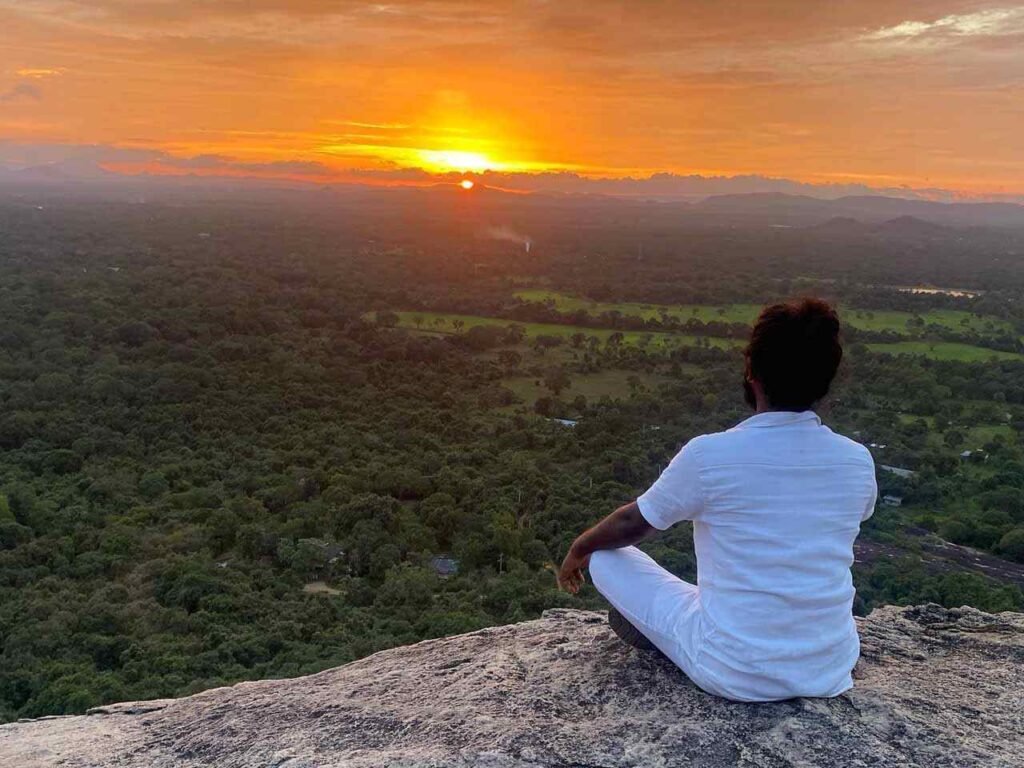
Pidurangala is the short, steep hike near Sigiriya: about 20 to 30 minutes up, finishing with a scramble over boulders. Wikivoyage listed the entry fee as Rs 1,000 for foreigners in August 2024 (Wikivoyage).
Love Sri Lanka says there are small gaps to squeeze through near the top. It recommends the hike to people with some experience, and suggests taking a guide if you haven’t done much hiking (Love Sri Lanka). Wear proper shoes, not flip-flops, and cover your shoulders and knees for the temple at the start. The view from the top looks straight across at Sigiriya, and our Sigiriya guide covers the rock itself and the day trips around it.
4. Ella Rock
Ella Rock is the bigger walk from Ella. Atlas & Boots describes about 40 minutes along the railway from Ella station to Kithalella station, then a climb to the summit. The round trip is about 10 km and takes about three hours, plus an hour at the top (Atlas & Boots). On the way up you pass tea estates and a small eucalyptus forest (Love Sri Lanka).
The line is a working railway. Step off the track when a train comes. The turn-off is easy to miss, and touts on the tracks sometimes tell hikers they’ve gone the wrong way in order to sell their services as guides. Download the route before you go, or arrange a guide through your guesthouse. In March 2024, Atlas & Boots reported a charge of 930 rupees for adults at the main viewpoints.
5. Horton Plains and World’s End
Horton Plains National Park is a high plateau near Ohiya, roughly an hour from Nuwara Eliya. It’s open all year from 6am to 6pm, and plastics are banned, so carry snacks in other packaging (Love Sri Lanka). Its circuit trail is about 9 km (Wikivoyage) and takes in World’s End, a sheer cliff with a drop of about 870 metres, and Baker’s Falls.
Wikipedia puts the dry season from January to March and says mist can hang over the plains for most of the day in the wet season. Love Sri Lanka gives March to the end of May as the season to visit, so March is the month both agree on. An early start gives you the best chance of a view. The plains average 13°C over the year, so bring a warm layer (Wikipedia).
6. Diyaluma Falls
At 220 metres, Diyaluma is the second highest waterfall in Sri Lanka, about 6 km from Koslanda (Wikipedia). Our Island of Endless Horizons tour climbs it on day 8. The path is steep and rough underfoot, and the chain of pools at the top is the reason people make the climb. The pools sit right above a sheer drop: stay well back from the edge, and keep out of the water after heavy rain.
Hard hikes and guided treks
7. Sinharaja Forest Reserve
UNESCO calls Sinharaja, in the south-west, “the last viable remnant of Sri Lanka’s tropical lowland rainforest”. Its World Heritage listing records 19 of the 20 bird species then counted as endemic to Sri Lanka, along with many reptiles and rare amphibians (UNESCO). Conservation rules require every visitor to enter with a licensed guide (Wikipedia), and the walks are more about wildlife than distance.
You’ll need a permit, sold with the ticket at the entrances, and an ID card or passport to get in. Leeches are common, so wear long clothes and use a leech repellent (Wikivoyage).
8. The Knuckles range
The Knuckles range lies north-east of Kandy, in the Matale and Kandy districts. British surveyors named it after a row of peaks that look like the knuckles of a clenched fist from parts of Kandy District. Its higher slopes are often wrapped in thick cloud (Wikipedia).
Treks here run through cloud forest and past remote villages. Protected parts of the range need an entrance permit and a registered guide. Visit Knuckles, a local trekking operator, warns that the small permit offices may be closed when you arrive (Visit Knuckles). The same page gives January to March as the best months and October to January as the wet season, when trails turn slippery.
9. Adam’s Peak (Sri Pada)
Adam’s Peak is the classic night climb: about 5,200 steps from Dalhousie, a small settlement 33 km by road south-west of Hatton. The route from Dalhousie is about 7 km. It takes about three hours to reach the top, give or take an hour depending on fitness, and most people set off around 3am to be on the summit for sunrise (Sri Pada).
In the pilgrimage season, from December to May, the path is lit and tea houses along the way are open, some through the night. January and February are the busiest months. Out of season the path is unlit, so you’ll need a torch, and from May to October the peak is often lost in cloud. It’s cold at the top before dawn: carry an extra warm layer, and leave plastic bags behind, because they’re banned on the trek. Our guide to historical places in Sri Lanka explains why the peak is sacred to four faiths.
A longer walk: the Pekoe Trail
The Pekoe Trail is a 300 km walking route through the tea country of the Central Highlands. It’s split into 22 stages that can be walked in short sections or over several days. Stage 16, from Ella to Demodara, is graded easy: 9.5 km and about three hours.
Most stages are open from 6am to 6pm, you need a trail pass, and some stages also need tickets or permits for protected areas or private land (The Pekoe Trail). The organisers post stage alerts on the trail’s website. When we checked on 27 September 2026, six stages were under an amber alert and the rest under a yellow advisory, so look before you set off.
Before you go
- Start early. Mornings are usually clearer and cooler than afternoons in the hills.
- Wear shoes with good grip, and carry water, a light rain jacket and cash for entry fees.
- Pack leech protection for Sinharaja and the Knuckles, especially in wet weather.
- Tell someone at your hotel where you’re going, and take a guide wherever the rules require one.
Our Sri Lanka weather by month guide explains both monsoons in more detail. The Kandy to Ella train is the classic way into the hiking country around Ella.
Hiking questions
What is the best hike in Sri Lanka for beginners?
Little Adam’s Peak. The path is clearly marked, the whole walk takes two to three hours, and Love Sri Lanka rates it easy enough for children.
When is the best time to go hiking in Sri Lanka?
For most of the trails in this guide, February and March are the most reliable months, and January is usually good too. The south-west monsoon brings rain to the central hill country from May to September, and the Knuckles is wettest from October to January. Horton Plains is driest from January to March. Adam’s Peak keeps its own calendar: the path is lit only in the pilgrimage season, from December to May.
Do you need a guide to hike in Sri Lanka?
Not on Little Adam’s Peak or Adam’s Peak, where the paths are clearly marked. Sinharaja requires a licensed guide, protected parts of the Knuckles need a registered guide, and a guide saves time on Ella Rock, where the turn-off is easy to miss.
Plan your hiking trip
Our Island of Endless Horizons tour is built for walkers. It’s ten days with a private driver-guide, taking in a working tea estate above Kandy, the Knuckles cloud forest, the train to Ella, Little Adam’s Peak and the Diyaluma trek.
We checked trail details, fees and permit rules against the linked sources on 27 September 2026. They change, so ask locally before you set off.