Is it safe to surf in Sri Lanka? No official source we read says yes. GOV.UK’s Sri Lanka advice, dated 21 September 2026, was shown as still current when we checked on 22 October 2026. Its “Swimming safety” entry, beside a pointer to holiday advice from the Royal Life Saving Society, reads (GOV.UK): “Many beaches in Sri Lanka have dangerous surf or rip tides at certain times of the year. Get advice from your hotel or tour operator before going in the sea.” For surfers, the sources below point to five main risks: rip currents, shallow reef and rock, crowded line-ups, strong sun and, in some months, stinging blue bottles.
Key takeaways
- Official UK advice, last updated on 21 September 2026, warns that the surf on many beaches can be dangerous, with rip tides, at certain times of year. Its advice: consult a hotel or tour operator first.
- Canada calls public beaches generally unsupervised. Australia’s Smartraveller says lifesaving services are rare.
- Many named breaks run over reef, rock or boulders, among them Main Point, Ram’s and Hiriketiya. Mondo Surf lists a sand bottom at Weligama.
- None of the 65 unprovoked bites in the International Shark Attack File’s 2025 report was in Sri Lanka. Its Asia map of confirmed unprovoked attacks since 1580 does mark Sri Lanka, without a number.
What the official travel advice says about the sea
We read four governments’ advice on 22 October 2026, and three deal with the sea directly. GOV.UK’s warnings section (GOV.UK) also states that “No travel can be guaranteed safe”.
| Government | Last updated | What it says about the sea |
|---|---|---|
| UK, GOV.UK | 21 September 2026 | Dangerous surf or rip tides at certain times of year |
| Canada, travel.gc.ca | 13 October 2026 | Dangerous riptides; beaches generally unsupervised |
| Australia, Smartraveller | 14 August 2026 | Strong rips; lifesaving services rare |
| United States, State Department | 14 October 2025 | Nothing on the sea in its summary |
Canada’s advice says tidal changes and strong winds can cause dangerous riptides, and public beaches are generally unsupervised. It asks visitors to keep to areas reserved for swimming, stay well clear of boats and restricted areas, and respect warning flags. It also says to keep away from the coast when the forecast is poor, and never to dive into unfamiliar water, because hidden rocks or shallows can cause serious injury or death. Its overall rating, “Exercise a high degree of caution”, cites demonstrations, terrorism and crime (Government of Canada).
Smartraveller uses the same rating. It calls swimming conditions unsafe at some beaches, warns that rips can be strong, and says lifesaving services are rare and below Australian standards. “Take appropriate precautions,” it adds (Smartraveller). The US advisory, issued on 14 October 2025, sits at Level 2, “Exercise Increased Caution”, and cites civil unrest, terrorism and landmines (US Department of State). Risks on land are in our page on whether Sri Lanka is safe for tourists.
Rip currents: what they are and how to get out
A rip current is a narrow channel of fast water heading away from the beach. NOAA, the US ocean agency, clocks rips at up to eight feet (about 2.4 m) a second, quicker than an Olympic swimmer (NOAA). A rip pulls you out, not under, says the US National Hurricane Center. Its three steps: relax and float; swim parallel to the shoreline, then angle in with the waves, never straight against them; wave your hands for help. If someone else is caught, don’t swim out, because many rip deaths are people trying to rescue others; throw them something that floats and call for help instead (NOAA National Hurricane Center). The RNLI’s 2016 surf safety booklet adds a rule for board riders: keep hold of your board, which keeps you afloat and makes you easier to find (RNLI).
Sri Lanka Police said in February 2026 that water-related accidents had risen significantly. Its own figures, though, show a fall: 595 water-related deaths in 2024, 388 in 2025 and 24 in the first six weeks of 2026, with no split between sea, rivers and reservoirs. It reported 71 police lifeguard units, and 96 foreign tourists rescued in 2025. It urged everyone to obey warning signs and to take special care where red flags fly (Ada Derana). A Coast Guard release dated 1 May 2026 counts 16 lifesaving posts along beaches that draw tourists (Sri Lanka Coast Guard). Neither names the beaches or gives hours. For dated 2026 reports from one surf bay, read our Weligama beach guide’s section on swimming.
Reef, rock and urchins: know what is under the wave
Several well-known breaks run over reef or rock. Love Sri Lanka, the consumer website of the Sri Lanka Tourism Alliance, a private-sector tourism group, says so in pages written in 2020 and 2022. Its Arugam Bay guide describes Main Point breaking near rocks and onto coral reef. It advises the point for intermediates and professionals only, after studying the tides and swell (Love Sri Lanka). At Mirissa, it says, the reef can be quite dangerous at low tide, so surf it at high tide only (Love Sri Lanka).
Mondo Surf’s spot guides, read on 22 October 2026, agree. Ram’s sits on a reef they call “shallow and sharp”, for advanced surfers (Mondo Surf). Hiriketiya’s main left breaks over boulders and is “not good for beginners” (Mondo Surf). In the line-up at Midigama Right and at Mirissa, Mondo warns of rocks and urchins (Mondo Surf; Mondo Surf). At Weligama, Mondo lists sand (Mondo Surf).
The NHS page on cuts, reviewed in April 2026, says to clean a small cut with bottled or tap water and then cover it. Get medical advice, it says, if a wound is still dirty after cleaning, or turns swollen, red and more painful (NHS).
Are there sharks in Sri Lanka?
Sharks do live in Sri Lankan waters (The Morning), and the bite records we found are thin rather than empty. The Florida Museum’s International Shark Attack File confirmed 65 unprovoked bites worldwide in 2025, and its report breaks them down by country. Sri Lanka isn’t on that list, although the Maldives had one non-fatal case (Florida Museum). The file’s map of confirmed unprovoked attacks in Asia since 1580 draws a circle over Sri Lanka, so the file holds at least one Sri Lankan case. The map gives no number, and its page was last updated in February 2018 (Florida Museum). We found no published Sri Lankan total.
In a June 2026 interview with The Morning, Shownath Sitsabeshan of the Blue Resources Trust put Sri Lanka’s sharks and rays at 105 species. They include requiem, hammerhead, tiger, mako and whitetip reef sharks. He said historical records mention occasional incidents near Colombo and Trincomalee, and that Sri Lanka “does not feature prominently in global shark attack databases”. Most incidents, he said, happen when people and sharks meet unexpectedly in murky water or near fishing. His advice for lowering the risk: avoid dawn, dusk, and water where there is bait or fishing (The Morning).
Blue bottles, crocodiles and the sun
A blue bottle, or Portuguese man o’ war, trails stinging tentacles that can pass 10 metres. The Sunday Times reported on 14 June 2026 that large numbers had washed up in Matara and Galle that week. Dozens of people were stung, and parts of Polhena beach closed for two days. Professor Terney Pradeep Kumara linked their numbers to the south-west monsoon, from about May to September. Stranded ones can still sting, so never touch one. The report’s first aid: leave the water at once and lift tentacles off with tweezers or gloves. Dr Janaka Ruban of the University of Ruhuna adds: rinse with seawater, not fresh water, and don’t rub. Comfortably hot water may ease the pain. Get medical help for severe symptoms, a large sting, breathing problems or signs of an allergic reaction (Sunday Times).
Crocodiles come up in two advisories. Canada says they are present in some parts of Sri Lanka; it tells visitors to ask locals about safe swimming areas and to avoid rivers (Government of Canada). Smartraveller says saltwater crocodiles live in some locations and that attacks have killed people. It advises getting local advice before you swim, and staying out of rivers and lagoons (Smartraveller).
On sun, the World Health Organization says UV is stronger near the equator and bounces off water and sand. It ranks shade and clothing above sunscreen (WHO). The NHS says to reapply sunscreen straight after a session, even a water-resistant one, and every two hours (NHS).
Crowds and right of way
Love Sri Lanka says Whisky Point always draws a crowd in season (Love Sri Lanka). Mondo Surf lists Mirissa and Hiriketiya as crowded (Mondo Surf; Mondo Surf).
The RNLI booklet sets out etiquette that holds at any break. The surfer closest to the peak has priority. Don’t drop in on someone already riding, and don’t snake round them for position. Paddle out wide of the peak rather than through it, and never throw your board (RNLI).
Which coast is surfable in which month
Sri Lanka’s Department of Meteorology puts the south-west monsoon in May to September, with wetter weather in the south-west. The north-east monsoon, it says, runs from December to February and affects the north-east (Department of Meteorology). For surfing, Wikivoyage gives the west and south coasts November to April (Wikivoyage). Arugam Bay’s season runs April to October, it says, with July and August drawing the biggest crowds (Wikivoyage).
Each coast’s months are laid out in when to surf in Sri Lanka, the monsoon season guide explains both monsoons, and surfing in Sri Lanka in July covers the east coast’s peak.
Lowering the risk as a beginner
The RNLI tells new surfers to start with a lesson, on a soft foam board, which floats well and is easier to paddle. Wear a leash, and never surf alone. Stay in the shallow white water before moving to unbroken waves, and avoid heavy shore break. Don’t go out in conditions beyond your ability (RNLI). Smartraveller warns that operators don’t always keep to safety standards, water sports included. Check that your insurance covers the activity, that staff are trained, and that safety gear is there and used. If you’re unsure, it says, choose another provider or skip it (Smartraveller).
Love Sri Lanka’s 2022 surf map says Weligama caters mainly to novices, over a soft sea bed (Love Sri Lanka). Our Weligama surf lessons page compares ten of the bay’s schools as their own websites describe them. On the east coast, Love Sri Lanka points novices to Baby Point, which starts and ends on sand and is best in August (Love Sri Lanka). Each point there has its own entry in our Arugam Bay surf guide. Surfing in Sri Lanka lists 16 spots with the season and level for each.
If something goes wrong: numbers, hospitals and insurance
The UK, Australian and Canadian lists of emergency numbers don’t fully agree, so save them all before you paddle out.
| Service | GOV.UK | Smartraveller | Canada |
|---|---|---|---|
| Ambulance | 1990 or 011 2691111 | 110 (Colombo also +94 11 269 1111) | 110 or +94 11 242 2222 |
| Police | 118/119 | 118 or 119 | 119 or 118 |
| Tourist police | 011 2421052 | +94 11 242 1052 or +94 11 238 2209 | +94 11 242 1052 |
| Fire and rescue | 111 | 110 | 110 or +94 11 242 2222 |
Sources: GOV.UK, Smartraveller and Government of Canada, all read on 22 October 2026. GOV.UK lists one more number, 1912, a round-the-clock hotline run by Sri Lanka Tourism (GOV.UK). The 1990 Suwa Seriya service, set up by an Act of Parliament in 2018, describes itself as free, island-wide pre-hospital emergency care for all Sri Lankans. Its home page doesn’t say whether visitors pay (1990 Suwa Seriya).
GOV.UK warns that emergency medical treatment outside the main cities is not readily available. You may have to be brought to Colombo, private treatment can be expensive, and flying you home in an emergency has few options and costs a great deal (GOV.UK). It wants your insurance to cover your itinerary, the activities you plan and costs in an emergency (GOV.UK). Its general insurance guidance adds that some activities need specialist cover or an add-on (GOV.UK). Check that your policy names surfing.
Questions about surfing safety in Sri Lanka
Are there sharks where people surf in Sri Lanka?
Sharks live in Sri Lankan waters (The Morning). None of the 65 unprovoked bites in the International Shark Attack File’s 2025 report was in Sri Lanka (Florida Museum). Its Asia map since 1580 still marks the island (Florida Museum). No source we found gives a total.
Is Sri Lanka safe for beginner surfers?
None of the official pages we read rates a beach as safe for beginners. Love Sri Lanka says Weligama caters mainly to novices (Love Sri Lanka). GOV.UK tells visitors to check with their hotel or tour operator before they go in (GOV.UK).
Which coast should I surf, and when?
Wikivoyage gives the west and south coasts November to April (Wikivoyage), and Arugam Bay on the east coast April to October (Wikivoyage).
What should I do if a rip pulls me out?
Stay calm and float, keeping hold of your board, and wade if you can stand. Paddle parallel to the beach until you are out of the pull, then come in at an angle with the waves. Raise an arm and shout for help (NOAA National Hurricane Center; RNLI).
Planning a surf trip from Weligama
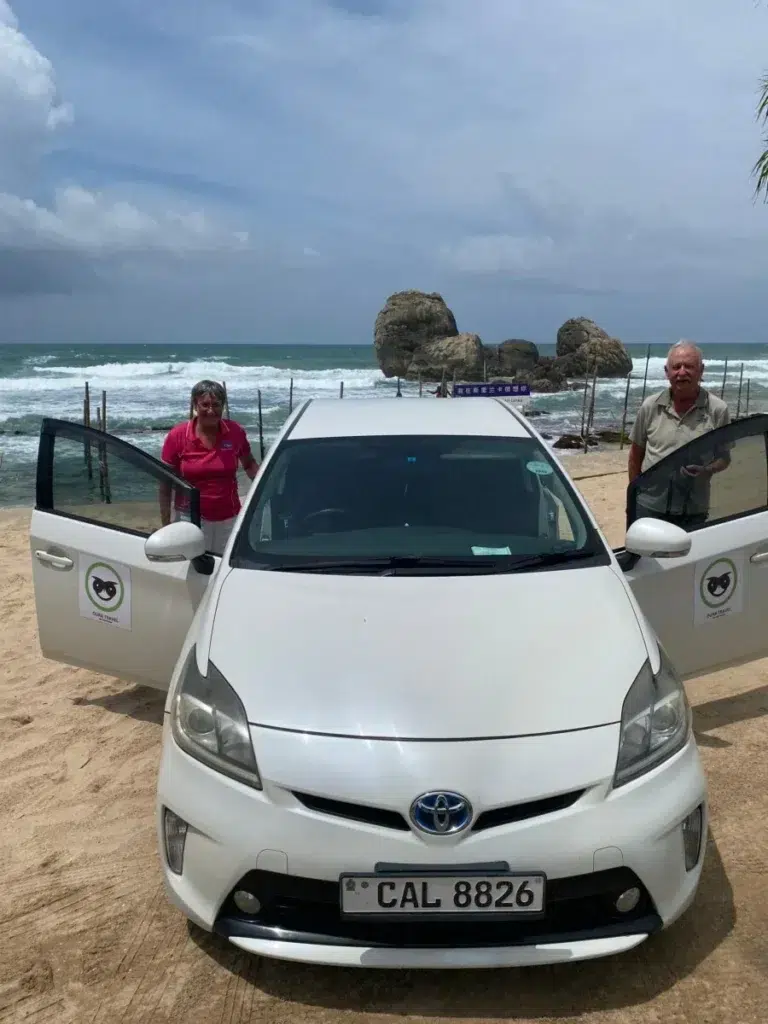
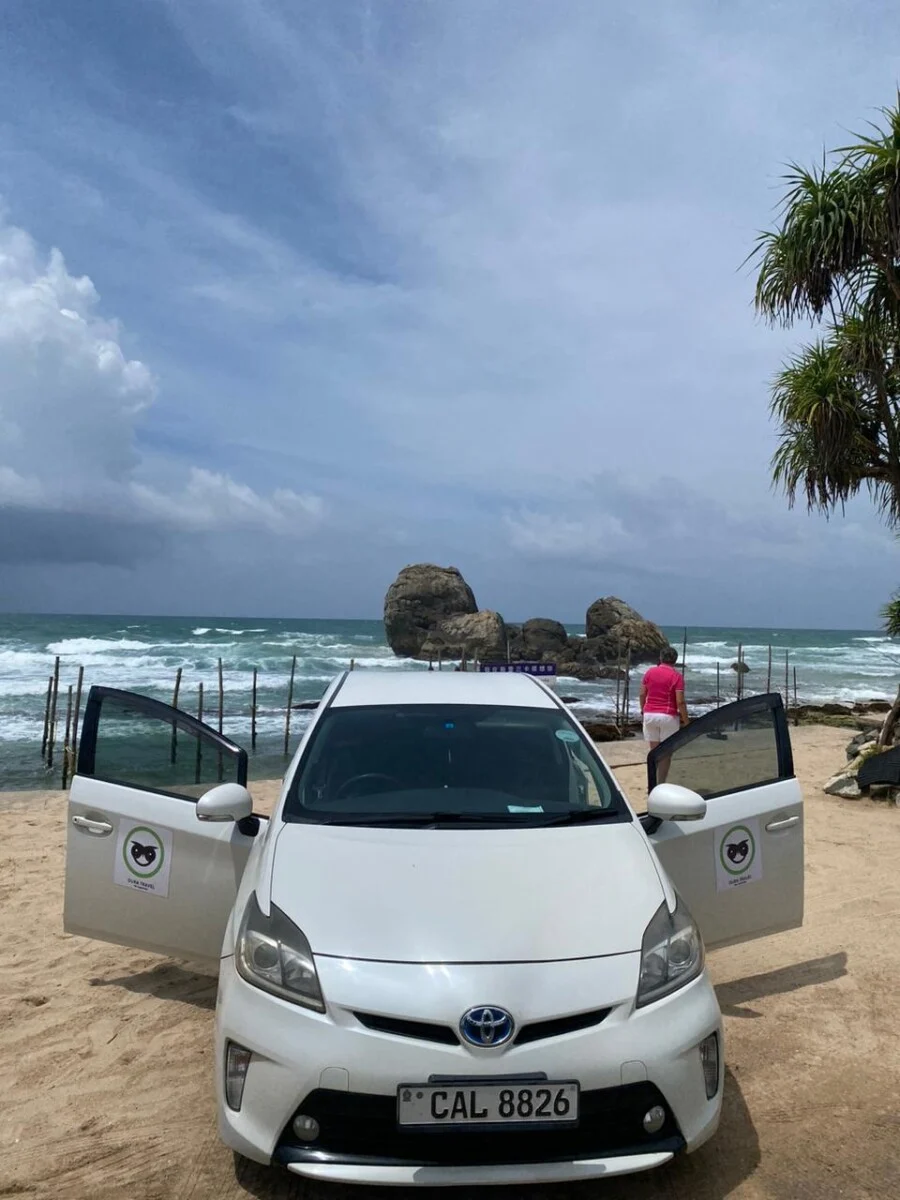
From its base in Weligama, Oura Travel plans private, driver-guided trips by car. The private car with driver page mentions room for surfboards. If you’d like the road between the coasts planned around the season, tell us your dates and board lengths.
Every source above was opened again on 22 October 2026. Advice, numbers and sea conditions change, so check your own government’s page before you paddle out.