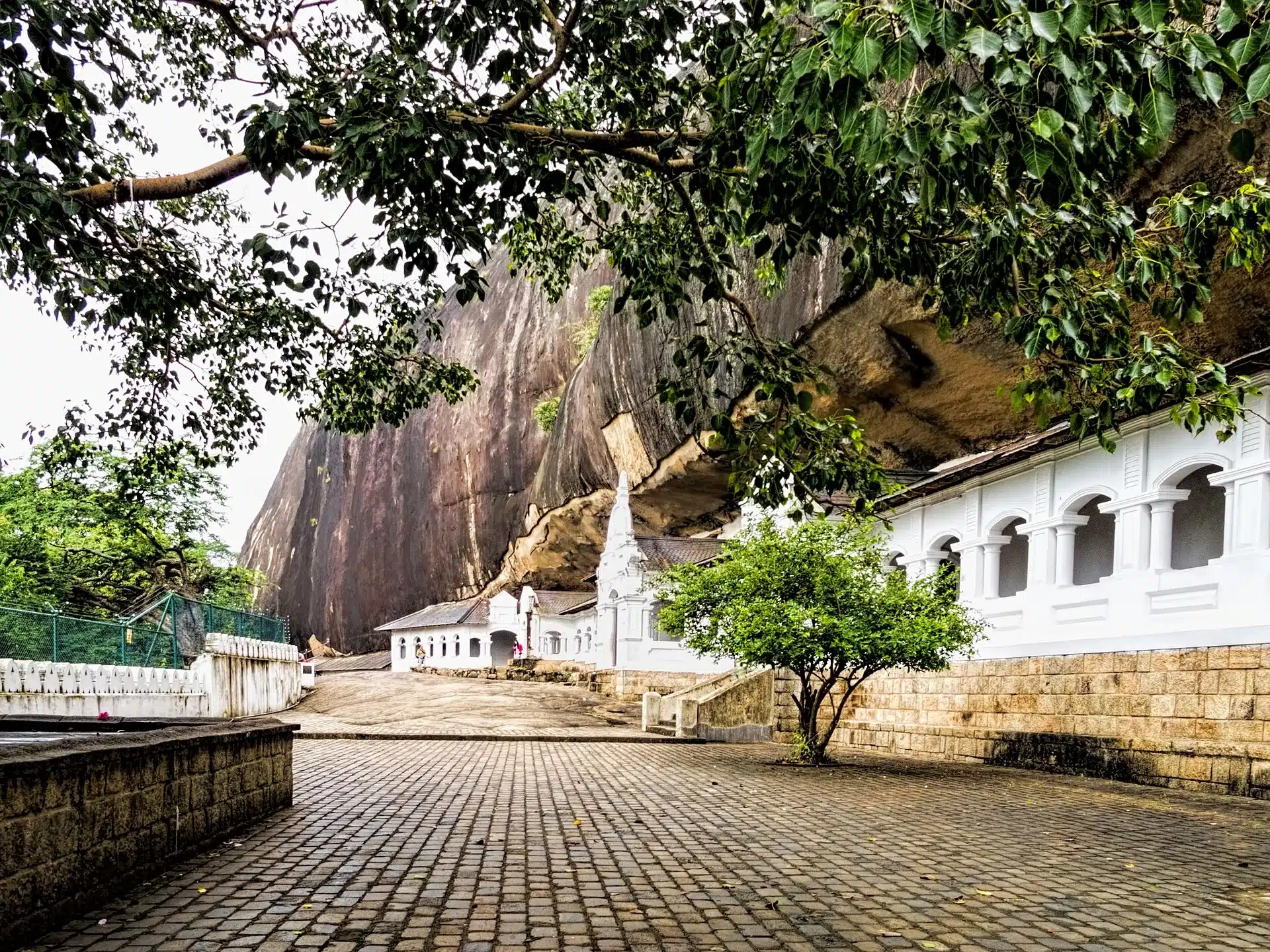
The Dambulla Cave Temple, five painted Buddhist cave shrines in central Sri Lanka, costs foreign adults LKR 2,000 to 3,000 in cash in 2025 and 2026 reports (Wikivoyage; Expatolife). It opens at 7am, closing is given as 5pm to 7pm, most reports stop ticket sales at 5pm, and a visit takes 1 to 2 hours after a 10 to 20 minute climb (CCF tickets; Love Sri Lanka; Destinationless Travel). When we checked on 27 October 2026, the newest visitor reports we found, from October 2025 and January 2026, said LKR 3,000, so carry that much in rupee notes. UNESCO inscribed the site in 1991, counts 157 statues and 2,100 square metres of murals, and records it as the property of a chapter of Buddhist monks (UNESCO).
Key takeaways
- Foreign adults paid LKR 2,000 to 3,000 in cash in 2025 and 2026 reports. The newest visitor reports say LKR 3,000, so carry that much.
- Buy the ticket on the side road, not at the Golden Temple on the main road, or you climb twice.
- The caves open at 7am. Closing is given as 5pm, 6pm or 7pm, and most reports stop ticket sales at 5pm, so arrive before then.
- Cover shoulders and knees, take off shoes and hats, and never pose with your back to a Buddha image.
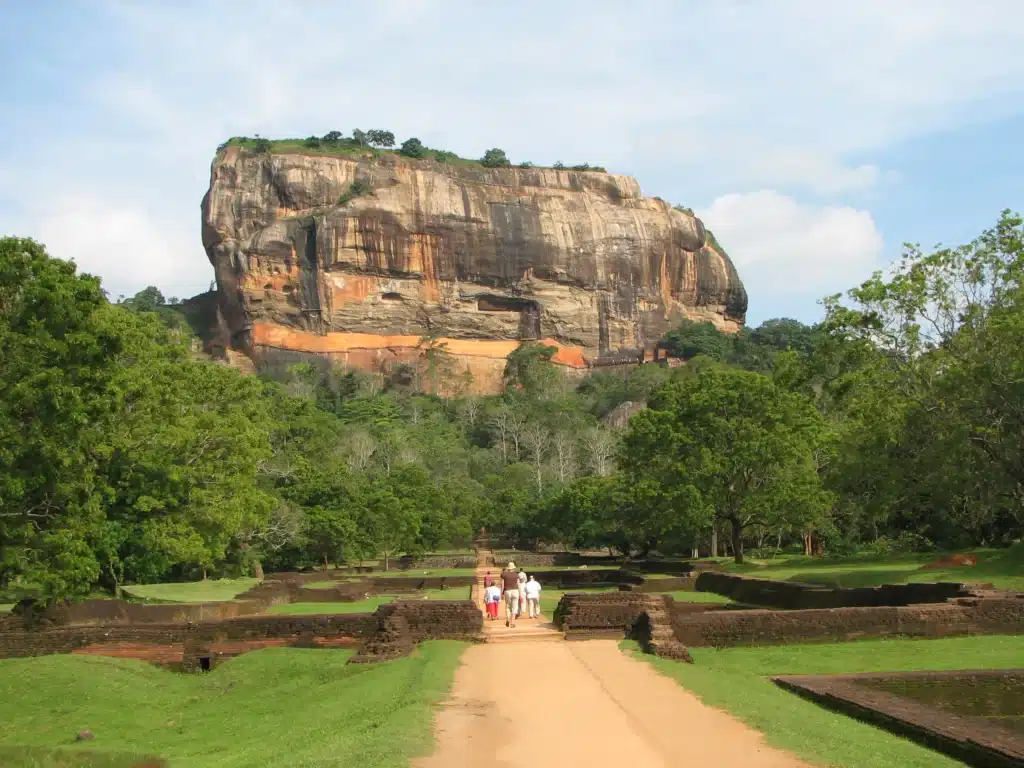
- Sigiriya is 19 km away by road, so the two fit into one day with Sigiriya in the morning.
Dambulla cave temple entrance fee and hours in 2026
The ticket price, report by report
We found no official fee list for the cave temple online, so we dated every report we could find. On 15 August 2025 Wikivoyage changed its listing from Rs 2,000 to Rs 3,000, cash only (Wikivoyage edit).
| Report | Foreign adult | Also noted |
|---|---|---|
| Sunday Times, 26 February 2017 | Rs 1,500 from 11 February 2017 | Reintroduced about five months after charges were dropped (Sunday Times) |
| Destinationless Travel, updated 29 August 2024 | LKR 2,000, cash | Shoe rack LKR 20 (Destinationless Travel) |
| Wikivoyage, edited 15 August 2025 | Rs 3,000, cash only | Listing marked “updated Sep 2025” (Wikivoyage) |
| Two readers, 29 October 2025 and 22 January 2026 | Rs 3,000 | Comments under a tuk-tuk rental firm’s fee list (Tuktuk Rental) |
| Expatolife, page dated 18 July 2026 | LKR 2,000 | Shoe storage LKR 200 (Expatolife) |
Three of the four dated reports from 2025 and 2026 say LKR 3,000. Expatolife’s page carries a July 2026 date, but its figure matches the 2024 report, so it may come from an earlier visit. Destinationless Travel says the temple asks for rupees, though the man at the counter told its writers in 2024 that US dollars would do. Shoe-keeping reports differ too: LKR 20 in the 2024 report, LKR 200 on Expatolife, and free with a tip expected on a blog updated in October 2026 (Salt in our Hair).
Who runs it, and why your round ticket does not count
UNESCO records the caves as property of the Asgiriya Chapter of Buddhist monks. The monks keep the site and use part of the gate money from foreign visitors for its upkeep (UNESCO). The Central Cultural Fund’s Cultural Triangle round ticket covers Sigiriya, Anuradhapura, Polonnaruwa and the archaeological museums, and the caves are not on that list (CCF tickets). The fund’s price list, whose last update was on 14 October 2026, has no cave temple line at all. It does price a separate “Dambulla (Museum)” ticket at USD 3, or LKR 1,008 (CCF price list). The fund also runs the Dambulla Painting Museum, opened in 2003 within walking distance of the caves (CCF).
Opening hours
Sources disagree on closing time, and none of them is the temple itself. Love Sri Lanka, the website of the private-sector Sri Lanka Tourism Alliance, gives 7am to 7pm every day on an undated page (Love Sri Lanka). Wikivoyage’s listing, updated in September 2025, agrees. Expatolife, on its page dated July 2026, says 7am to 6pm. The Central Cultural Fund’s ticket page lists the cave temple at 7am to 5pm, the same hours it prints for every heritage site on that page. Destinationless Travel (2024), Expatolife and Amazing Lanka all say the ticket counter closes at 5pm (Amazing Lanka). Be at the counter before 5pm; we could not confirm how late you can then stay inside.
Where to buy the ticket, and the climb to the caves
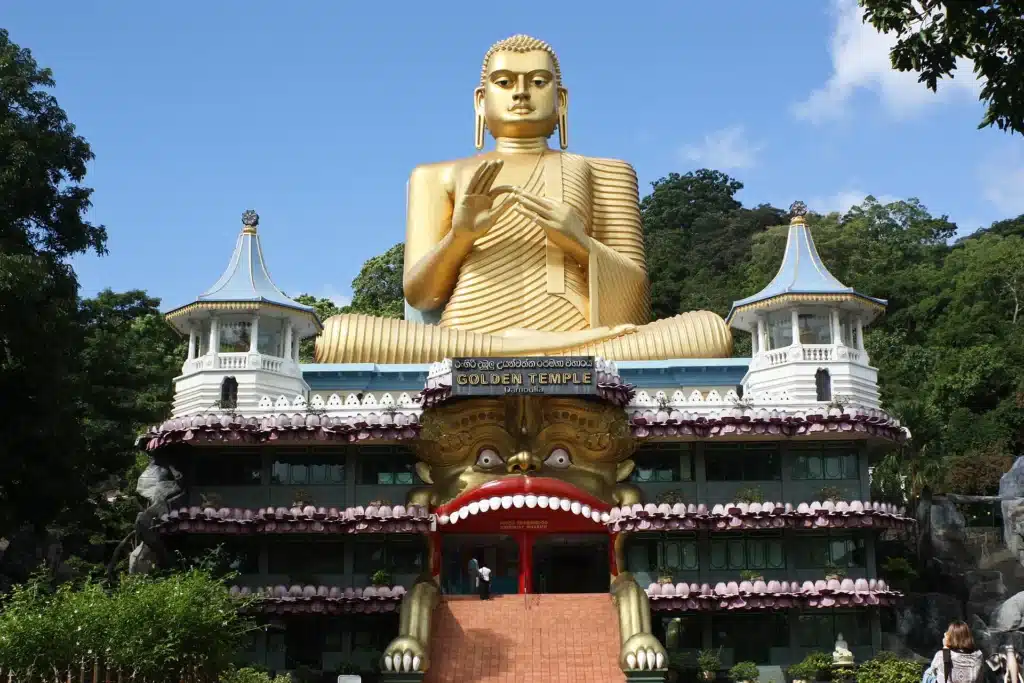
Two paths lead up the rock, and only one has a ticket booth. Destinationless Travel says the path from the giant golden Buddha has no booth at the top, so you walk up, down the far side to pay, and up again. Wikivoyage says the same and suggests starting from the side road with the car park. Expatolife puts the ticket office about 1 km west of the main highway, on the south side of the hill (Destinationless Travel; Wikivoyage; Expatolife).
The neat answer, which Destinationless Travel describes, is to be dropped at the ticket side and collected at the Golden Buddha. Expatolife did the same, walking down the main stairway to the Golden Temple on the main road. Tell your driver the plan before you set off.
The climb is short. Wikivoyage calls it a 10-minute stair climb, Love Sri Lanka says 10 to 15 minutes (Love Sri Lanka), and Destinationless Travel and Expatolife each took about 20. Destinationless Travel counted about 370 steps. The CCF rates the effort as moderate, and the view from the top takes in Sigiriya’s rock (CCF). Destinationless Travel also warns that monkeys hang around the path and steal things left unattended, so keep your bag close.
Inside, allow 1 hour for the five caves, or up to 2 if temples are your thing, as Destinationless Travel suggests. Expatolife spent about 2 hours exploring. It says nothing is sold at the top, so bring water, and suggests an on-site guide if you want the history explained.
Best time to visit: heat, light and crowds
Expatolife suggests 7am to 9am or 4pm to 6pm, because the middle of the day is hot and crowded. Destinationless Travel reached the booth at about 4.30pm and climbed in time for sunset. It also suggests socks, because the ground gets very hot under bare feet by midday (Expatolife; Destinationless Travel). Wikipedia notes that swallows swoop round the cave entrance at dusk (Wikipedia).
Love Sri Lanka warns that the temples can get crowded at weekends and on poya days, the full moon holidays (Love Sri Lanka). The next two on the Central Bank’s list are Il poya on 24 November 2026 and Unduwap poya on 23 December 2026 (CBSL).
For weather, the nearest station with World Meteorological Organization normals is Maha Illuppallama, about 36 km north-west. Its 1991 to 2020 averages put the driest months in June and July, about 21 mm each on 3 rain days. October and November are the wettest, at 270 to 274 mm on 14 to 17 days, and April has a smaller peak of 179 mm on 11 days. Average highs peak at 34°C in April and fall to about 29°C in December (WMO climate normals). Our Sri Lanka weather by month guide compares the other regions.
Why the Dambulla cave temple is famous
UNESCO says forest monks have lived in these caves since the 3rd century BCE and calls the site a pilgrimage place for 22 centuries. No cave temple complex in the country is larger or better preserved, UNESCO adds, and its painted shrines took their present interior form in the 18th century (UNESCO).
Tradition credits King Valagamba with turning the caves into a temple in the 1st century BCE. Driven from Anuradhapura by invaders, he hid here for 15 years and built the temple in thanks once he had his capital back. Nissanka Malla of Polonnaruwa gilded the caves and added about 70 Buddha statues in 1190. The Kingdom of Kandy restored and painted them in the 18th century, and the arched colonnades along the front date from 1938 (Wikipedia).
Statue counts vary: UNESCO gives 157, while Wikipedia counts 153 Buddhas, three kings and four gods, including Vishnu and Ganesha. The caves are still a working shrine, and UNESCO counts festival crowds among the site’s challenges.
The five caves: what to look for in each
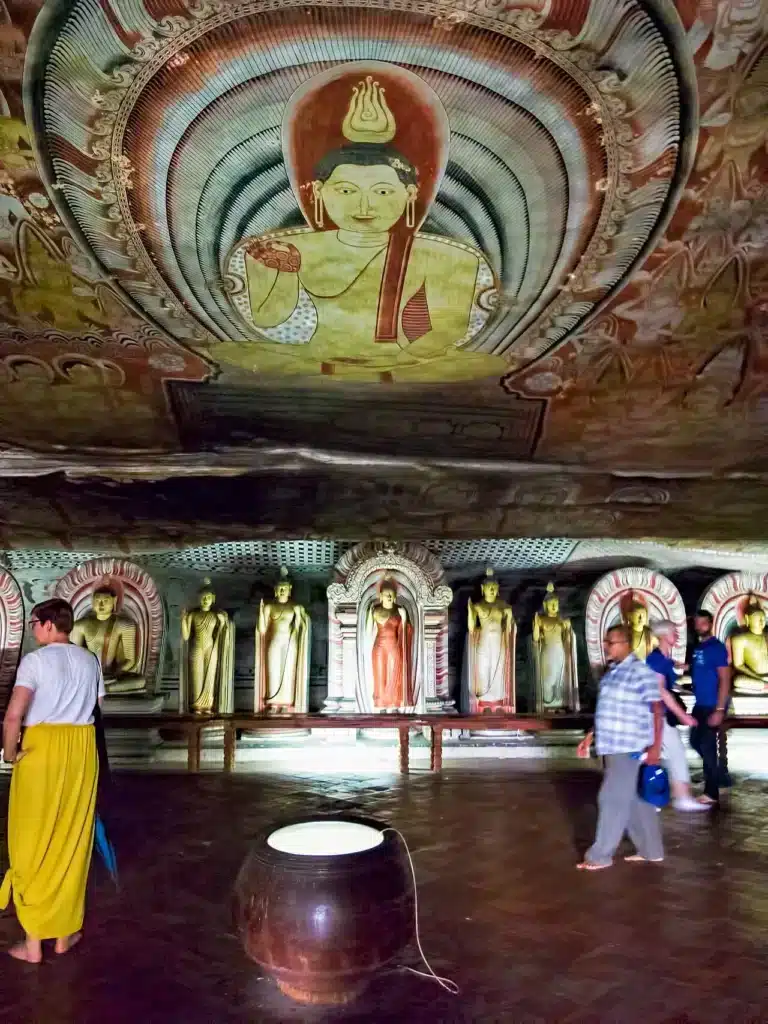
The five caves sit side by side beneath a single huge overhang, with a groove cut into the rock above to shed rainwater. Shoes stay off from the temple gate onwards, Expatolife notes. The table draws on the Central Cultural Fund’s page on the site and on Wikipedia (CCF; Wikipedia).
| Cave | Name | What to look for |
|---|---|---|
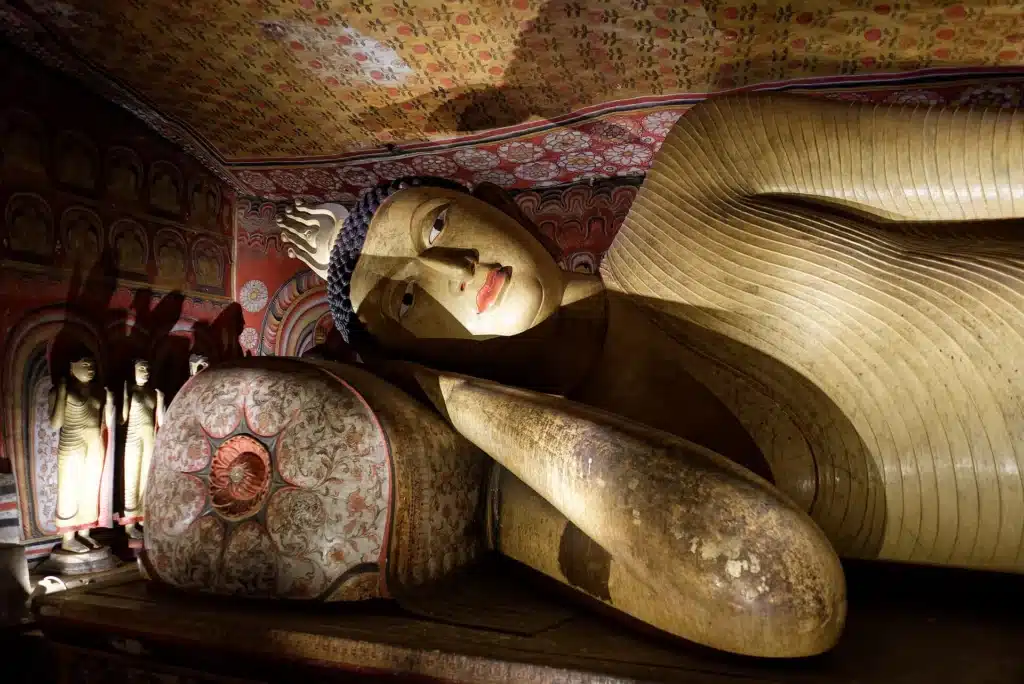
| 1 | Devaraja Viharaya, Cave of the Divine King | A 14 m reclining Buddha cut from the rock, with Ananda at his feet, and a 1st-century Brahmi inscription over the door |
| 2 | Maharaja Viharaya, Cave of the Great Kings | The largest, about 52 m by 23 m, with 56 Buddha statues and painted walls and ceiling; water drips from a crack in the ceiling |
| 3 | Maha Alut Viharaya, Great New Monastery | Kandyan paintings from King Kirti Sri Rajasinha’s reign (1747 to 1782), 50 Buddha statues and a statue of the king |
| 4 | Pachima Viharaya, Western Temple | A smaller shrine with a dagoba and a seated Buddha under a dragon arch |
| 5 | Devana Alut Viharaya, Second New Temple | The newest cave, from the Kandyan period, with reclining Buddhas and Hindu gods |
Give Cave 2 the most time. Wikipedia says it stands 7 m high at its tallest. Among its figures are King Vattagamani Abhaya, another name for Valagamba, and King Nissanka Malla. The water dripping from its ceiling is said to have healing powers, and 18th-century paintings on the ceiling show the Buddha’s life. UNESCO singles out the monastery’s 18th-century work from the Kandy school (UNESCO).
Dress code and temple etiquette
GOV.UK’s Sri Lanka advice was updated on 21 September 2026 and still current when we checked on 27 October (GOV.UK). For Buddhist temples it says: legs and shoulders covered, shoes and hats off. It warns that disrespecting Buddhist images can lead to arrest, and says not to pose for photos in front of a Buddha statue (GOV.UK).
Destinationless Travel says entrance staff turn away anyone with bare knees or shoulders, and a sarong over a T-shirt was enough for its writer (Destinationless Travel). Salt in our Hair reports cheap sarongs for hire at the entrance (Salt in our Hair).
We found no photography policy from the temple itself online. Destinationless Travel says photos are allowed only without people in them, and asks visitors not to photograph anyone praying. A 2016 visitor wrote that flash is forbidden in the shrine rooms, which have CCTV cameras (Wheels On Our Feet).
Getting to the Dambulla cave temple
The temple stands on the A9, the Kandy to Jaffna highway, which meets the A6 to Sigiriya, Habarana and Trincomalee at Dambulla (Wikipedia). Each road leg below was run from the temple on 27 October 2026 through OpenStreetMap’s route planner. The planner expects clear roads, so every figure is rounded up, and legs that our Cultural Triangle guide also prints carry its ranges.
| From | Distance | Usual drive |
|---|---|---|
| Sigiriya | 19 km | 30 to 40 minutes |
| Habarana | 24 km | 30 to 40 minutes |
| Kandy | 70 km | 2 to 2.5 hours |
| Anuradhapura | 68 km | 1.5 to 2 hours |
| Polonnaruwa | 68 km | 1.5 to 2 hours |
| Bandaranaike airport | 133 km | 3 to 3.5 hours |
| Negombo | 129 km | 3 to 3.5 hours |
| Colombo Fort | 149 km | 3.5 to 4 hours |
For day rates by car, see the cost of hiring a driver in Sri Lanka.
By bus, services from Colombo, Kandy, Anuradhapura and Sigiriya stop at Dambulla bus station on the Kandy road. Wikivoyage puts Kandy and Anuradhapura 2 to 3 hours away by bus, with buses from Sigiriya every 30 minutes, the last at 6pm, in listings edited in 2024 and 2025 (Wikivoyage). The temple is 2.3 km south of the bus station, about 30 minutes on foot (OpenStreetMap).
There is no train to Dambulla itself. The town does not appear on Sri Lanka Railways’ station list, and the Matale Line from Kandy ends at Matale, 148.6 km from Colombo Fort (Sri Lanka Railways). Matale is 46 km from the temple by road, 1 to 1.5 hours (OpenStreetMap). The other railhead is Habarana, on the line to Trincomalee and Batticaloa (Wikivoyage).
Sigiriya and Dambulla in one day, and what else is nearby
The two sites are 19 km apart, so one day covers both. Climb Sigiriya when its counter opens at 7am (CCF tickets), rest through the midday heat, then drive 30 to 40 minutes to the caves. Arrive by about 3.30pm to buy a ticket before 5pm. That way you see the caves in the cooler late afternoon, as Expatolife suggests. For the morning half, see what to do in Sigiriya, which times the climb itself.
To choose a base, our page on where to stay in the Cultural Triangle sets Sigiriya village, Habarana and Dambulla town side by side.
Around town, Wikipedia describes burial sites with human skeletons about 2,700 years old at Ibbankatuwa, near the caves (Wikipedia), and the CCF price list above charges USD 3 for that site. The town sits at a major junction and is a centre of the country’s vegetable trade (Wikipedia). Wikivoyage lists the hillside Sankassapura temple across the Ibbankatuwa reservoir, at Rs 500 in September 2025 (Wikivoyage). The gate of Minneriya National Park, known for its elephants, is 33 km away, 40 to 50 minutes by road (OpenStreetMap).
Questions about the Dambulla cave temple
How much is the Dambulla cave temple entrance fee in 2026?
Reports from 2025 and 2026 give LKR 2,000 to 3,000 for a foreign adult, paid in cash. Wikivoyage has said LKR 3,000 since August 2025, while a page dated July 2026 still says LKR 2,000 (Wikivoyage; Expatolife). No official list was online when we checked on 27 October 2026, so carry LKR 3,000 plus a little for shoe-keeping.
How long does it take to visit the Dambulla cave temple?
Allow 1 to 2 hours inside and 10 to 20 minutes for the climb (Destinationless Travel). With the drive from Sigiriya, it fills half a day.
How many steps are there?
Destinationless Travel counted about 370, and the CCF calls the effort moderate (CCF).
Can you take photos inside the caves?
Visitors’ reports say yes, without flash and without people in the shot (Destinationless Travel; Wheels On Our Feet). GOV.UK says never to pose in front of a Buddha statue. Follow the signs and the staff in each cave.
Is there a lower entry fee for Indians or other SAARC visitors?
Some tour sellers’ pages list a SAARC rate, but they disagree and none cites the temple, so we found no figure to rely on when we checked on 27 October 2026. The CCF gives SAARC tourists relief tickets at its own sites, with a valid passport (CCF e-tickets), but the caves are not on its price list. Show your passport and ask at the counter.
Plan Dambulla into your trip
Oura Travel is a small team in Weligama, on the south coast, that arranges private trips by car with a driver-guide. On our six-day Cycling Tour Sri Lanka, the bikes go on the vehicle after Kurunegala for the drive up to the Dambulla caves. To see where the Triangle sits in a longer trip, how many days in Sri Lanka compares trips of 5 to 21 days. If you want the caves in your route, write to us with your dates and say whether you prefer the morning or the late afternoon.
We read every fee report, the CCF lists, GOV.UK and each route again on 27 October 2026. The temple sets its own price and can change it without notice, so carry spare rupees and check at the counter.
Top photo: Dan Lundberg, CC BY-SA 2.0, via Wikimedia Commons.