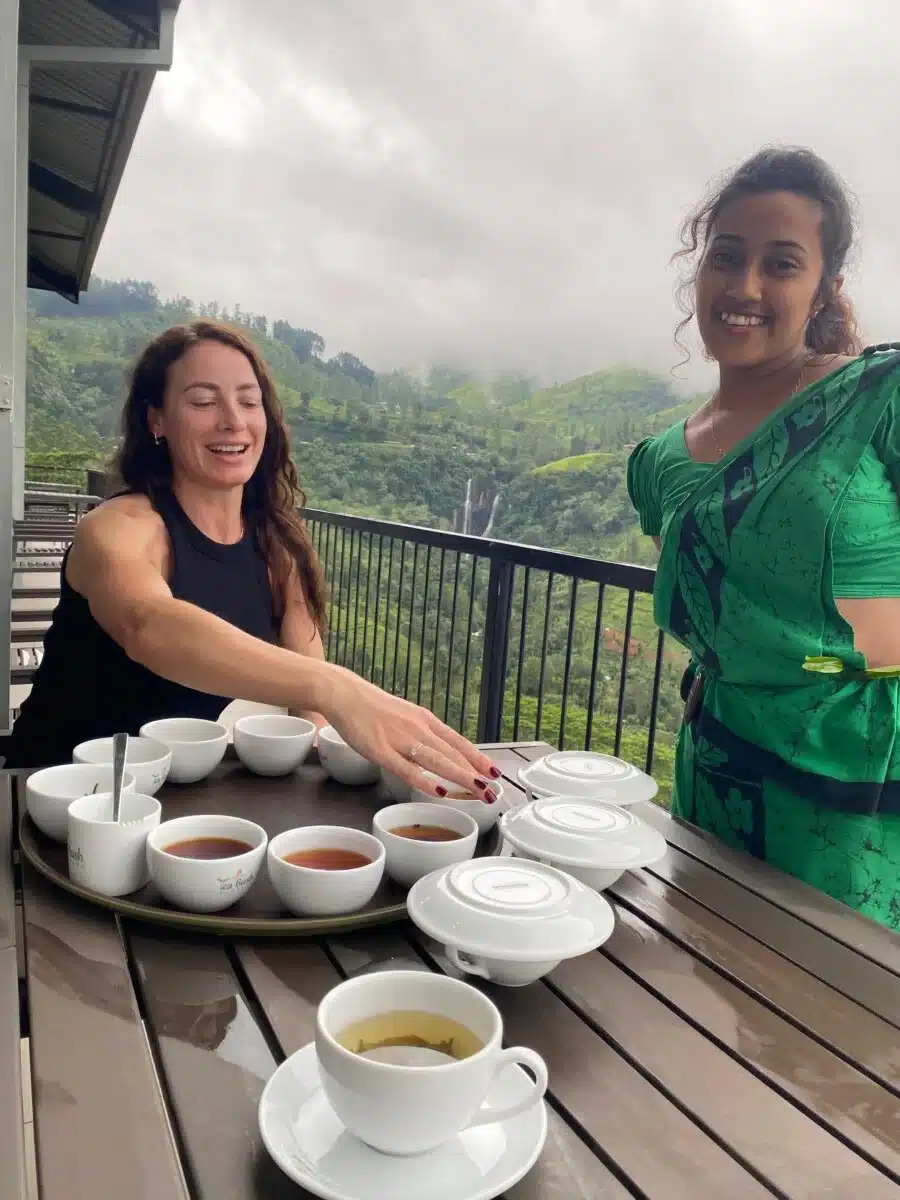
A tea plantation tour in Sri Lanka is usually a walk among the bushes, a guided look round a factory and a tasting. You can fit one into almost any route. The Sri Lanka Tea Board divides the island’s tea into seven districts: Kandy, Nuwara Eliya, Uda Pussellawa, Uva, Dimbula, Sabaragamuwa and Ruhuna (Sri Lanka Tea Board). Near Kandy you have the Ceylon Tea Museum and Loolecondera, the island’s first tea estate (Wikipedia). Nuwara Eliya has Pedro and Damro Labookellie, Ella has Uva Halpewatte, and Haputale has Dambatenne. On the south coast, Handunugoda near Ahangama runs daily tours. Halpewatte listed its factory tour at LKR 3,000 when we checked on 24 October 2026 (Halpe Tea).
Key takeaways
- Pick the estate nearest your route rather than a “best” one: Nuwara Eliya, Ella, Haputale and Weligama each have a factory tour within 15 km by road.
- Three places publish their own hours and prices: the Ceylon Tea Museum, Uva Halpewatte and Handunugoda. For the rest we found only older third-party figures or none, so ask on the day.
- Tea is plucked all year. Kandy is driest in February, Nuwara Eliya in February and March, and the Ella side in July and August.
- Wikivoyage advises against photos inside tea factories, so expect to take your pictures in the fields.
- The Pekoe Trail links several estates on foot. Its notice of 17 October 2026 had Stage 2, the one to Loolecondera, closed.
Where tea grows in Sri Lanka
The Tea Board’s seven districts are legal names. A tea may carry one only if it was grown and made in that district (Sri Lanka Tea Board). Each name also implies an altitude band. Kandy tea is “mid-grown”, from 650 m to 1,300 m (Sri Lanka Tea Board). Uva estates sit between 1,000 m and 1,600 m, and Nuwara Eliya’s average around 2,000 m (Sri Lanka Tea Board). Dimbula, whose sub-districts include Dickoya, Kotagala, Talawakelle and Nanu Oya, is high-grown too (Sri Lanka Tea Board).
Ruhuna is the low-grown south, below 600 m, on the coastal plain and low hills of the Southern Province (Sri Lanka Tea Board). That puts a Sri Lanka tea experience within reach of a beach stay on the south coast, which is why Handunugoda appears in the table below.
Tea factories and estates that take visitors
The table runs from Kandy south to the coast. It reports what each place’s own page, Love Sri Lanka, Wikivoyage, The Island or the Pekoe Trail showed when we checked on 24 October 2026; it is not a ranking or our judgement. Drive times come from the OpenStreetMap route planner (the “route” links), rounded up for hill roads.
| Place, and the drive to it | What the visit includes | Hours and fee on record |
|---|---|---|
| Ceylon Tea Museum, Hantane. From Kandy, 8 km, usually 20 to 30 minutes (route) | Old machinery on two floors, a library, a tea shop and a top-floor cafe (Ceylon Tea Museum) | Tuesday to Friday 8.30am to 4pm, weekends 8am to 5pm, closed Mondays; LKR 1,000 for a non-resident adult, LKR 500 for a child (Ceylon Tea Museum) |
| Loolecondera estate, near Deltota. From Kandy, 35 km, usually 1 to 1.5 hours (route) | James Taylor’s seat, his cottage and the Loolkandura factory are marked stops on the Pekoe Trail (Pekoe Trail) | We found no visitor hours or fee published by the estate, so check access before you go |
| Damro Labookellie Tea Centre. From Nuwara Eliya, 12 km on the Kandy road, usually 20 to 30 minutes (route) | Tea with a valley view, the factory floor and a tea shop (The Island) | Neither hours nor a fee appear on the pages we read |
| Pedro Tea Estate. From Nuwara Eliya, 4 km, usually 10 to 15 minutes (route) | A 20-minute factory tour and a tea boutique above the estate (Love Sri Lanka) | Love Sri Lanka gives two different sets of daily hours on the same page; no fee shown |
| Uva Halpewatte Tea Factory. From Ella, 6 km, usually 10 to 20 minutes (route) | Factory tour with tasting; plantation tour with plucking; a two-hour handmade tea class (Halpe Tea) | Factory or plantation tour LKR 3,000, 8am to 4.30pm; tea class LKR 9,000 (Halpe Tea) |
| Dambatenne Tea Factory. From Haputale, 9.5 km, usually 15 to 25 minutes (route) | Tours every 30 minutes through the process, then a tasting and a shop (Love Sri Lanka) | Rs 1,000 in a Wikivoyage listing updated January 2025 (Wikivoyage) |
| Lipton’s Seat (viewpoint): 6 km beyond Dambatenne, usually 20 to 30 minutes (route) | A lookout at 1,970 m with a statue of Lipton on a bench (Love Sri Lanka; Wikivoyage) | Rs 550 in the same January 2025 listing (Wikivoyage) |
| Handunugoda Tea Estate (Herman Teas), Ahangama. From Weligama, 14 km, usually 25 to 35 minutes (route) | Plantation walk, a factory with 150-year-old machinery and a tea tasting programme (Herman Teas) | Open daily 8am to 4.30pm (Herman Teas); standard tour Rs 1,000, free for under-14s (Herman Teas) |
Where a figure comes from Wikivoyage or Love Sri Lanka rather than the estate, treat it as a guide and confirm the price at the gate.
How to choose: start from where you already are
The right factory is usually the one on your road.
From Kandy
The Ceylon Tea Museum is the easy half day. It fills the old Hantane factory, built in 1925, and opened as a museum on 1 December 2001 (Love Sri Lanka). Love Sri Lanka’s page lists shorter hours than the museum’s own site, so go by the museum and phone if you are cutting it fine. It pairs well with a temple morning on a day in Kandy.
Loolecondera, where Taylor planted the first tea, is about 35 km south-east of Kandy (Wikipedia). The estate publishes no visitor arrangements that we could find. Treat it as a drive to see where Ceylon tea began, and ask your driver to check access before you set out.
Around Nuwara Eliya
Our Nuwara Eliya tea plantations guide covers the five estates around the town, with their hours, fees and a one-day plan, so we keep this short. Pedro is the closest to town, and Damro Labookellie stands beside the Kandy road, so it can be a stop on the drive up (see the table above).
From Ella and Haputale
If you’re staying in Ella, Uva Halpewatte is the nearest factory with published tours. Halpe Tea runs the tours there and describes it as a functioning factory and one of the largest producers of Ceylon tea (Halpe Tea). An undated Wikivoyage listing describes a quick visit with green tea tasting at the Newburgh Green Tea Factory (Wikivoyage). It is about 3 km by road from Ella station (OpenStreetMap).
Dambatenne and Lipton’s Seat make a single morning from Haputale, which is 22 km from Ella, usually 30 to 45 minutes (OpenStreetMap). Go to the viewpoint first. Wikivoyage warns that cloud can roll in from 10am (Wikivoyage), and Love Sri Lanka also says go early to beat the crowds and the fog (Love Sri Lanka).
Coming from Kandy, Ella is a long day by road. It is about 134 km, and the route planner’s estimate is under three hours (OpenStreetMap). Hill roads are slower than that, and our Kandy to Ella train guide allows 4 to 5 hours for the drive. On 24 October 2026 we found no single train covering the whole way. Trains between Nanu Oya and Badulla, through Haputale and Ella, have run since 20 June 2026 (Sunday Times). Colombo Times reported on 2 October 2026 that trains would not run between Peradeniya and Kandy until a bridge was repaired, and that work continued between Hatton and Nanu Oya (Colombo Times). The train guide keeps track of the line as it reopens.
From the south coast
You don’t need the hills to see a tea factory. Love Sri Lanka places Handunugoda between the Sinharaja forest and the southern coast, and says it specialises in Virgin White Tea (Love Sri Lanka). Its owners describe that tea as cut from a single unopened bud with golden scissors, never touched by hand (Herman Teas). From Galle Fort it is about 23 km, usually 30 to 45 minutes (OpenStreetMap), so it fits into half a day from Galle or Weligama. Our guide to day trips from Weligama covers the other options along that coast.
What happens on a factory tour
Most tours follow the leaf through the orthodox method, the slow traditional process that the Tea Board says Sri Lanka still keeps (Sri Lanka Tea Board). The fresh leaf is withered in troughs for up to a day, rolled to break it open and spread on tables to react with the air. A firing chamber then dries it to black tea, and a sifter sorts it into leaf, broken and dust grades (Sri Lanka Tea Board). The Tea Board adds that leaf size changes the strength and colour of a cup, not its quality, which is worth remembering at the tasting table. The Nuwara Eliya guide linked above takes each stage in more detail.
Ceylon tea history in four lines
Coffee came first. Coffee rust showed up on a Madulsima plantation in 1869, and the blight went on to wipe out the island’s coffee (Sri Lanka Tea Board).
Two years before that, in 1867, James Taylor planted 19 acres of tea at Loolecondera, and in 1872 he opened a fully equipped factory there (Wikipedia).
Thomas Lipton visited Ceylon in 1890 and his company began selling Ceylon tea in Europe and the United States that year (Wikipedia). Love Sri Lanka dates his Dambatenne factory to the same year (Love Sri Lanka).
The Tea Board says it was with tea from his Uva estates that Lipton won Americans over to tea (Sri Lanka Tea Board).
When to go: plucking never stops
Tea is picked all year round in Sri Lanka, the Tea Board notes (Sri Lanka Tea Board), so there is leaf to pick in any month. What changes is the weather, and the two sides of the hills run on opposite calendars.
The Tea Board’s “quality seasons” show it. Kandy estates make their best tea in the first three months of the year, when cool, dry weather sets in (Sri Lanka Tea Board). On the Uva side the quality season runs from July to September (Sri Lanka Tea Board).
The 1991 to 2020 averages from the nearest weather stations tell the same story. Bandarawela, the nearest station with these averages to Ella and Haputale, is about 9 km from Ella and 8 km from Haputale in a straight line.
| Weather station (area) | Driest months | Wettest month |
|---|---|---|
| Katugastota (Kandy) | February, 78 mm on 6 days | October, 303 mm on 18 days |
| Nuwara Eliya | February 73 mm and March 72 mm, on 7 days each | October, 247 mm on 19 days |
| Bandarawela (Ella, Haputale) | July 71 mm on 7 days, August 68 mm on 8 | October, 347 mm on 22 days |
| Galle (south coast) | February, 71 mm on 6 days | October, about 345 mm on 18 days |
Sources: WMO 1991 to 2020 normals for Katugastota, Nuwara Eliya, Bandarawela and Galle.
October and November are wet everywhere in the table. Bandarawela averages 338 mm on 24 days in November (WMO normals). Factory floors are under a roof, but viewpoints and field walks suffer. Mornings are the better bet in any month. Our Sri Lanka weather by month page has the full picture for the coasts as well.

What to wear, and taking photos
Pack a warm layer for the high estates. Nuwara Eliya’s average night-time low stays between about 10°C and 14°C all year (WMO normals). Bandarawela, lower down, averages 23°C to 27°C by day (WMO normals). Shoes with some grip help on estate paths after rain. The Pekoe Trail warns that one of its forest sections near Deltota is prone to leeches (Pekoe Trail).
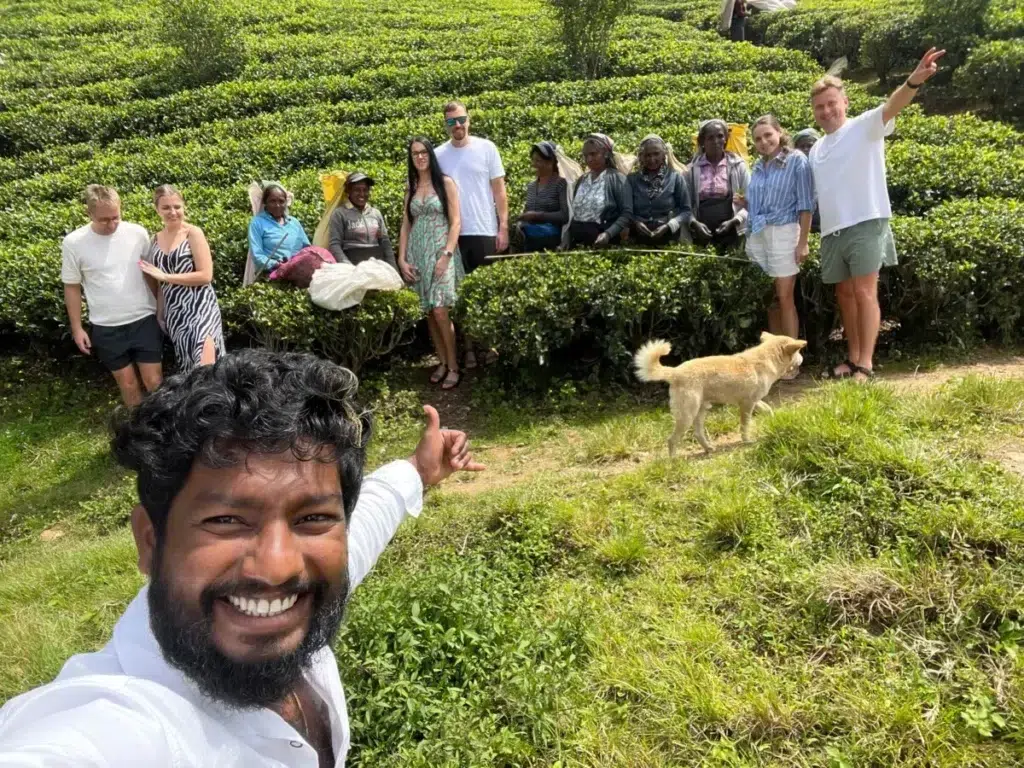
Inside, don’t count on taking pictures. Wikivoyage’s Sri Lanka guide advises against photography inside tea factories and says the outside is fine (Wikivoyage), and Love Sri Lanka says Pedro forbids it (Love Sri Lanka). In the fields, the pluckers are at work. We’d ask before taking anyone’s picture, keep to the paths between the rows, and accept a no.
The Pekoe Trail: walking between estates
Running for 300 km across the central highlands, the Pekoe Trail is divided into 22 stages (Pekoe Trail). Its stage list runs from the Kandy area through Hatton, Haputale and Ella to Nuwara Eliya, and the trail says most stages can be walked between 6am and 6pm (Pekoe Trail). Its stage pages say the trail is free to walk, with an optional trail pass as a contribution (Pekoe Trail). Some stages need separate tickets or permits from landowners or government departments (Pekoe Trail).
These stages pass the estates in our table, as the trail describes them:
- Stage 2, Galaha to Loolkandura (14.7 km): passes James Taylor’s seat and cottage and ends at Loolkandura (Pekoe Trail).
- Stage 3, Loolkandura to Tawalantenne: starts on the Loolkandura estate and follows the old Dimbula road, built for horses and bullock carts (Pekoe Trail).
- Stage 13, Haputale to St Catherine’s: tea trails with views across the valley to Lipton’s Seat (Pekoe Trail).
- Stage 22, Kandapola to Pedro: ends at the Pedro estate, whose factory the trail says offers guided tours (Pekoe Trail).
Check conditions before any walk. In its update of 17 October 2026, the trail had temporarily closed Stage 2 and put eight stages, including 3, on amber alert (Pekoe Trail). Every other stage was under a yellow advisory because of the north-east monsoon.
Questions about tea plantation tours in Sri Lanka
Which is the best tea factory to visit in Sri Lanka?
There isn’t one best factory, and we don’t rank them: choose by your route. Uva Halpewatte and Handunugoda publish their tours, times and prices (Halpe Tea; Herman Teas), which makes them the easiest to plan. Dambatenne pairs with Lipton’s Seat, Pedro is closest to Nuwara Eliya, and the Ceylon Tea Museum suits Kandy.
How much does a tea plantation tour in Sri Lanka cost?
On 24 October 2026, Halpewatte listed LKR 3,000 for a factory or plantation tour (Halpe Tea). Handunugoda’s standard tour was Rs 1,000 (Herman Teas), and the Ceylon Tea Museum charged LKR 1,000 for a non-resident adult (Ceylon Tea Museum). Wikivoyage’s January 2025 figure for Dambatenne is Rs 1,000 (Wikivoyage).
Do I need a guide or a booking?
Halpewatte and Handunugoda describe their tours as guided, so you don’t need to bring a guide of your own (Halpe Tea; Herman Teas). For a standard factory tour, none of the pages we read says you must book, though Halpewatte links each tour to a booking page and Handunugoda has a booking page of its own (Halpe Tea; Herman Teas). Love Sri Lanka says Dambatenne’s tours start every 30 minutes (Love Sri Lanka). Halpewatte’s handmade tea class runs in set two-hour slots (Halpe Tea), so reserve that one ahead.
Can I visit a tea estate from the south coast?
Yes. Handunugoda, at Tittagalla near Ahangama, is open daily from 8am to 4.30pm (Herman Teas). It is about 14 km from Weligama, usually 25 to 35 minutes by road (OpenStreetMap).
Add a tea day to your route
Oura Travel plans private road journeys from its office in Weligama, and you travel with your own driver-guide (Oura Travel). Our 11-day Waves and Wonders route stops for two nights in a planter’s bungalow at Hatton. Its tea day is an estate walk, the factory and a tasting. Still weighing up how many days in Sri Lanka to give the hills? Send us your dates and the estates you’d like to see.
We read every estate page, listing, weather normal, trail notice and rail report linked here on 24 October 2026 and ran each drive on the route planner that day. Tour prices, opening hours and trail conditions change, so check them before you set off.