
Sri Lanka drivers who carry tourists come in three kinds, and you can look two of them up before you pay. Chauffeur tourist guides hold a Sri Lanka Tourism Development Authority (SLTDA) licence and are registered to drive visitors as well as guide them (SLITHM). Tourist drivers take a four-day course, then apply for an SLTDA identity (SLITHM; SLTDA). The rest are on neither list. Safety is a separate question: UK advice calls driving erratic and says road accidents happen often (GOV.UK). We sell a car with a driver ourselves, so treat us like any other company. This page reports no register result for anyone, and the check is yours to run.
Key takeaways
- A chauffeur tourist guide is registered as both guide and chauffeur, for a vehicle with up to seven seats. A tourist driver has a four-day course and an SLTDA identity.
- Sri Lanka Tourism’s website has three searchable registers: tour guides, authorised tourist drivers and travel agents. Ask for a name and a registration number, then look them up.
- No official advice we read calls hired drivers safe or unsafe. On 5 October 2026 the UK, Australian and US pages all warned about the roads, in the words quoted below.
- We found no official day rate, bata rate or tipping figure for a hired driver. Get what is included in writing.
Sri Lanka drivers and driver guides: who is who
Sri Lanka driver guides have an official name: chauffeur tourist guides. SLITHM, the institute that trains guides, defines one as a person registered to practise as a tourist guide and as chauffeur of a vehicle with no more than seven seats. It calls the SLTDA licence “the prime legal requirement to perform as a Tourist Guide in Sri Lanka” (SLITHM).
Four kinds of guide work under that licence: national, chauffeur, area and site (SLTDA). Only national and chauffeur guides may guide anywhere in the country (SLTDA study, May 2024).
| Who | Training and SLTDA document | Register, and number listed on 5 October 2026 |
|---|---|---|
| Chauffeur tourist guide (the “driver guide”) | Five-month full-time course with a module on safe driving, then an SLTDA licence. Applicants need five years’ experience of driving a seven-seat vehicle (SLITHM) | Tour guides register, type “Chauffeur”: 1,008 |
| National tourist guide | Five-month full-time course, then an SLTDA licence (SLITHM). Generally leads large coach groups whose coach has its own driver | Tour guides register, type “National”: 1,326 |
| Area guide or site guide | Licence to guide in one area or at one site (SLTDA study) | Tour guides register, types “Area” and “Site”: 696 and 24 |
| Tourist driver | Four-day course for Sri Lankan citizens aged 23 to 60 with five years on a driving licence, then an SLTDA “Tourist Driver Identity” (SLITHM; SLTDA) | Authorised tourist drivers register: 982 |
| Any other driver | No SLTDA document | On neither register |
| Travel agent (the company selling the trip) | SLTDA registration number, licence number and a validity date | Travel agents register: 483 “Formal” and 132 “Provisional” |
The four guide types came to 3,054 names that day, and the totals move. An SLTDA study estimated 4,887 licensed and 1,460 unlicensed guides as of May 2024 (SLTDA study).
How to check a driver on the official registers
We found three searchable lists on Sri Lanka Tourism’s website. SLTDA’s own registration page links to two of them, the guide and agent lists (SLTDA).
- Ask the company for the full name and SLTDA registration number of the person who will drive you.
- For a guide, search the tour guides register by name or number. A listing shows the category, languages, registration number and a line such as “Valid till 31st December 2027”.
- For a tourist driver, search the authorised tourist drivers register by name, number or association. The listings we saw gave a number beginning SLTDA/ATD/ and an association name, with no expiry date.
- For the company, search the travel agents register by name or registration number, under “Formal” and then “Provisional”. SLTDA also links a list of suspended travel agents, a file created in February 2023.
- At pick-up, ask to see the card. SLTDA’s process for guides ends with a licence that is an identity card (SLTDA).
On the first page of the guide and agent lists, every entry read “Valid till” a date. A separate view held 2,503 guides that day, its first page reading “Expired on” (expired guide licences). If a name isn’t listed, ask for the number and the card, and read the date.
A listing tells you that SLTDA has that person or company on its books and, for guides and agents, until when. A guide files a police report and a medical report to get there, and again at renewal (SLTDA). A listing can’t tell you how someone drives.
Are Sri Lanka drivers safe? What official advice says
We won’t answer that with a yes or a no, and no government page we read does either. On 5 October 2026 the UK advised against travel to no part of the country, the US rated Sri Lanka Level 2 of 4 and Australia said “exercise a high degree of caution”. All three warn about the roads, and none rates hired drivers. The tables report each page’s road advice that day.
UK: GOV.UK, updated 21 September 2026
| Topic | What GOV.UK says |
|---|---|
| Overall | No advice against travel to any part of the country, with the line “No travel can be guaranteed safe” (warnings) |
| Driving | Calls driving “erratic”, with “frequent road accidents, particularly at night”. Remote roads especially may be in poor condition. Watch for pedestrians and animals. Riding a motorbike “can be especially dangerous” |
| After a collision | Stay with the vehicle while that is safe. If it isn’t, or you feel threatened, go to a police station |
| Buses | Public buses are “often driven fast”, seldom give way and often lack maintenance, which it links to serious accidents in recent years. Tourist buses: “usually driven more professionally and safely”, though “standards can vary” |
| Taxis and tuk-tuks | Agree a tuk-tuk fare first or find a working meter. Harassment is reported occasionally, of women at night in particular. Change vehicle if the driver or the driving worries you |
| Checkpoints | Some main roads still have them. Do what the officers say: forces have fired on vehicles that didn’t stop. Colombo roads near government and military sites often close |
| Landmines | Take warning signs in the north seriously. In parts of the east, don’t step off roads or cleared footpaths (regional risks) |
| Rain | The inter-monsoon rains have pushed up flood and landslide risk, and transport may be disrupted. Heavy rain and landslips can close roads (warnings) |
| Fuel | Purchases are limited and each vehicle is to get a weekly quota. Special arrangements for tour operators and hotels have been announced (warnings) |
Australia: Smartraveller, updated 14 August 2026
| Topic | What Smartraveller says |
|---|---|
| Overall | “Exercise a high degree of caution”, for which it gives public demonstrations and security risks as the reasons |
| Driving | Calls driving “hazardous”. Road accident injuries and deaths are common, driving standards are poor and vehicles “aren’t well maintained”. If you drive, learn local traffic laws and don’t drink and drive |
| Operators | Not every transport or tour operator follows “safety and maintenance standards”. For adventure activities: use safety gear such as seatbelts, and go elsewhere if you doubt a company’s safety |
| Buses and trains | Safety standards may be lower than in Australia. Road deaths and injuries are high, intercity buses especially, and railways have had fatal accidents in recent years |
| Taxis and tuk-tuks | Ride-share vehicle standards vary. Women may experience sexual harassment and assault, and are told to take care on public buses and in tuk-tuks |
| Solo travellers | Tells them to “arrange travel through a reputable company”. The page doesn’t say how to judge one |
| Checkpoints | Police and military may set them up, or close roads, without warning. Carry identification. Demonstrations can disrupt traffic |
| Landmines | Minefields, marked and unmarked, remain in the Northern Province and parts of the Eastern. Keep to main roads and watch for warning signs |
| Rain | Floods and landslides come with the monsoons. Be ready to change plans, and stay out of floodwater |
| Cyclone Ditwah | Most affected areas are cleared and tourist destinations “are operating as usual”. Rail, bridge and landslide repairs will go on for some time. Check conditions before a trip into the central mountain districts |
| Fuel | Vehicles must be registered in a national fuel system and hold a QR code. With a tour operator “you’re unlikely to be affected”. Check that a privately hired vehicle has both |
US: State Department, advisory issued 14 October 2025
| Topic | What the State Department says |
|---|---|
| Overall | Level 2 of 4, “exercise increased caution”, for civil unrest, terrorism and landmines. Its travel guidance is dated 16 October 2025 |
| Roads | Conditions “differ significantly” from those in the United States. Roads are often crowded with trucks, “buses that are not driven well” and other vehicles. They “are improving, but many remain in medium to poor condition” |
| Hired cars | “Visitors generally do not drive.” Many hire cars and drivers for longer trips. Anyone renting a vehicle should ask specifically for working seatbelts |
| Tourism industry | Describes it as “not well regulated”: safety inspections are rare, dangerous areas aren’t always signed, and staff “may not be trained or certified” |
| Buses | The embassy recommends avoiding public buses, for safety and a high risk of harassment and theft |
| Taxis and tuk-tuks | Take a metered tuk-tuk or agree the fare first. Beware drivers offering “special” tours or a way into festivals or gem shops, who “may be scammers”, and friendly strangers offering tours |
| Checkpoints | Police and military keep checkpoints around the country. Carry your passport or risk detention. Unexpected roadblocks and one-way streets may not be signed |
| Landmines | Don’t leave well-used roads, tracks and paths in certain northern and eastern areas |
| Landslides | Frequent in heavy rain, in the central highlands above all, and they “can block roads” |
| Routes | Research any route a GPS suggests, because the fastest “is not always the safest” |
Those are the road passages only. The same pages say more to women travelling alone, and our first-visit guide covers what the three governments say about the country as a whole.
What the casualty figures show
| Measure | Figure | Source |
|---|---|---|
| Road deaths in 2025 | 2,710, in 2,562 fatal accidents: 322 more deaths than in 2024. Speeding, drunk driving, fatigue and narcotics were named among the main causes | Police spokesperson, 2 January 2026 (Xinhua) |
| Road deaths from 1 January to 20 August 2026 | 1,749, in 1,654 fatal accidents. The report lists 617 motorcyclists, 576 pedestrians, 173 passengers, 139 drivers, 122 pillion riders and 119 cyclists | Deputy inspector general for traffic, 21 August 2026 (Newswire) |
| Estimated road deaths per 100,000 people, 2021 | Sri Lanka 11.5. UK 2.4, Australia 4.5, United States 14.2 | World Health Organization (WHO) |
These are national counts of everyone killed on the roads. None separates tourists, hired cars or any kind of driver, so they say nothing about one trip or one company.
Three things are in a passenger’s hands. Ask for working seatbelts, plan driving days that end before dark, and change vehicle if the driving worries you. The Automobile Association of Ceylon lists yawning, slow reactions and missed road signs among the signs of a tired driver (AA Ceylon). Ask any operator how many hours off the driver gets between driving days. Our own private car page, linked at the foot of this post, says around ten. That is a company’s statement, ours, and nothing here verifies it.
Sri Lanka driver reviews: where to read them and what to trust
Our search for Sri Lanka driver reviews on 5 October 2026 returned eight Tripadvisor pages and one Trustpilot page. An SLTDA study in May 2024 reported high satisfaction among tourists and one concern: “the lack of transparent platforms and sources to find dependable” guides (SLTDA study).
Tripadvisor says it received 31.1 million reviews in 2024 and caught 2.7 million fraudulent ones. More than half of the fakes (54%) were “review boosting” by owners, employees or others tied to the business (Tripadvisor, March 2025). Google’s policy, as it stood on 5 October 2026, bans paid reviews and any incentive offered for one (Google). In the UK, fake reviews have been banned since 6 April 2025 (GOV.UK).
The US Federal Trade Commission’s advice on judging reviews, dated October 2022, comes down to five checks (FTC):
- Read more than one source.
- Look at the dates. Many reviews arriving close together can sometimes mean they’re fake.
- Open the reviewer’s profile. An account created to write one review is a warning sign.
- Don’t trust your eye. Some fake positive reviews give less than top marks to look real.
- Remember that fakes can be negative, posted to harm a competitor.
We’d add a sixth. Favour reviews that name the route, the month and the person who drove, and that mention the vehicle, the pace, night driving and any shop stop nobody asked for. Some small businesses told SLTDA’s researchers that guides take tourists to preferred gem shops and restaurants to earn commission (SLTDA study).
Apply the same checks to ours: on 5 October 2026 the reviews widget on our tour list displayed “EXCELLENT” and “Based on 73 reviews”, with no numeric score, so read them on Google itself.
Questions to ask a driver before you pay
Send these in writing and keep the answers. To put them to us, use our contact page.
- Who will drive, and what is that person’s SLTDA registration number?
- Is the driver a chauffeur guide or a tourist driver, and who gives commentary at the sites?
- What does the price include: fuel, tolls, parking, the driver’s meals and bed? What is extra?
- When does each driving day end, and how many hours off does the driver get?
- Will we stop anywhere I haven’t asked for?
- What happens if the car breaks down or the driver is ill?
- What insurance covers passengers, and can I see the certificate?
- How does the weekly fuel quota affect our route?
- Who do I call if there’s a problem, and what is refunded if the trip ends early?
If something goes wrong, GOV.UK lists the Tourist Police on 011 2421052 and Sri Lanka Tourism’s 24-hour hotline on 1912 (getting help; warnings). SLTDA takes complaints online and gives each a tracking number (SLTDA complaints).
The daily bata and where your driver sleeps
We found no official Sri Lankan definition of a driver’s bata and no official rate. Only the dictionary sense can be sourced. Merriam-Webster defines batta, as used in India, as “subsistence money” or the “maintenance or traveling expenses of an employee” (Merriam-Webster; see also Wikipedia).
Reading the “daily bata” on a quote as the driver’s daily allowance is our interpretation, not a sourced definition. So ask what it covers, meals only or a bed as well, and whether it sits inside the day rate or on top.
On beds, we found one SLTDA guideline. Where drivers need to stay overnight, a heritage hotel “must provide such suitable accommodation and meals” (heritage hotel guidelines). SLTDA’s draft hotel classification criteria list only toilets for drivers, and its 2024 guest house guidelines don’t mention them. So ask a small guesthouse whether it has a bed and a meal for a driver, and who pays if not.
What a Sri Lanka driver costs per day, and what to get in writing
We found no official day rate for a car and driver in Sri Lanka. We don’t print our own price here, and our private car page shows no day rate either. Give two or three companies the same route, dates and group size, then compare what each quote includes. If the route isn’t fixed yet, our Sri Lanka itinerary planner works through it step by step.
Get these on one page before you pay:
- the vehicle type and the driver’s name
- the dates, the pick-up and drop-off points and the route day by day
- any daily distance cap and the charge beyond it
- the deposit, the balance, the currency and the cancellation terms
Driving yourself, or not being driven at all
The US State Department says “Visitors generally do not drive” (State Department). A visitor can, with paperwork, and the official pages we read on 5 October 2026 describe two routes.
| Source | What it says a visitor needs |
|---|---|
| Bandaranaike airport, for the Department of Motor Traffic (airport site) | A temporary driving licence, which tourists can get on landing. Bring a full foreign licence valid for a year or more, a translation if it isn’t in English, and your passport and visa |
| UK (GOV.UK) | A 1949 international driving permit, bought before leaving the UK, and a Sri Lankan “recognition permit” from the Automobile Association of Ceylon in Colombo |
| Australia (Smartraveller) | Either an international driving permit endorsed by the Automobile Association, or a temporary Sri Lankan licence from the Department of Motor Traffic |
The airport page limits the temporary licence to motorcycles and light vehicles and prices it at Rs 15,000 for one month, the fee in the department’s own schedule (Department of Motor Traffic). GOV.UK adds checks on the hire company: registration with the tourist board, a “Safe & Secure” certificate, insurance and a roadworthy vehicle. Smartraveller warns that without a permit or licence, insurance may not cover you.
For travel without any driver, our Kandy to Ella train guide gives the hill line’s status section by section.
Questions about Sri Lanka drivers
What is a driver guide in Sri Lanka?
Officially it’s a chauffeur tourist guide: someone registered to practise as a tourist guide and to drive visitors in a vehicle with up to seven seats (SLITHM). A tourist driver has a four-day course and an SLTDA identity instead (SLITHM).
How do I find a reliable tourist driver in Sri Lanka?
Get the driver’s name and SLTDA number and search the official registers. Read reviews on more than one platform, then send the questions above in writing. No register or review can promise how a person will drive.
Is hiring a driver in Sri Lanka safe?
No official advice we read says yes or no, and none rates hired drivers. On 5 October 2026 GOV.UK called driving “erratic”, Smartraveller called it “hazardous” and the State Department described the tourism industry as “not well regulated”. The tables above give each page’s road advice, with its date.
How much should I tip a driver in Sri Lanka?
We found no official figure for a driver hired by the day. In June 2024 the Sunday Times reported Department of Labour officials saying Sri Lanka has no laws on tipping or service charges (Sunday Times).
If you ask us for a quote
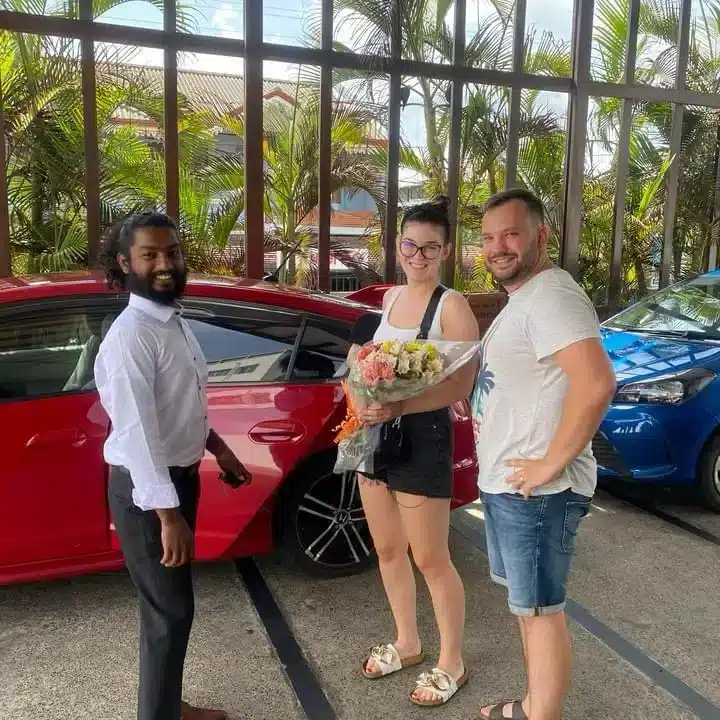
We’re Oura Travel, based in Weligama, and we arrange private trips by car with a driver. Our private car page is where a quote is requested: you send your dates, your group size and roughly what you want to see. Put the same questions to us in writing first.
We read the registers, advice pages, fee tables and figures above at their sources on 5 October 2026. All of them change, so search the registers again and reopen your own government’s advice before you pay anyone.