
Tailor-made Sri Lanka journeys, planned in Weligama.
(+94) 71 489 9799 (+94) 76 173 1708 contact@ouratravel.com
10 days Wildlife Private tour
Sri Lanka’s Big Five Game
- 10 days Duration
- 50 Max People
- Airport Pickup
- Udaya Guider
About this trip
About this route
Ten days and four national parks, plus a rainforest and a boat out to the whales. Outside Africa there are few places with this strike rate for big animals in a small area, and this route is built to use that.
You start in Colombo, go north to Minneriya, climb to Nuwara Eliya, drop to Yala and Bundala, cross to Udawalawe, walk in Sinharaja and finish on the south coast at Galle and Mirissa.
It is private throughout. Your own driver-guide stays with you for all ten days, and every park drive is with a naturalist or tracker who works that park.
Why this route works
- Four parks with four different habitats, so you are not looking for the same animals twice.
- Minneriya for elephants at the reservoir, Yala for leopard, Bundala for water birds, Udawalawe for elephants at close range all year.
- Sinharaja adds the wet zone, which is where the endemic birds and amphibians are.
- Blue whales off Mirissa at the end, in the season when they pass.
Who it suits
- Anyone whose reason for coming is the animals rather than the temples.
- Photographers, because the route gives you morning and evening light in the same park more than once.
- Families with older children who can handle early starts and long jeep hours.
Who it does not suit
- If you want a relaxed holiday, this one has a lot of dawn alarms.
- If the ancient cities are the point, only Sigiriya is on this route.
Included activities
- Colombo city tour
- Safari at Minneriya National Park
- Sigiriya rock fortress
- Tea plantation and factory visit on the hill country drive
- Two safaris at Yala National Park
- Safari at Bundala National Park
- Evening safari at Udawalawe National Park
- Udawalawe Elephant Transit Home
- Two treks in the Sinharaja rainforest
- Galle Fort walking tour
- Whale and dolphin watching from Mirissa
Best time to go
The south and west are driest from roughly November to April, which is also the whale season off Mirissa. The elephant gathering at Minneriya builds through the dry months and peaks around August and September. Yala Block 1 normally closes for about a month in the second half of the year, and we move the route to Bundala and Udawalawe when it does. February to April is the fullest compromise if you want everything.
How booking works
Send your dates through the enquiry form on this page, or message us on WhatsApp. You get back a day by day plan with the hotels named and a price for your group. Nothing is held or charged while you think about it.
To confirm, we ask for a deposit of 50 percent of the total, with the balance due at least five days before you arrive. Bookings made within ten days of arrival are paid in full at the time of booking. Card payments are handled by PayHere, and a booking is confirmed only once we send you written confirmation.
Prices shown here are per person in US dollars, based on the level 1 hotels. A higher hotel level, extra nights or changes to the route all change the price, so ask us for a quote on your own dates. Cancellation terms are set out in our refund policy.
Day by day
A plan, not a timetable. Any day can be swapped once you are here.
Your driver-guide meets you at the airport and drives you into Colombo, about an hour depending on traffic. Most people go straight to the hotel and sleep.
If you land early there is time for a first look at the city: the market streets of Pettah, the old Fort quarter, the Hindu temples on Sea Street and the Dutch church at Wolvendaal.
North to Minneriya, which covers about 8,900 hectares and sits on an elephant corridor. The herds come down to the reservoir to drink and feed, and in the dry months they arrive in numbers you will not see anywhere else on the island.
Twenty three mammal species live here along with more than 170 birds, so leopard, sloth bear, sambar and buffalo are all possible while you are watching the elephants.
Sigiriya in the morning. It is over a thousand steps past the fifth century frescoes and the lion paws to a citadel built on top of a rock, with the whole plain below it.
Then you drive up into the hills, stopping at a tea plantation and factory to see the leaf picked and processed. Nuwara Eliya at the top is a hill station the British built, cool enough in the evening to want a jacket, with a racecourse, a golf course and hedges.
You come down from the hills into the dry scrub at Yala, which takes half a day and changes the landscape completely.
The evening drive is the first of your two at Yala. Block 1 holds one of the highest leopard densities recorded anywhere, and elephant, sloth bear, sambar, buffalo and crocodile are all regular. No park guarantees a leopard on a single drive, which is why you have two.
The morning is at Bundala, a chain of lagoons, dunes and thorn scrub with 197 bird species and 32 mammals recorded. It is the better park for birds by a distance, and flamingo arrive in season.
In the evening you go back into Yala with your tracker, who will be working the alarm calls of the deer and langur rather than the map.
You cross west to Udawalawe, which holds somewhere between 600 and 700 elephants and shows them more reliably than any other park in the country. The terrain is open, so the sightings are long and close.
Leopard and bear are here too but hard to see in this landscape. Lunch, then the evening drive around the reservoir that feeds the whole district.
You start at the Elephant Transit Home, where orphaned and injured calves are raised and then released back into the wild. Feeding times are the moment to be there.
Then you drive to Sinharaja, the last large stretch of primary rainforest on the island and a World Heritage Site. Over half of the country's endemic mammals and butterflies live here, along with most of its endemic birds. You walk it twice, morning and evening, because the forest is a different place in each.
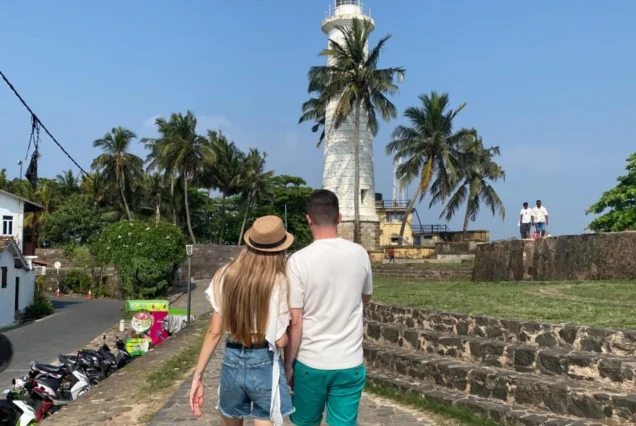
Out of the forest to the coast and Galle, the oldest living city in Sri Lanka. The fort is a Dutch walled town on Portuguese foundations, still lived in, with the ramparts, the lighthouse, the churches and the warehouses among the cafes and shops.
You walk it with your guide and keep the afternoon free. Late in the day the whole town comes out onto the wall.
An early boat out of Mirissa to look for whales. This is one of the few places in the world where blue whales and sperm whales are both seen, because the continental shelf runs close to shore here and the deep water is within reach.
Dolphins often travel with the boat on the way out. You are back on land by late morning, and the rest of the day is yours.
Your driver-guide takes you to the airport. From Mirissa it is about three hours on the expressway, and we set off with time in hand for the queues.
What is included
- Private air-conditioned vehicle with an English-speaking driver-guide for all ten days
- Nine nights of hotels and lodges with daily breakfast, based on the level 1 rooms
- Entrance fees for the parks, sites and activities listed in the itinerary
- Jeeps and naturalists for Minneriya, Yala twice, Bundala and Udawalawe
- Two guided treks in Sinharaja
- The whale watching boat from Mirissa
- Bottled drinking water in the vehicle every day
- All government taxes and service charges
- International and domestic flights
- Lunches, dinners and snacks unless the itinerary says otherwise
- Sri Lanka visa fees
- Travel insurance, which we strongly recommend you arrange
- Tips for your driver-guide, the trackers and hotel staff
- Personal spending such as laundry, phone calls and room service
- Anything not listed in the itinerary
Where this route goes
Colombo, Minneriya National Park, Dambulla, Nuwara Eliya, Yala National Park, Udawalawa, Sinharaja Forest Gate, Sinharaja Access Road, Mederipitiya, Deniyaya 81500, Galle, Mirissa, Colombo Bandaranaike International Airport
- Private tour, never a group
- Your own driver-guide and vehicle
- Every day can be changed
- One number to call, any hour
You May Like

Sustainable Luxury – Responsible Eco Tour
Sunsets and Serenity of Sri Lanka
Serenity of Ceylon
Scenic Sri Lanka
Want this trip, but not exactly like this?
Every route on this site is a starting point. Tell us your dates and what you would change, and we will send back a version that fits.
